You found that perfect name for your new business. It is short, memorable, and ends with a .in extension that screams “Made in India.” You pay a small fee, the domain is yours, and you feel a sense of ownership. A few months later, you get an email. Your domain is about to expire. You are confused. Did you not already pay for it?
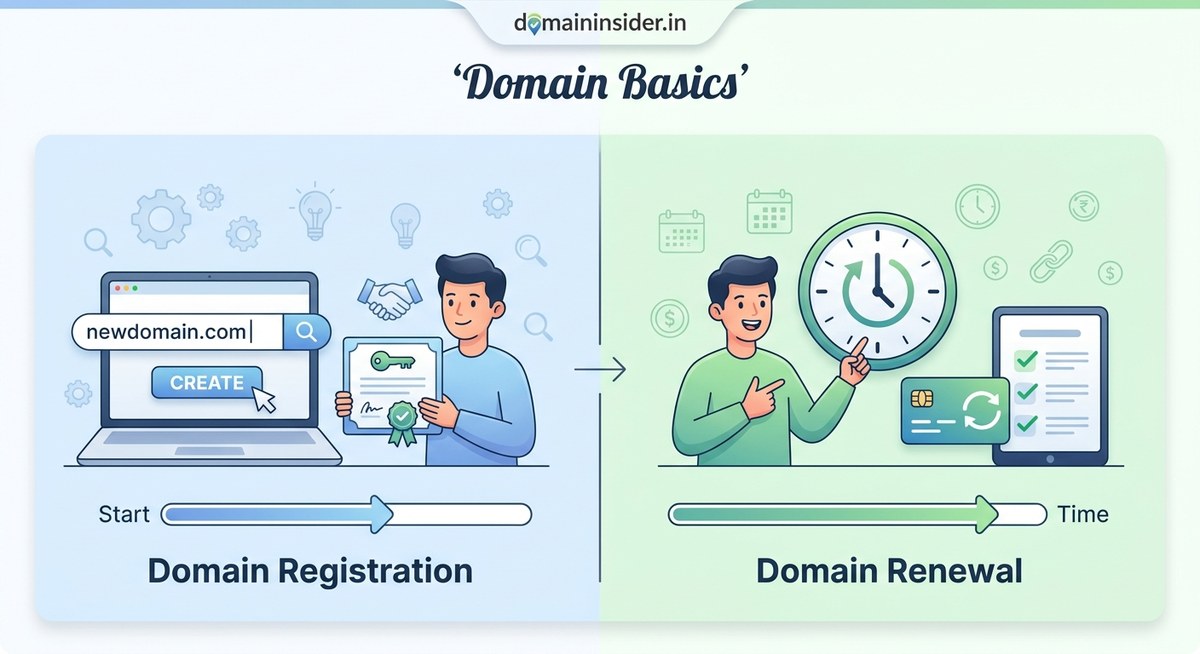
This is the classic confusion between domain registration and domain renewal. They sound similar, but they are two very different transactions. One is a one-time purchase to claim a digital address. The other is a recurring payment to keep that address active. Let us break down exactly what sets them apart, so you never risk losing your online identity.
Domain registration is the upfront cost to secure a name for a set period, usually one to ten years. Domain renewal is the annual fee you pay to maintain ownership after the initial period ends. Forgetting to renew can lead to losing your domain to someone else. Set auto-renew and track expiry dates to protect your business.
The One-Time Purchase: What Domain Registration Really Means
When you register a domain, you are not buying the name forever. You are leasing the rights to use it for a specific amount of time. Think of it like renting a shop in a busy market like Mumbai’s Linking Road. You pay the landlord an upfront deposit and the first month’s rent to secure the space. That initial payment gets you in the door.
Domain registration works the same way. You pay a fee to a registrar, and they reserve the name in the central database for you. This fee covers the administrative cost of adding your name to the global internet system. It also includes the cost of maintaining your DNS records, which point your domain to your website.
The price you see during checkout is often discounted for the first year. Many registrars offer a low introductory price, sometimes as low as ₹299 for a .in domain. This is a marketing tactic to attract new customers. The real cost becomes clear when it is time to renew.
Here is what you get during the registration process:
- Your name is added to the WHOIS database. Your contact details become the official record for that domain.
- You control the DNS settings. You can point the domain to any web host or email provider.
- You get a specific registration period. You can choose one year or up to ten years in advance.
The Recurring Fee: Why Domain Renewal Is Not Optional
Domain renewal is the regular payment you must make to keep your lease active. The internet does not allow permanent ownership of domain names. ICANN, the global governing body, sets this rule. If you stop paying, the domain eventually goes back into the pool for someone else to register.
The renewal fee is usually higher than the first-year registration price. This is the biggest shock for many new website owners. You pay ₹299 to register a .in domain, and then the next year the renewal is ₹749. That jump happens because the introductory price is a loss leader for the registrar.
Let us compare the two side by side.
| Aspect | Domain Registration | Domain Renewal |
|---|---|---|
| Timing | One-time event at the start | Recurring annually or multi-year |
| Cost | Often discounted to attract customers | Usually the standard or full price |
| Risk if skipped | Domain remains available for anyone | Domain expires and can be lost |
| Duration | You choose 1 to 10 years upfront | You pay for additional years of use |
| Reminder | No reminder needed, you just paid | Your registrar will email you |
The Hidden Danger: What Happens When a Domain Expires
Imagine you run a small business selling handmade juttis in Jaipur. You registered myjuttishop.com two years ago. You forgot to renew it because the email reminders went to your spam folder. One day, your website stops loading. Your customers cannot find you. Your email stops working. You have effectively vanished from the internet.
This is the nightmare scenario. When a domain expires, it goes through a specific lifecycle.
- Grace period. Most registrars give you a short window, usually 30 to 40 days, after the expiry date. You can still renew at the standard renewal price.
- Redemption grace period. If you miss the grace period, the domain enters a redemption phase. This can last up to 30 days. Renewing now costs a hefty redemption fee, often ₹3,000 or more.
- Pending delete. The registrar releases the domain back to the public. It becomes available for anyone to register.
The worst part? Someone else can snap up your domain during the pending delete phase. They might hold it for ransom, try to sell it back to you at a huge premium, or use it for spam and damage your brand reputation.
To avoid this, I always advise setting auto-renew on every domain you own. Most registrars offer this feature. You link a credit card or UPI to your account, and the system pays the renewal fee automatically. This is the single best way to protect your online presence.
Another option is to register your domain for multiple years at once. If you can afford it, paying for five or ten years upfront locks in the current price and removes the worry of annual renewal for a long time. This is especially useful if you are launching a long-term project like a blog or an e-commerce store.
Expert advice: “Never rely on email reminders alone. Calendar apps are your best friend. Set a recurring reminder on your phone or computer for 60 days before each domain expiry. This gives you a buffer in case you need to update payment details or contact support.”
The Price Difference: Why Renewal Costs More Than Registration
You might wonder why the renewal price is higher. There are a few reasons.
First, the registration price is artificially low to get you in the door. The registrar makes a loss on the first year, hoping to recover it over the following years through renewals and upsells like hosting, email, and privacy protection.
Second, the registry that manages each extension sets pricing. For example, the .in registry charges a wholesale fee to registrars. That fee can increase over time. Registrars pass on these increases to you.
Third, some extensions are classified as premium. A one-word domain like “cars.in” might have a registration fee of ₹5,000 and a renewal fee of the same amount. These domains are considered high value by the registry.
Strategies to Reduce Renewal Costs Without Losing Your Domain
Nobody likes paying more than they expected. Here are a few ways to keep renewal costs manageable.
- Lock in multi-year registration at discounted rates. Some registrars offer a lower per-year price when you register for three, five, or ten years.
- Look for coupons or promo codes. Many registrars send discount codes to existing customers, especially during festive seasons like Diwali or Republic Day.
- Transfer your domain to a cheaper registrar. You can move your domain to another registrar after 60 days from registration. Compare renewal prices before you transfer. Keep in mind that transferring adds one year to your expiry date.
- Use a reputable registrar. Cheap registrars might have hidden fees or poor customer support. You saved ₹200 at registration but might lose your domain due to bad service.
Building Trust with Your Audience Through Domain Ownership
Your domain name is a signal of credibility. A website that expires frequently or gets parked by a stranger shows that the business behind it is unreliable. On the other hand, a domain that has been renewed consistently for years tells visitors that your business is stable.
I have seen many Indian entrepreneurs lose customers because their domain expired during a critical period. A few years ago, a popular blogger in Delhi forgot to renew his domain. It was taken by a squatter who demanded ₹50,000 to return it. The blogger had to start from scratch with a new name, losing years of SEO work and loyal readers.
Do not let that happen to you. Treat your domain like a bill you cannot ignore. It is as important as your rent, electricity, or GST filing. Set a calendar alert. Enable auto-renew. Keep your contact details updated with the registrar so you never miss a notification.
If you are purchasing multiple domains for a portfolio, consider using a domain management tool or a spreadsheet to track expiry dates. This becomes critical if you own ten, twenty, or more domains for side projects or investment purposes.
Mastering the Ownership Cycle for Long-Term Success
The difference between domain registration and renewal comes down to one simple idea. Registration opens the door. Renewal keeps the door unlocked for you.
When you understand this difference, you stop treating your domain as a one-time expense and start treating it as an ongoing investment. Your domain is the foundation of your online brand. It is the address customers use to find you. It is the asset that grows in value as your business grows.
Make the decision today to never lose a domain again. Check your registrar account. Verify your auto-renew settings. Update your payment method if needed. These five minutes of effort can save you from months of stress and unexpected costs.
If you want a deeper understanding of how domains connect to the internet, read our guide on what exactly happens when you type a domain name in your browser. For practical planning, check out our advice on how long should you register a domain name for. And if you are still weighing options, explore the benefits of a .in domain for your Indian startup.
You have the knowledge now. Use it. Register your domain. Renew it on time. Build your online presence with confidence. Your business deserves nothing less.
