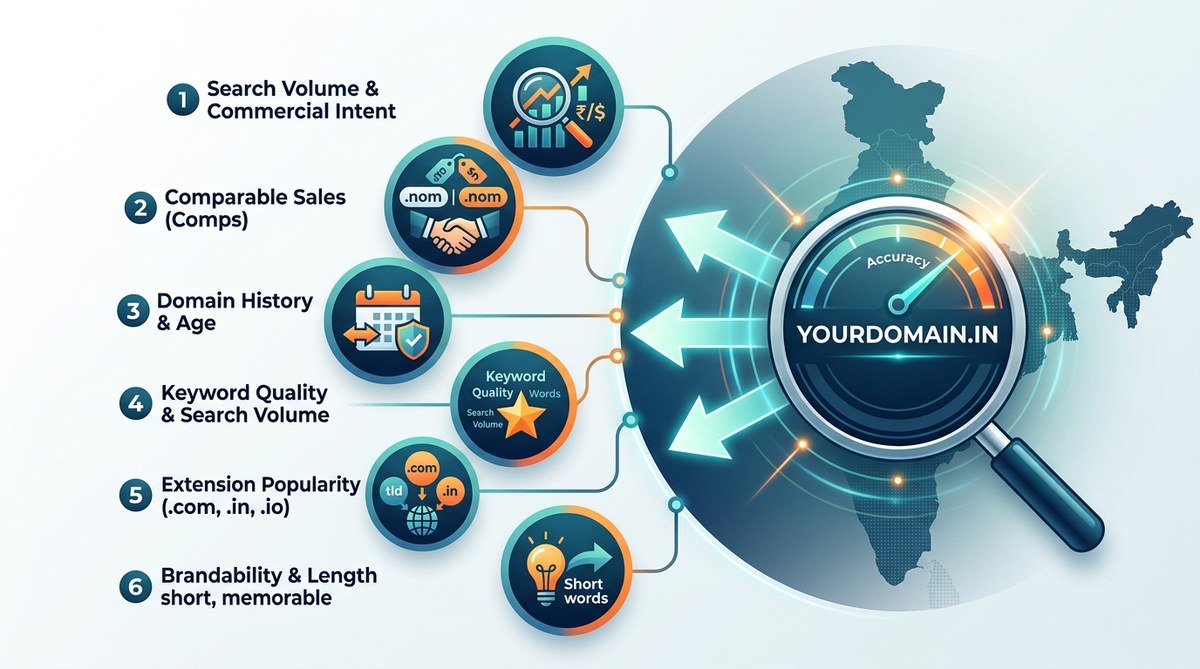
Pricing a domain name often feels like guessing the weight of a mango without a scale. You know it has value, but how much? Many investors rely on a hunch, a quick glance at GoDaddy’s appraisal tool, or the price of a similar sounding name. These methods are fine for a rough estimate, but they fall apart when real money is on the line. Whether you are buying your first .in domain or selling a portfolio of premium names, your accuracy determines your profit. Get it wrong and you either overpay or leave lakhs on the table. The difference between an amateur guess and a professional valuation comes down to six specific data points. Master these, and your domain appraisal accuracy will triple.
Accurate domain appraisal is not a mystery. It relies on six measurable data points: comparable sales, keyword demand, extension type, domain length, brandability, and existing traffic or backlinks. By systematically analysing each factor, you can avoid emotional pricing and make data-backed decisions. This guide shows you exactly how to apply these metrics to the Indian market, helping you buy low and sell high with confidence.
Why Guessing Fails and Data Wins
The domain market in India is maturing fast. In 2026, we are seeing more startups, SMEs, and individual creators entering the space. This means more buyers, but also more noise. A domain like “MumbaiProperties.in” might be listed for 50,000 rupees by one seller and 5 lakhs by another. Without a structured method, you cannot tell which price is fair.
Relying on a single appraisal tool is dangerous. These tools use algorithms that often miss local context. They might undervalue a short Hindi keyword domain or overvalue a long, awkward .com name. The solution is to build your own valuation framework using data you can verify. Let us look at the six data points that matter most.
The Six Data Points That Define Domain Appraisal Accuracy
1. Comparable Sales (Comps)
This is the closest thing to a market price. Look for recent sales of domains that share similar characteristics. If you are valuing “DelhiCafe.in”, find sales of other food or hospitality domains with .in or .com extensions. Check platforms like NameBio, DNJournal, or Indian marketplace histories.
Key things to compare:
– Extension: .com vs .in vs .co.in
– Length: 8 characters vs 15 characters
– Word type: Dictionary word vs brandable vs hyphenated
– Industry: Real estate domains sell differently than tech domains
Do not just look at the highest sale price. Look at the median. A single high sale can be an outlier. If three similar domains sold for 1 lakh, 1.2 lakhs, and 5 lakhs, the median is 1.2 lakhs. That is your benchmark.
2. Keyword Demand and Search Volume
A domain containing a high-demand keyword is worth more. This is especially true in India where many users type keywords directly into the address bar or search for services like “PunePlumber.com”.
Use Google Keyword Planner or tools like Ahrefs to check monthly search volume for the core keyword in your domain. A domain with a keyword that gets 50,000 searches per month in India is significantly more valuable than one with 500 searches.
But be careful. The value comes from commercial intent. A keyword like “free wallpaper” has high volume but low purchase intent. A keyword like “car insurance” has high volume and high intent. Always check the type of traffic, not just the number.
3. Extension Type and Trust
In India, .com still commands the highest trust and resale value. However, .in domains are catching up fast, especially for local businesses. A domain like “TechGuru.in” can be just as valuable as “TechGuru.com” if the buyer targets the Indian market.
Here is a rough hierarchy of value by extension in the Indian market:
| Extension | Typical Value Multiplier | Best Use Case |
|---|---|---|
| .com | 1.0 (baseline) | Global brands, startups |
| .in | 0.5 to 0.8 | Indian focused businesses |
| .co.in | 0.3 to 0.5 | Companies, registered firms |
| .net | 0.2 to 0.4 | Tech services, alternatives |
| .org | 0.2 to 0.4 | NGOs, trusts |
| New gTLDs (.xyz, .online) | 0.1 to 0.3 | Creative projects, low budget |
These are rough multipliers. A premium one-word .in domain can sometimes sell for more than a mediocre .com domain.
4. Domain Length and Memorability
Short domains are rare. A four character .com is almost impossible to find today. In India, a five or six character .in domain with a real word is highly desirable. Length directly impacts recall and typo errors.
Consider this:
– 3 to 5 characters: Premium. Very high value.
– 6 to 8 characters: Good. Standard for brandable names.
– 9 to 12 characters: Average. Needs to be a strong keyword phrase.
– 13+ characters: Low value unless it is a highly specific search term.
But length is not just about character count. It is about syllable count and ease of pronunciation. A 10 character domain that is one word, like “TravelIndia.in”, is worth more than an 8 character domain that is a random string like “Xyztplc.com”.
5. Brandability and Memorability
This is subjective, but you can measure it. A brandable domain is easy to say, easy to spell, and suggests a positive concept. “Zomato” is brandable. “BestOnlineFoodDeliveryMumbai” is not.
Ask these questions:
– Can you say it over the phone without spelling it?
– Does it sound like a company name or a description?
– Does it avoid hyphens and numbers? (Hyphens and numbers almost always lower value)
– Is it easy to remember after hearing it once?
A brandable domain can command a 2x to 10x premium over a descriptive domain of the same length. This is because companies pay more for identity than for description.
6. Existing Traffic and Backlink Profile
This point applies mainly to expired or aged domains. If a domain already has visitors or links, it has instant value. A domain with 500 monthly visitors from organic search is worth more than a fresh registration, even if the name is less attractive.
Check these metrics using free tools:
– Wayback Machine: See the site’s history. Was it a spam blog or a legitimate business?
– Ahrefs or Moz: Check the number of referring domains. One link from a .gov or .edu site is worth more than 100 spam links.
– Google Search Console (if available): See actual traffic data.
A domain with clean traffic and relevant backlinks can be valued at 12 to 24 months of the traffic’s potential revenue. For example, if a domain earns 10,000 rupees per month through affiliate income or ads, it could be worth 1.2 to 2.4 lakhs.
A Practical Process for Applying These Data Points
You do not need to be a data scientist. Follow this numbered process every time you appraise a domain.
- Collect the comps. Search NameBio or Indian marketplaces for at least five similar sales. Note the median price.
- Analyse the keyword. Use a free keyword tool to get monthly search volume for India. Note the commercial intent.
- Assess the extension. Apply the multiplier from the table above relative to a .com baseline.
- Measure length and brandability. Count characters. Say the name out loud. Rate it from 1 to 5.
- Check for existing assets. If it is an expired domain, run a backlink check and traffic estimate.
- Calculate a range. Take the median comp price. Adjust it up or down based on the other five points. Create a low and high estimate.
“The biggest mistake new investors make is falling in love with a name. They see a domain like ‘BangaloreStartups.in’ and assume it is worth a fortune because it sounds good. But without data on comparable sales and keyword demand, they are just guessing. Always lead with data, not emotion.” — Ravi Sharma, domain investor and founder of DomainInsider.in
Common Mistakes That Ruin Your Accuracy
Even experienced investors slip up. Here is a table of common errors and how to fix them.
| Mistake | Why It Hurts | The Fix |
|---|---|---|
| Using only one appraisal tool | Tools have different algorithms and miss local context | Cross reference three tools and your own comps |
| Ignoring the Indian market | Global data does not reflect local demand | Focus on .in and .co.in sales in India |
| Overvaluing exact match domains | Google no longer gives special ranking to EMDs | Prioritise brandability over exact match |
| Forgetting renewal costs | A high renewal fee can kill your profit margin | Factor in yearly renewal cost for long holds |
| Not checking trademark risk | You could be sued or lose the domain | Run a trademark search on IPIndia |
How to Scan a Potential Domain in Under 5 Minutes
When you are browsing expired lists or auction sites, you need a quick scanning method. Use this bulleted checklist.
- Check the domain length. Reject anything over 12 characters unless it is a high volume keyword phrase.
- Check the extension. Prioritise .com and .in. Be cautious with new gTLDs.
- Check for hyphens and numbers. If present, lower your value estimate significantly.
- Do a quick Google search for the exact domain name. See if any businesses already use it.
- Check the Wayback Machine for the domain’s history. Avoid domains with spam or adult content.
- Use a free backlink checker. If it has links, note the quality.
- Search the keyword on Google Trends for India. Is interest rising or falling?
This scan takes five minutes. It will save you from buying duds.
Bringing It All Together for Better Appraisals
The goal is not to find a perfect price. No one can do that. The goal is to find a price range that protects you from overpaying and helps you sell with confidence. By using these six data points consistently, you move from guesswork to a repeatable system. Your domain appraisal accuracy will improve with every domain you evaluate.
Start today. Pick one domain from your portfolio or a name you are considering. Run it through the six steps. Write down your low and high estimate. Then check it against actual sales data. Do this ten times and you will see a clear pattern. Your estimates will get closer to the market reality.
The Indian domain market is full of opportunity. But opportunity favours those who do their homework. Use these data points, trust the numbers, and let your accuracy speak for itself.
