<meta name=”description” content=”Stuck between .in, .com, and new gTLDs? Learn how to choose the right domain extension for an Indian business with local examples, SEO insights, and practical tips.”
Choosing a domain extension is one of the first decisions you make when launching a business online in India. It feels big because it sticks with your brand for years. Whether you run a chai stall in Pune, a fintech startup in Bangalore, or a boutique in Jaipur, the extension you pick signals who you are. Let us walk through the options so you can make a choice you won’t regret.
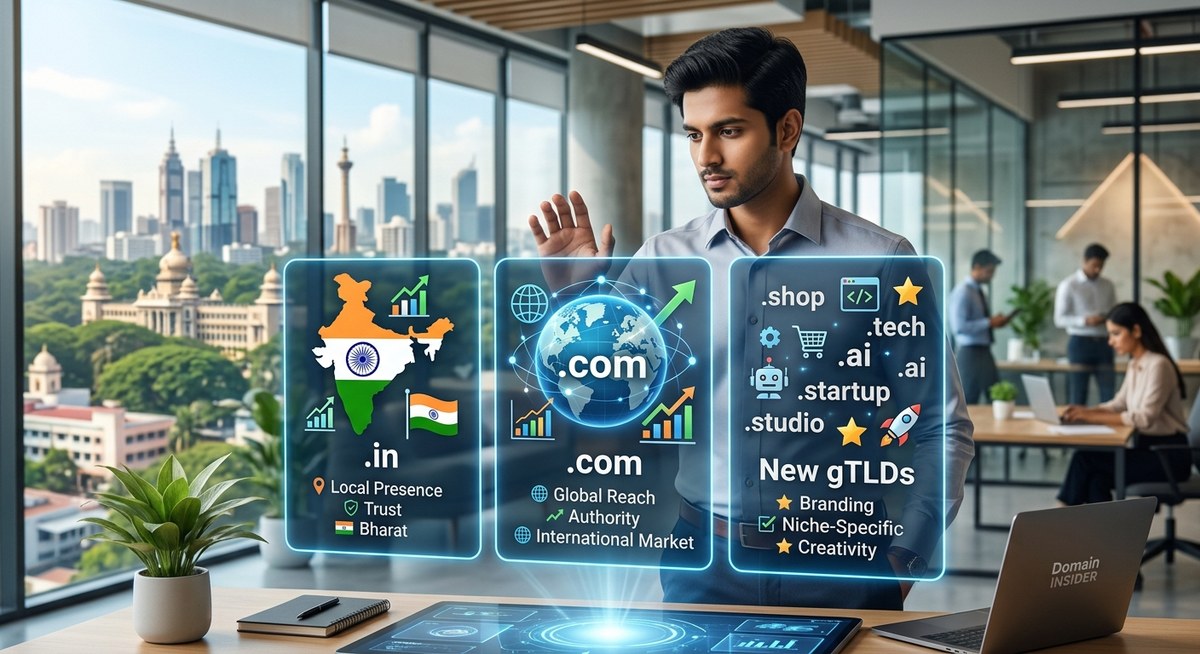
Your domain extension directly affects brand trust, local SEO, and customer recall. For most Indian businesses targeting local customers, a .in or .com is the safest bet. New gTLDs like .tech or .store work best when your brand name is taken or your niche is hyper-specific. Always prioritise memorability over trends. The best pick matches your audience, budget, and long-term growth plan.
How .in, .com, and New gTLDs Differ in Practice
Each extension comes with a different weight in the Indian market. Let us break them down with real context.
.in: The Local Champion
India’s own country code top-level domain (ccTLD). It tells visitors instantly that you operate in India. This can boost local trust and may help with regional SEO. Many Indian consumers feel safer clicking a .in link because they associate it with homegrown businesses. For example, a Delhi-based bakery named “SweetByte” might find sweetbyte.in available when sweetbyte.com is taken. The renewal fee is usually lower than .com too.
.com: The Global Default
The king of extensions. It is the first thing people type when they guess your URL. If you aim for international clients or plan to scale globally, .com is still the gold standard. Indian startups like Zerodha and CRED use .com because they want to be seen as serious players beyond India. The downside? Good .com names are often taken or priced in lakhs.
New gTLDs: The Creative Alternatives
These are extensions like .tech, .store, .club, .online, .app, .blog, .design, and many more. They let you get a memorable name when the .com version is gone. For a Jaipur-based clothing brand, “rajasthanistyle.store” could be catchy. But be careful: some new gTLDs carry a stigma of spam or are harder for older customers to remember. Renewal costs can also be higher than expected.
A Step-by-Step Process to Choose Your Extension
Follow this numbered list when you sit down to decide.
- Define your primary audience. Are you serving customers in India only? Or do you plan to ship globally? If local, .in gets an edge. If global, lean towards .com.
- Search your preferred name across extensions. Use a domain registrar’s search tool. Check .in, .com, and relevant new gTLDs like .tech or .store.
- Evaluate availability and cost. Note the registration price and renewal price. Some new gTLDs look cheap at first but double in the second year.
- Test memorability. Say the full domain out loud. Would a customer in a tier-2 city remember it after hearing it once? Long or confusing extensions fail here.
- Consider SEO impact. Google treats all extensions equally in rankings, but local ccTLDs like .in can boost local search presence in India.
- Check brand protection. If you can afford it, register your name in .in and .com together. Redirect one to the other to prevent cybersquatting.
A Table to Compare Extension Scenarios
The table below shows common business types and the best extension fit. It also lists mistakes to avoid.
| Business Type | Best Extension Pick | Common Mistake to Avoid |
|---|---|---|
| Local restaurant in Chennai | .in | Choosing a .com that forces you to add a weird word (e.g., eatatchennaicafe.com) |
| E-commerce brand selling pan-India | .com or .in (both if possible) | Picking a .shop that is hard to type over the phone |
| SaaS startup targeting global clients | .com | Spending too much on a premium .com when .io works fine |
| Tech blog or developer portfolio | .dev or .tech | Assuming all new gTLDs are cheap for renewal |
| NGO or non-profit | .org or .in | Using .biz which feels commercial and less trustworthy |
| Local service (plumber, electrician) | .in | Adding hyphens or numbers that confuse callers |
Why Trust Is the Hidden Factor in Domain Choice
Indian internet users have become savvier. They notice if your domain looks odd. A .xyz or .top extension might trigger spam alerts for some visitors. On the other hand, .in feels familiar and official. A study by a domain registrar once showed that .in domains had a 12% higher click-through rate in India compared to .com in local search results. This is not guaranteed for every case, but it shows the power of country association.
Blockquote: “For any business that primarily serves Indian customers, I always recommend .in first. It builds trust faster than any other extension and it is cheaper to maintain. If .in is taken, then .com. Everything else is a distant third.” — Varun Sharma, domain investor and founder of an Indian registrar.
This advice comes from someone who has seen thousands of Indian businesses succeed and fail online. Listen to it.
When New gTLDs Actually Make Sense
New gTLDs are not all bad. They shine in a few specific situations.
- Your ideal .in or .com name is already taken but the .tech or .store version is available with the exact keyword.
- Your brand is already well-known and the extension becomes part of the recall.
- You are running a short-term campaign or a landing page for an event.
- Your target audience is young and tech-savvy, like college students.
Examples that work well:
– A coding bootcamp could use “learntocode.dev”
– A festival ticketing site could use “jaipurmusic.club”
But always ask yourself: will a customer in Lucknow or Patna type this correctly?
The Costs You Cannot Ignore
Many new gTLDs lure you with a low first-year price, typically around Rs 200 to Rs 500. But renewals can jump to Rs 1,500 or more. Compare this with .in, which often renews for Rs 600 to Rs 800. .com renews for Rs 800 to Rs 1,200. Over five years, a new gTLD can end up costing more than a .in, especially for small businesses. Also, some cheap new gTLDs have poor DNS reliability or limited support from major registrars.
Check the price carefully. Use a tool like the one mentioned in how to check if a domain name is available and always look at the renewal column before hitting “buy”.
Common Pitfalls in the Indian Market
Indian buyers often make these mistakes:
- Buying a .co.in when .in is available. .co.in is a third-level domain (like a subdomain) and looks less professional. Unless .in is taken, avoid it.
- Choosing a .com with numbers or hyphens because the clean version was taken. Example: “best-delhi-bakery.com” is hard to remember.
- Buying multiple new gTLDs without a strategy, then letting them expire.
- Not buying domain privacy, leading to spam calls from local “domain renewal” scammers.
Learn more about these in 5 common domain name mistakes every first-time buyer should avoid.
A Practical Checklist for Your Final Decision
Before you finalise, run through this bullet list.
- Does the extension match your business location? (Local: .in; Global: .com)
- Is the extension easy to spell and pronounce in Indian languages?
- Have you checked renewal cost for at least three years?
- Is the brand name available on social media in the same form?
- Would you feel confident putting this domain on your visiting card?
- Have you registered the alternative extension to protect your brand? (Consider domain privacy protection)
Your Domain Is an Asset, Not an Expense
The extension you choose will sit on your website, emails, and ads for years. Changing it later is costly and confusing for customers. Take time now. If you are a local business in India, .in is often the smartest choice. If you have global ambitions, .com remains the safest bet. New gTLDs can be creative tools for niche projects but require extra care.
Sit with your co-founder or partner. Search the options. Write them down. Then pick one that feels right and stick with it. Your future customers will thank you.
