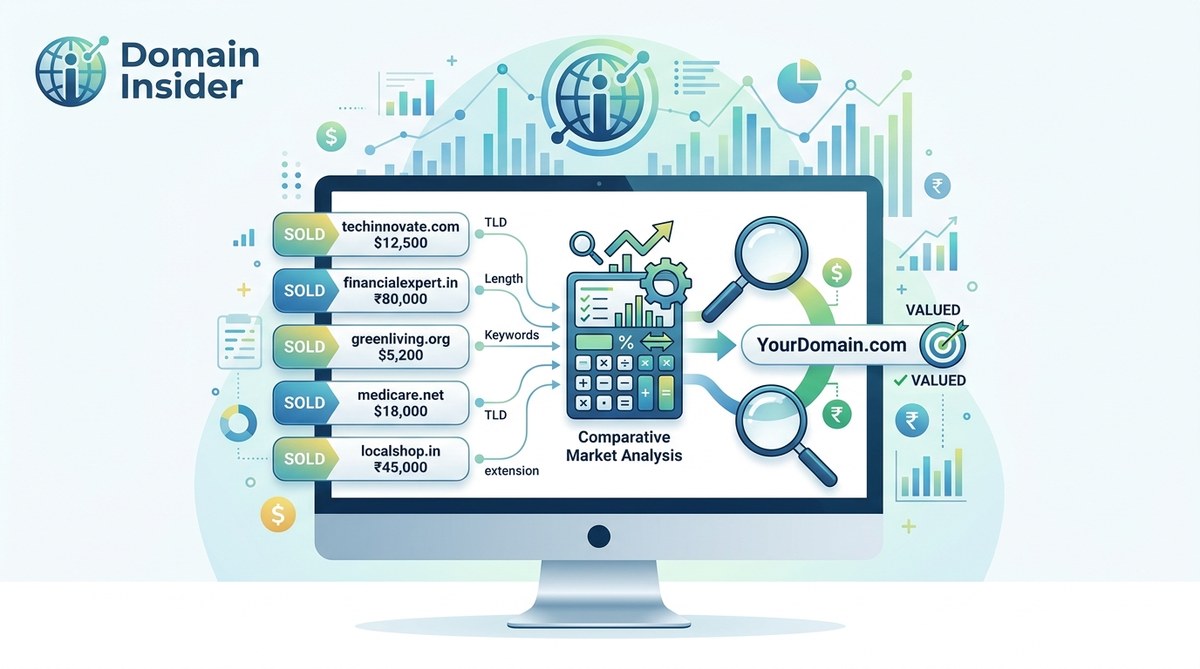
Pulling a price out of thin air is the fastest way to lose money in the domain business. You might underprice a gem or scare away buyers with a number that makes no sense. Either way, you lose. The smartest investors in India and around the world rely on one proven method: comparable sales. This approach uses real transaction data to set a price that the market will actually accept. No guesswork. No gut feelings. Just facts.
Domain valuation comparable sales is the gold standard for pricing domains in 2026. By finding similar domains that have actually sold, you remove emotion from your pricing and replace it with market data. This article walks you through a five step process to classify your domain, find real sales data, filter out bad comps, adjust for context, and pick a final price that works.
What Are Comparable Sales in Domain Valuation
Comparable sales, often called comps, are records of domains that have sold in the past. These records include the domain name, the sale price, the date of sale, and sometimes the platform where the sale happened. The idea is simple: if a domain similar to yours sold for a certain amount, your domain is probably worth something close to that.
But similarity matters a lot. You cannot compare a three letter .com with a long tail .in domain and expect the numbers to match. The art of using domain valuation comparable sales lies in finding the right comps and knowing how to adjust them.
Why Comparable Sales Beat Automated Appraisals
Automated tools are convenient. They give you a number in seconds. But they often miss context that a human can catch. A tool might not know that a particular keyword just became hot because of a new government policy or a trending startup sector. It might also ignore the brandability of a name or the fact that a domain has existing traffic.
Comps give you real world evidence. When a buyer asks why your domain costs Rs 1.5 lakhs, you can point to similar domains that sold for that range. That builds trust. It also helps you stay confident during negotiations.
The Five Step Method for Using Comparable Sales
Here is a practical process you can apply to any domain you want to price. Follow these steps in order.
-
Classify your domain by type. Write down the exact TLD, the number of characters, the words it contains, and whether it is a brandable, a keyword domain, or a geographic name. For example, a domain like smartfintech.in would be a two word keyword domain in the .in extension with a financial tech theme.
-
Find comparable sales from trusted sources. Look at NameBio, DNJournal, and public auction records from platforms like GoDaddy Auctions and Sedo. For Indian domains, check the sales data shared by Indian domain forums and marketplaces that specialise in .in and .co.in extensions. You can also read about 7 free tools to check your domain name value in 2026 to expand your research toolkit.
-
Filter your list to keep only relevant comps. Remove any sale that is more than three years old unless it was a landmark deal. Remove sales where the domain had a completely different structure, like a hyphenated name when yours is not hyphenated. Also remove sales that seem to involve unusual circumstances, like a distressed seller or a premium buyer who overpaid.
-
Adjust the comp prices for context. Apply a discount or premium based on timing. If the comp sold during a market peak and the market has cooled since, adjust downward. If your domain has a higher value keyword than the comp, adjust upward. Consider factors like domain age, backlink profile, and trademark risk. The hidden factors professional appraisers use to value domain names can give you deeper insight into what adjustments matter most.
-
Pick your final price after considering your goals. If you want a sale within 30 days, price at the lower end of your adjusted range. If you can wait for the right buyer, price at the higher end or even above the range. Remember that a listed price is an asking price, not a final price. Most domain sales involve some negotiation.
Where to Find Reliable Sales Data in India
Global data is useful, but Indian domain investors need local comps too. The Indian market behaves differently. A .com might sell for less in India than in the US, while a .in domain with a popular Hindi keyword might sell for more than you expect.
Here are some sources you should check:
- NameBio is the largest database of reported domain sales. It covers most TLDs and lets you filter by year, extension, and price range.
- DNJournal publishes weekly and monthly sales reports that often include Indian domains.
- Indian domain forums like those on Digital Point India and the Indian section of NamePros sometimes share verified sales.
- Auction platforms such as GoDaddy Auctions, Sedo, and Afternic show current bids and past sale data.
- Private sales records from brokers and marketplace owners are harder to find but very valuable.
If you want to understand how the Indian market compares to global standards, read comparing domain valuation standards between Indian and global markets.
Factors That Make a Comp More or Less Useful
Not all comps are equal. Some deserve more weight than others. Use this table to evaluate each comp you find.
| Factor | High Quality Comp | Low Quality Comp |
|---|---|---|
| Sale date | Within the last 12 months | Older than 3 years |
| TLD match | Same TLD as your domain | Different TLD |
| Word count | Same number of words | Different word count |
| Keyword relevance | Same industry or theme | Unrelated industry |
| Brandability | Similar brand potential | Poor brandability |
| Sale platform | Major marketplace or auction | Private sale with unknown details |
| Buyer type | End user | Investor or flipper |
A comp that scores high on most of these factors is worth using. A comp that scores low should be ignored or given very little weight.
Common Mistakes When Using Comparable Sales
Even experienced investors slip up sometimes. Here are the most common errors and how to avoid them.
- Using only one comp. A single data point is not reliable. You need at least three to five comps to see a pattern.
- Ignoring the TLD difference. A .com comp cannot directly price a .in domain. The market values them differently.
- Forgetting to adjust for inflation. A sale from 2021 at Rs 50,000 is worth more in 2026 rupees. Apply a small inflation adjustment.
- Overvaluing a comp because of a famous buyer. If a startup with big funding bought a domain for a high price, that does not mean your similar domain is worth the same.
- Not checking the domain history. Some domains sell with existing traffic or backlinks. Yours might not have those. Read how to value expired domains with existing backlinks to understand how this affects pricing.
Expert advice from a domain insider: “The best comp is one that matches your domain in at least four ways: extension, length, word type, and industry. If you find a comp that matches in all four, you are in good shape. If you have to stretch to make it fit, keep looking.”
How to Adjust Comps for the Indian Market
The Indian domain market has its own rhythm. Premium .in domains have gained huge popularity in recent years, especially among startups and local businesses. A keyword rich .in domain can sometimes command a price close to its .com equivalent, especially if the business serves an Indian audience.
When you look at comps from global databases, you need to ask yourself: would this domain sell for the same price in India? Often the answer is no. Indian buyers tend to prefer shorter domains and names that are easy to pronounce in Hindi, Tamil, Telugu, or other regional languages. English only keywords might not perform as well unless they target a global audience.
For a deeper look at what makes a domain valuable in India, check out what makes a domain worth Rs 1 lakh vs Rs 10 lakhs in India.
When Comps Are Scarce and What to Do
Sometimes you will struggle to find any comparable sales. This happens with very new TLDs like .app or .ai, or with domains in niche industries that rarely change hands. In those cases, you have a few options:
- Expand your search to include similar TLDs. If you cannot find .app sales, look at .tech or .io sales for the same keyword.
- Use domain appraisal tools as a secondary reference, but do not rely on them alone. Read should you trust automated domain valuation tools or hire an expert for guidance.
- Look at lease prices. If a similar domain is being leased, you can capitalise the lease payments to estimate a sale price.
- Ask in domain investor communities. Someone might have sold a similar domain privately and can share the price.
How Negotiation Changes Your Pricing Strategy
Your comparable sales research gives you a starting number. But negotiation is where the final price gets decided. Most buyers will not pay your asking price. They will counter lower. So you need to build in some room.
If your comps suggest a fair market value of Rs 1 lakh, list at Rs 1.3 to 1.5 lakhs. That gives you room to negotiate down to your target. Never list below your minimum acceptable price, because you might get an offer you cannot accept.
For more on this, read how to negotiate domain prices like a pro and save thousands. The principles work for buyers and sellers alike.
Putting It All Together for a Real Example
Let us say you own the domain greenenergy.in. You want to price it for sale. Here is how you apply the method.
First, classify it: a two word keyword domain, .in extension, in the renewable energy industry. It has 11 characters. It is brandable but also descriptive.
Next, find comps. You search NameBio for .in domain sales in the energy sector over the last two years. You find three sales: solarpower.in sold for Rs 1.2 lakhs, windenergy.in sold for Rs 95,000, and cleantech.in sold for Rs 1.5 lakhs.
You filter these comps. All three are within two years, same TLD, same word count, and similar industry. They are all good comps.
Now adjust. Solarpower.in sold 18 months ago. The market for green energy domains has grown since then, so you add a 15 percent premium. Windenergy.in sold to an end user, which is a good sign, but the keyword is slightly less in demand than green energy, so you add a 10 percent premium. Cleantech.in is a broader term and sold for more, but you consider that an outlier because cleantech covers more industries.
Your adjusted range comes to roughly Rs 1.1 to 1.4 lakhs. You decide to list at Rs 1.5 lakhs with a minimum acceptable price of Rs 1.2 lakhs.
Your Next Move as a Domain Investor
Domain valuation comparable sales is not a complicated concept. But applying it well takes practice. Start by researching five domains in your portfolio this week. Find comps for each one. Use the five step method. See how the prices compare to what you originally thought.
Over time, you will build a mental database of prices and patterns. That instinct, backed by real data, is what separates successful domain investors from the rest.
If you want to go deeper, explore how brand potential impacts domain valuation more than you think and why your premium domain isnt selling common valuation mistakes. Both articles will sharpen your pricing instincts even further.
Now go pull up your domain list and start pricing with confidence. The data is out there. All you have to do is use it.
