
You’ve found the perfect domain name for your business. It’s memorable, brandable, and available. Now you’re wondering: can you buy a domain name forever and truly own it like you would a piece of property?
The short answer might surprise you. And understanding the reality behind domain ownership could save you from losing your brand’s most valuable digital asset.
You cannot buy a domain name forever because you never truly own it. Domain names work on a lease system managed by registrars and registry operators. You register a domain for a specific period (typically 1-10 years) and must renew it before expiration to maintain control. While some registrars offer 10-year registrations and auto-renewal options, perpetual ownership isn’t possible under the current domain system. Your best protection is long-term registration combined with automatic renewal settings.
The Uncomfortable Truth About Domain Ownership
Here’s what most registrars won’t tell you upfront.
You don’t actually own your domain name. Not in the traditional sense.
Think of it like leasing office space versus buying property. When you register a domain, you’re essentially renting the right to use that web address for a specific time period. The underlying system is controlled by organizations like ICANN (Internet Corporation for Assigned Names and Numbers) and various registry operators.
This means every domain name, from the biggest brands to your personal blog, exists on borrowed time.
The maximum registration period for most domains is 10 years. After that, you must renew. Miss that renewal window, and someone else can snatch up your domain within days.
How Domain Registration Actually Works
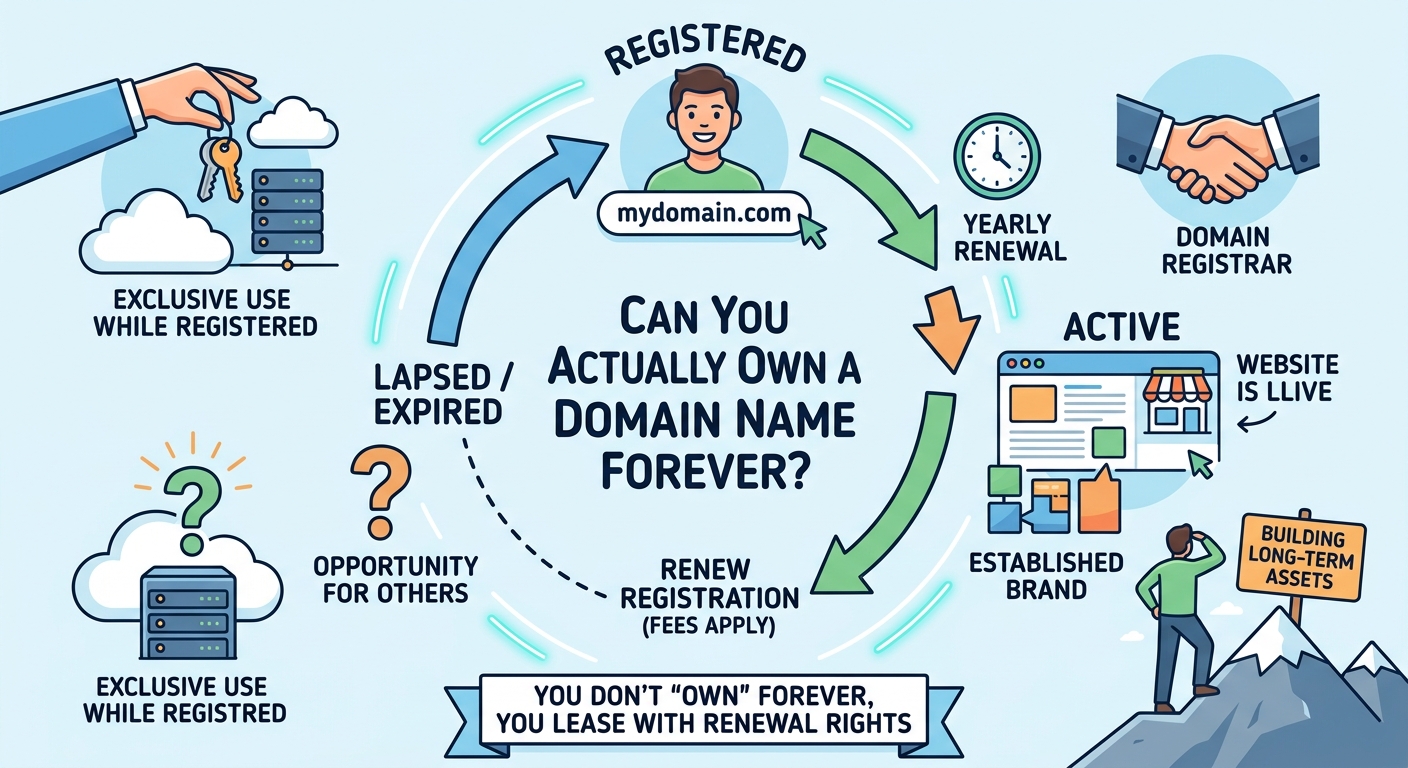
Let me break down the system that controls every web address on the internet.
At the top sits ICANN, which coordinates the global domain name system. Below them are registry operators who manage specific top-level domains (TLDs) like .com, .in, or .org. Then come registrars, the companies where you actually purchase your domain registration.
When you “buy” a domain, here’s what happens:
- You choose a registrar (GoDaddy, Namecheap, BigRock, etc.)
- You pay for a registration period between 1 and 10 years
- The registrar records your information with the registry
- You receive rights to use that domain during your registration period
- Before expiration, you must renew or lose those rights
The registrar acts as a middleman. The registry maintains the authoritative database. And you hold temporary usage rights.
This three-tier system ensures no single person or company can claim permanent ownership of any domain name. It’s designed to keep the internet flexible and prevent domain hoarding, though that hasn’t stopped people from trying.
Why Forever Ownership Doesn’t Exist
The technical architecture of the internet simply doesn’t support perpetual domain ownership.
Registry operators need to maintain databases, update DNS records, and ensure the global routing system functions properly. These ongoing operational costs require continuous funding, which comes from renewal fees.
If domains could be purchased forever, the entire economic model would collapse. There would be no recurring revenue to maintain the infrastructure that makes what exactly happens when you type a domain name in your browser possible in the first place.
Beyond economics, there are practical reasons too:
- Abandoned domains would clog the system forever
- Trademark disputes would become impossible to resolve
- Dead businesses would hold valuable names indefinitely
- The namespace would become increasingly restricted
The renewal system creates a natural recycling process. Domains that are no longer valued return to availability.
Maximum Registration Periods by Domain Type
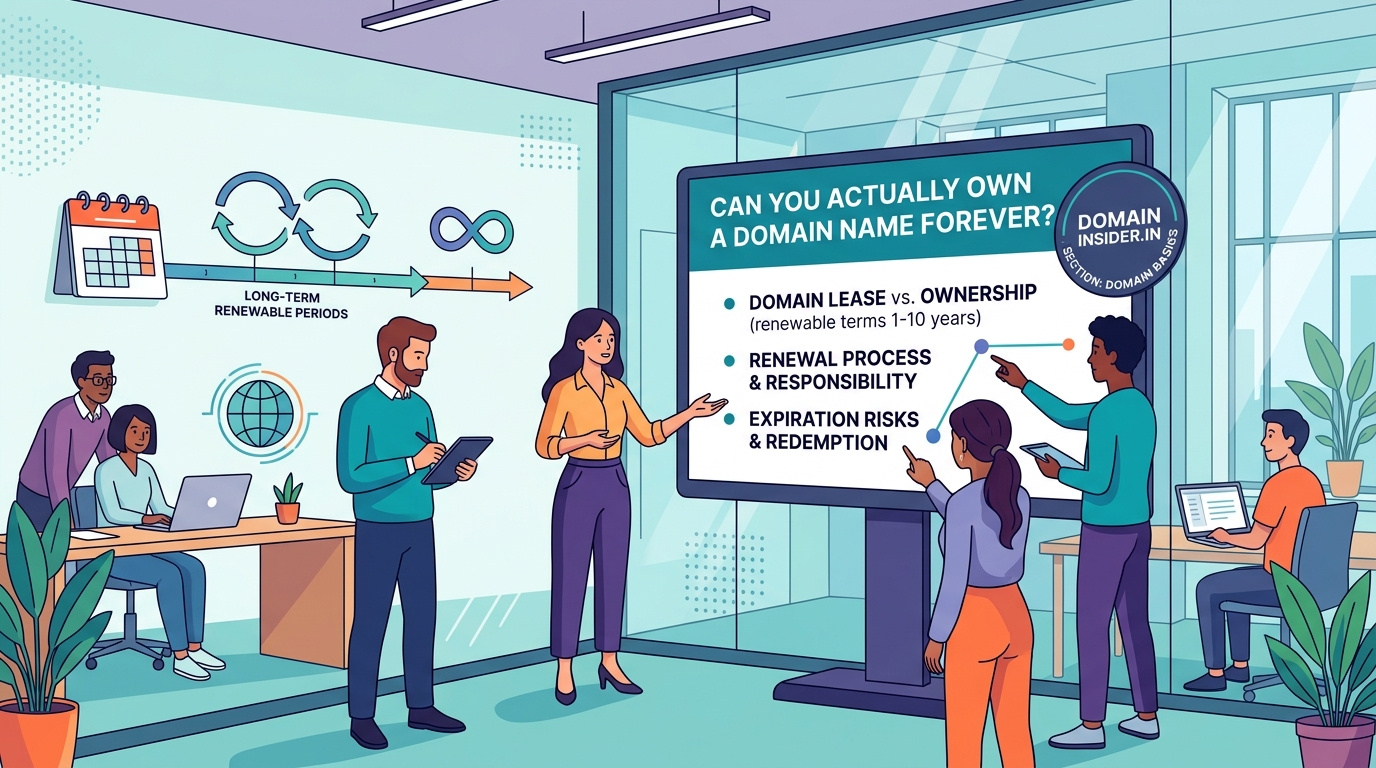
Different TLDs have different rules. Here’s what you need to know.
| Domain Extension | Maximum Registration Period | Typical Use Case | Registry Operator |
|---|---|---|---|
| .com | 10 years | Global businesses | Verisign |
| .in | 10 years | Indian businesses | NIXI |
| .co.in | 10 years | Commercial Indian entities | NIXI |
| .org | 10 years | Non-profits | Public Interest Registry |
| .net | 10 years | Network services | Verisign |
| .io | 10 years | Tech startups | Internet Computer Bureau |
Most registrars allow you to register for the full 10 years upfront. Some offer discounts for longer commitments. But that decade is as far as you can go in a single transaction.
After those 10 years? You’re back to square one, needing to renew again.
The Real Costs of Long-Term Domain Security
Let’s talk money and risk.
A typical .com domain costs between ₹500 and ₹1,200 per year, depending on your registrar. For a .in domain, expect to pay ₹400 to ₹800 annually. Choosing between a .co.in or .in domain for your Indian business affects both cost and perception.
If you register for 10 years upfront, you might pay ₹5,000 to ₹12,000 for a .com. That protects you for a decade, but it doesn’t eliminate the need for vigilance.
Here’s where people lose valuable domains:
- Credit card expiration before auto-renewal processes
- Changed email addresses missing renewal reminders
- Assuming someone else on the team handled it
- Registrar account credentials lost over time
- Business closure without domain transfer planning
I’ve seen businesses lose domains worth lakhs because someone forgot to update their payment method. The domain expired, entered a grace period, then a redemption period with inflated fees, and finally became available to the public.
Someone registered it within hours.
Setting Up Bulletproof Auto-Renewal
Your best defense is automation, but you need to do it right.
Here’s how to protect your domain for the longest possible time:
- Register your domain for the maximum 10-year period immediately
- Enable auto-renewal in your registrar account settings
- Add multiple payment methods as backup options
- Set calendar reminders for 2 years and 6 months before expiration
- Document your registrar login credentials in a secure password manager
- Add a secondary contact email for renewal notifications
- Review your domain portfolio annually to confirm all settings remain active
Most registrars send renewal reminders starting 90 days before expiration. But emails get filtered, addresses change, and people get busy.
Auto-renewal ensures that even if you forget, your registrar will attempt to charge your card and extend your registration. Just make sure that card won’t expire before your domain does.
“The most expensive domain you’ll ever lose is the one you forgot to renew. Set it and forget it with auto-renewal, but don’t actually forget to check your settings annually.”
What Happens If You Miss Renewal
The timeline of domain expiration is brutal and expensive.
Most domains follow this sequence after expiration:
Day 0-30 (Grace Period): Your domain stops working, but you can still renew at the regular price. Your website goes offline. Your email stops receiving messages. But you haven’t lost ownership yet.
Day 31-60 (Redemption Period): The domain enters a holding status. You can still recover it, but now you’ll pay a redemption fee of ₹5,000 to ₹15,000 on top of the renewal cost.
Day 61-75 (Pending Delete): The domain is locked and awaiting deletion from the registry. You cannot recover it during this phase.
Day 76+: The domain becomes available to the public again. Anyone can register it, including domain investors who specifically target expired domains with established traffic and backlinks.
Some registrars offer a grace period up to 45 days. Others are stricter. The exact timeline depends on your registrar’s policies and the TLD.
But here’s the thing: you don’t want to test these limits. By the time your domain expires, you’ve already lost business, confused customers, and damaged your brand.
Strategies for Near-Permanent Domain Control
You can’t buy forever, but you can get close.
Smart domain owners use these tactics:
- Max out initial registration: Always choose 10 years when first registering
- Renew early: Don’t wait until the last month; renew when you hit the 2-year mark
- Use dedicated email: Create a specific email address just for domain management
- Consolidate registrars: Keep all domains with one trusted registrar for easier management
- Set up domain monitoring: Use services that alert you to registration status changes
- Create a succession plan: Document who will manage domains if you’re unavailable
For valuable domains, some investors register similar variations to protect their brand. If you own example.in, you might also register example.co.in and exampleindia.com.
This isn’t about buying forever. It’s about building systems that make losing your domain nearly impossible.
The Hidden Value of Long-Term Registration
Here’s a benefit most people miss.
Google and other search engines view registration length as a minor ranking signal. A domain registered for 10 years suggests commitment and legitimacy. A domain renewed year-to-year might indicate a temporary project or potential spam site.
It’s not a major factor, but it contributes to your overall domain authority.
Long-term registration also:
- Locks in current pricing before potential increases
- Reduces administrative overhead from annual renewals
- Protects against registrar price hikes for existing customers
- Demonstrates brand commitment to potential investors or buyers
If you’re building a serious business, the 10-year registration sends a signal. You’re here to stay.
Premium Domains and Alternative Ownership Models
Some domains work differently.
Premium domains, those short, memorable names that registries hold back, often come with special pricing. You might pay ₹50,000 or more per year for a premium .in domain. These typically require annual renewal and don’t offer the same 10-year option.
Then there are aftermarket domains, purchased from previous owners rather than registrars. Learning how to negotiate domain prices like a pro becomes essential here.
When you buy an existing domain, you’re taking over the remaining registration period. If the seller had 3 years left, you inherit those 3 years and can extend from there.
Some investors build profitable domain portfolios by buying, holding, and eventually selling domains. They treat registration fees as carrying costs, similar to property taxes.
But even these investors don’t own their domains. They just control them for as long as they keep paying.
Building Your Domain Protection Checklist
Let’s make this practical.
Here’s your action plan for maximum domain security:
- Choose a reputable registrar with strong customer service
- Register for 10 years immediately
- Enable auto-renewal before leaving the registration page
- Add your domain renewal date to your personal calendar
- Store registrar credentials in a password manager
- Set up a dedicated email for all domain communications
- Add a backup payment method to your account
- Review your domain status quarterly
- Document your domain portfolio in a spreadsheet
- Share access details with a trusted business partner or family member
This might seem excessive for a ₹800 annual expense. But I’ve seen businesses pay ₹5 lakhs to buy back their own domain from someone who registered it after they forgot to renew.
Prevention is cheaper than recovery.
The Future of Domain Ownership
Will the system ever change?
There’s ongoing debate about alternative models. Blockchain-based domain systems like Ethereum Name Service (ENS) offer something closer to true ownership. You purchase a .eth domain as an NFT, and it’s yours until you sell it or transfer it.
But these systems exist outside the traditional DNS infrastructure. They work differently, require cryptocurrency wallets, and aren’t yet recognized by standard web browsers without extensions.
For now, the ICANN-regulated system remains the standard. And that means the renewal model isn’t going anywhere.
The best you can do is work within the system smartly. Max out your registration periods, automate renewals, and build redundant safeguards.
Why This Matters for Your Business
Your domain is your digital address.
Customers remember it. Marketing materials feature it. Email addresses use it. Your entire online presence connects to it.
Losing your domain doesn’t just mean rebuilding a website. It means:
- Losing all email communication to that address
- Breaking every link pointing to your site
- Confusing customers who can’t find you
- Potentially watching a competitor buy your old domain
- Starting your SEO efforts from zero
- Reprinting business cards, brochures, and signage
For established businesses, a lost domain can mean losing years of brand equity overnight.
The question isn’t whether you can buy a domain name forever. The question is whether you can build systems reliable enough that it doesn’t matter.
Protecting What You Can’t Truly Own
You’ll never own your domain in perpetuity. The internet wasn’t built that way.
But you can control it for decades with the right approach. Register long, renew automatically, monitor actively, and plan for succession.
Treat your domain registration like insurance. You pay regularly for protection you hope you’ll never need to test.
The businesses that thrive online aren’t the ones who found a loophole to permanent ownership. They’re the ones who built reliable systems around an inherently temporary arrangement.
Your domain is only as secure as your renewal process. Make that process bulletproof, and the lack of forever ownership becomes irrelevant.
