
You’ve owned that perfect domain name for months, maybe years. It’s short, memorable, and clearly valuable. Yet every time you check your inbox, there’s nothing but silence. No offers, no inquiries, not even lowball bids.
The problem isn’t always the domain itself. Most premium domains fail to sell because of avoidable valuation mistakes that push buyers away before they even consider making an offer.
Premium domains often fail to sell due to unrealistic pricing, poor market positioning, and lack of visibility. Understanding true market value, avoiding emotional attachment, and implementing proper marketing strategies can transform an unsold domain into a profitable asset. Most sellers overestimate value by 300-500% based on personal perception rather than actual buyer demand and comparable sales data.
You’re pricing based on emotion, not data
The biggest mistake domain investors make is falling in love with their own assets.
You see the potential. You imagine the perfect business that could use it. You calculate all the branding value, the SEO benefits, the traffic potential.
But buyers don’t see what you see. They see a price tag and compare it to alternatives.
A domain you value at ₹10 lakhs might have zero comparable sales to support that number. When buyers research your asking price and find similar domains selling for ₹50,000, they won’t negotiate. They’ll just move on.
Here’s what actually determines domain value:
- Length and memorability
- Extension credibility (.com vs .xyz)
- Keyword search volume and commercial intent
- Actual comparable sales in the past 12 months
- Current market demand in that niche
- Brandability for real businesses
Your personal attachment adds zero rupees to market value.
The valuation mistakes keeping buyers away
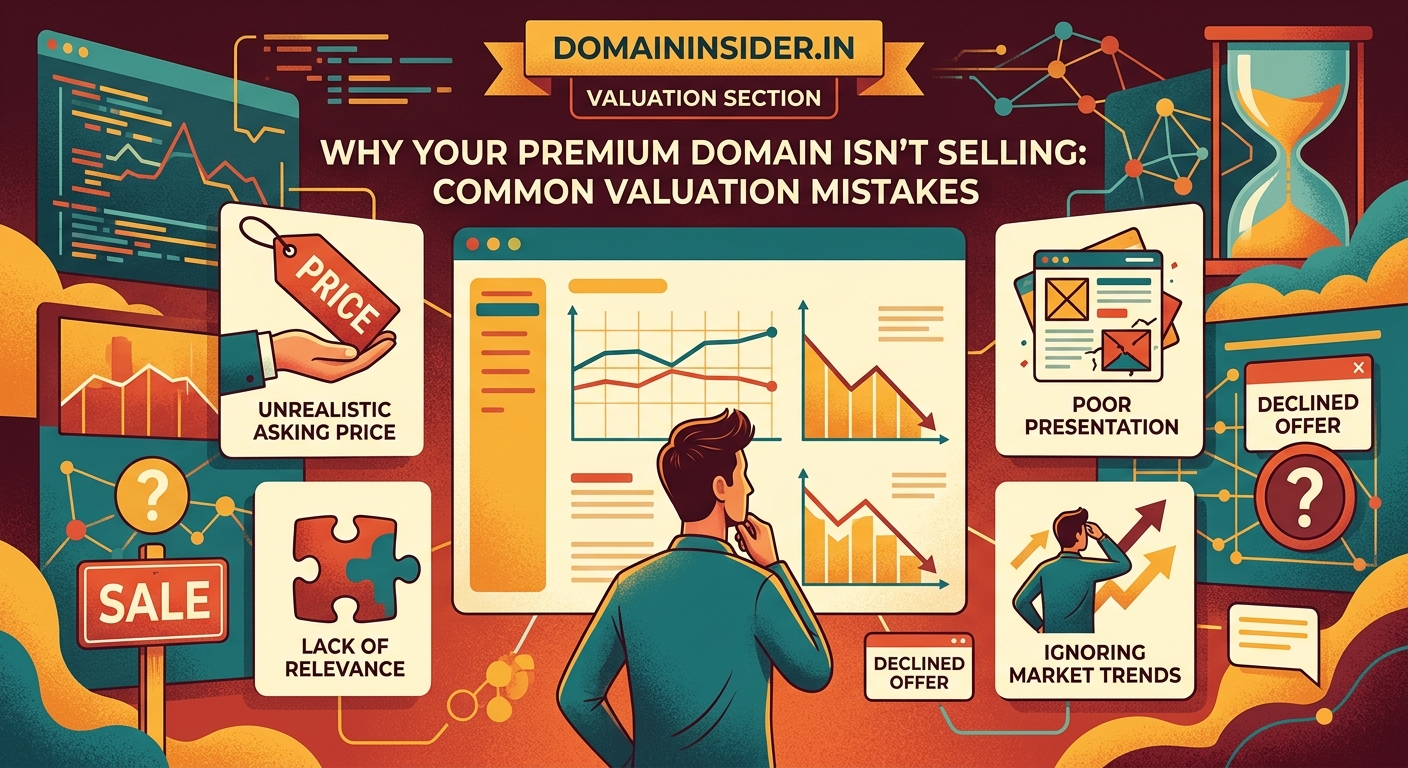
Most domain sellers make the same pricing errors. Let’s break down the most common ones.
| Mistake | Why It Fails | Real Impact |
|---|---|---|
| Automated tool pricing | Tools use algorithms, not market reality | Overpricing by 200-400% |
| Registration cost logic | “I paid ₹5,000 so it’s worth ₹5 lakhs” | Ignores actual demand |
| Keyword volume pricing | High searches don’t equal high value | Misses buyer intent |
| Domain age premium | Age matters less than relevance | Adds 10-20% max, not 10x |
| Extension confusion | Treating .in like .com | 60-80% value difference |
The 7 free tools to check your domain name value in 2024 can help, but only if you understand their limitations.
Automated appraisals give you a starting point, not a final answer. They can’t account for current trends, buyer psychology, or market timing.
Your marketing strategy is invisible
A premium domain sitting in your portfolio with a “For Sale” page isn’t being marketed. It’s just existing.
Buyers need to find you. More importantly, they need to understand why your domain solves their specific problem.
Here’s the reality: 90% of domain sales happen through active outreach or marketplace visibility, not passive waiting.
Where your domain should be listed
- List on at least three major marketplaces (Sedo, Afternic, Dan.com)
- Add your domain to auction platforms during peak buying seasons
- Create a professional landing page with clear contact information
- Use domain parking services that show relevant ads and buying options
- Join domain forums and communities where buyers actively search
- Consider broker services for truly premium assets above ₹5 lakhs
Each platform reaches different buyer segments. A startup founder might browse Dan.com while an enterprise buyer works through a broker.
Missing even one channel means missing potential buyers who would pay your asking price.
The extension problem nobody talks about

You might own PerfectBrand.in and price it like PerfectBrand.com.
That’s a mistake.
Extension matters tremendously in valuation. A .com domain typically commands 3-5x the price of the same name in .in, .co, or country-specific extensions.
Indian buyers are getting more comfortable with .in domains for their startups, but international buyers still heavily prefer .com.
If you’re selling a .in domain, your buyer pool is primarily:
- Indian businesses targeting local markets
- Startups with limited budgets
- Companies already using .co.in who want the shorter .in version
- Domain investors building India-focused portfolios
Price accordingly. Don’t compare your .in domain to .com sales and expect the same numbers.
Your domain isn’t as premium as you think
Hard truth time. Not every short domain is premium.
Premium means:
- Actual businesses would use it as their primary brand
- The name makes immediate sense without explanation
- It passes the “radio test” (people can spell it after hearing it once)
- Multiple buyers would compete for it
- Comparable domains have sold for significant amounts
Your domain might be good, even very good, but “premium” is a specific category with specific pricing power.
A seven-letter brandable .com might be worth ₹50,000. That same domain in .xyz might be worth ₹5,000. A fifteen-letter exact match domain in .in might be worth ₹15,000 despite high search volume.
“The domain market doesn’t care about your purchase price or how long you’ve held it. Buyers only care about what they can do with it today and what alternatives cost them.” — Domain broker with 15 years experience
You’re targeting the wrong buyers
Generic domains and niche domains require completely different sales strategies.
If you own FitnessTracker.in, your buyers are:
- Health and fitness apps
- Wearable device companies
- Gym management software providers
- Fitness content creators
These are specific, identifiable businesses. You can research them, reach out directly, and explain exactly why your domain fits their brand.
But if you’re trying to sell that domain to “anyone interested in fitness,” you’ll wait forever.
How to identify and reach real buyers
- Research companies in your domain’s niche currently using poor domains
- Look for businesses that recently raised funding (they have budget and growth plans)
- Find startups in beta or pre-launch phase (they’re still finalizing branding)
- Monitor trademark applications related to your keywords
- Join industry-specific groups where your target buyers gather
- Create a simple outreach email explaining the branding opportunity
Direct outreach works when you’ve done the research. Spray-and-pray emails to random companies don’t.
The strategies that help domains sell faster all start with understanding who actually needs your specific domain.
The pricing psychology you’re getting wrong
There’s a massive difference between ₹99,000 and ₹1,00,000 in buyer psychology.
That extra rupee pushes the price into a new mental category. It triggers different approval processes in companies. It changes how serious buyers perceive the negotiation.
Price your domain at ₹4,95,000 instead of ₹5,00,000. The perceived value stays similar, but the psychological barrier drops.
Other pricing mistakes:
- Odd numbers (₹3,47,832) look like you used a formula, not market knowledge
- Round numbers (₹5,00,000) signal room for negotiation
- Just-below-threshold pricing (₹4,99,000) suggests you understand buyer psychology
- Extremely high asking prices (₹50,00,000) for unproven domains scare away serious inquiries
Your asking price isn’t just a number. It’s a signal about how you’ll negotiate and whether you’re realistic about market conditions.
You’re not making negotiation easy
Buyers want to know they can actually reach you and have a conversation.
If your contact method is a web form that goes to an email you check monthly, you’re losing sales.
Make yourself available:
- Respond to inquiries within 24 hours, ideally within 6 hours
- Provide multiple contact methods (email, phone, WhatsApp for Indian buyers)
- Use an escrow service and mention it upfront to build trust
- Be willing to discuss payment plans for higher-value domains
- Show flexibility on price if the buyer is serious and qualified
The art of domain price negotiation works both ways. Sellers who understand negotiation dynamics close more deals at better prices than those who stay rigid.
The market timing factor
Domain sales follow market cycles just like any other asset class.
Selling a SaaS-related domain in 2021 during the tech boom? Easy. Trying to sell the same domain in a funding winter? Much harder.
Your domain might be perfectly valued and marketed, but if you’re selling business travel domains during a pandemic or crypto domains after a major crash, timing works against you.
Factors that affect domain market timing:
- Startup funding availability in your domain’s niche
- Overall economic conditions in your target market
- Seasonal business cycles (B2B domains sell better in Q1 and Q3)
- Technology trends and hype cycles
- Regulatory changes affecting industries
You can’t always wait for perfect timing, but understanding market conditions helps you set realistic expectations and adjust your strategy.
Your portfolio approach is hurting individual sales
If you own 200 domains and they’re all listed at premium prices, buyers assume you’re a speculator, not a serious seller.
That perception affects their willingness to negotiate and their trust in your pricing.
Consider different strategies for different portfolio segments:
- Premium tier: Your best 5-10 domains with firm pricing and active marketing
- Mid-tier: Good domains with flexible pricing and marketplace presence
- Clearance tier: Domains you’re willing to sell at near-registration cost to free up renewal fees
When you’re trying to build a profitable domain portfolio, remember that holding costs matter. A domain that costs ₹1,000 per year and never sells is a losing investment.
Sometimes selling a decent domain for ₹25,000 is better than holding it for five more years hoping for ₹50,000.
The documentation you’re missing
Professional domain sales include documentation that builds buyer confidence.
Create a simple one-page sheet for your premium domains that includes:
- Registration date and history
- Traffic statistics if any exist
- Previous offers received (without identifying buyers)
- Comparable sales with sources
- Potential use cases and target industries
- Clear transfer process explanation
This documentation does two things. It shows you’re professional and serious. It also gives buyers the information they need to justify the purchase internally.
A marketing director can’t just tell their CEO “I found a cool domain.” They need data, comparables, and a business case.
Give them the materials to build that case and you’ll close more sales.
What actually works for selling premium domains
After covering all the mistakes, here’s what successful domain sellers do differently.
They research comparable sales religiously. They know what similar domains sold for, when, and through which channels.
They price 20-30% below their ideal number, leaving room for negotiation while staying within market range.
They actively market to identified potential buyers rather than waiting for inbound interest.
They respond fast and professionally to every inquiry, even obvious lowball offers.
They use professional escrow services and make the transfer process as simple as possible.
They understand their domain’s true market position and adjust expectations based on real data, not hope.
Most importantly, they treat domain selling as a business with strategy, not a lottery ticket they’re waiting to cash in.
Getting real about your domain’s future
Your premium domain might sell tomorrow for your asking price. That happens.
But it’s far more likely that you need to adjust something. Your price, your marketing, your target buyer, or your timeline.
The domains that sell are the ones where sellers combine realistic pricing with active marketing and professional follow-through.
Start by honestly evaluating whether your domain would pass the tests outlined here. Check comparable sales using multiple sources. List on marketplaces you’ve been avoiding. Reach out to three specific companies that could use your domain.
Most unsold premium domains aren’t cursed. They’re just waiting for their owners to fix the fixable mistakes keeping buyers away.
The difference between an unsold domain and a sold one often comes down to small adjustments made consistently over time. Your domain has value. Now make sure the market can see it too.
