
Choosing a domain name is exciting. But once you’ve found the perfect one, you face another decision: how many years should you register it for? Most registrars offer options from one year all the way up to ten. The choice affects your budget, your site’s credibility, and potentially even your search rankings. Let’s break down what actually matters.
Register your domain for at least two years if you’re serious about your business. Multi-year registrations signal commitment to search engines, protect against price increases, and prevent accidental expiry. While one-year terms work for testing ideas, longer periods (3-5 years) offer better value and peace of mind. Balance your budget with your business goals, and always enable auto-renewal as backup protection.
Why Registration Length Actually Matters
Domain registration periods aren’t just about when you’ll need to renew. They send signals to multiple audiences.
Search engines look at registration length as one tiny indicator of legitimacy. A domain registered for ten years suggests a committed business owner. A domain renewed annually might indicate a temporary project or worse, a spam site that won’t exist next year.
Customers occasionally check domain details through WHOIS lookups. Seeing an expiry date several years away builds confidence. It tells them you’re planning to stick around.
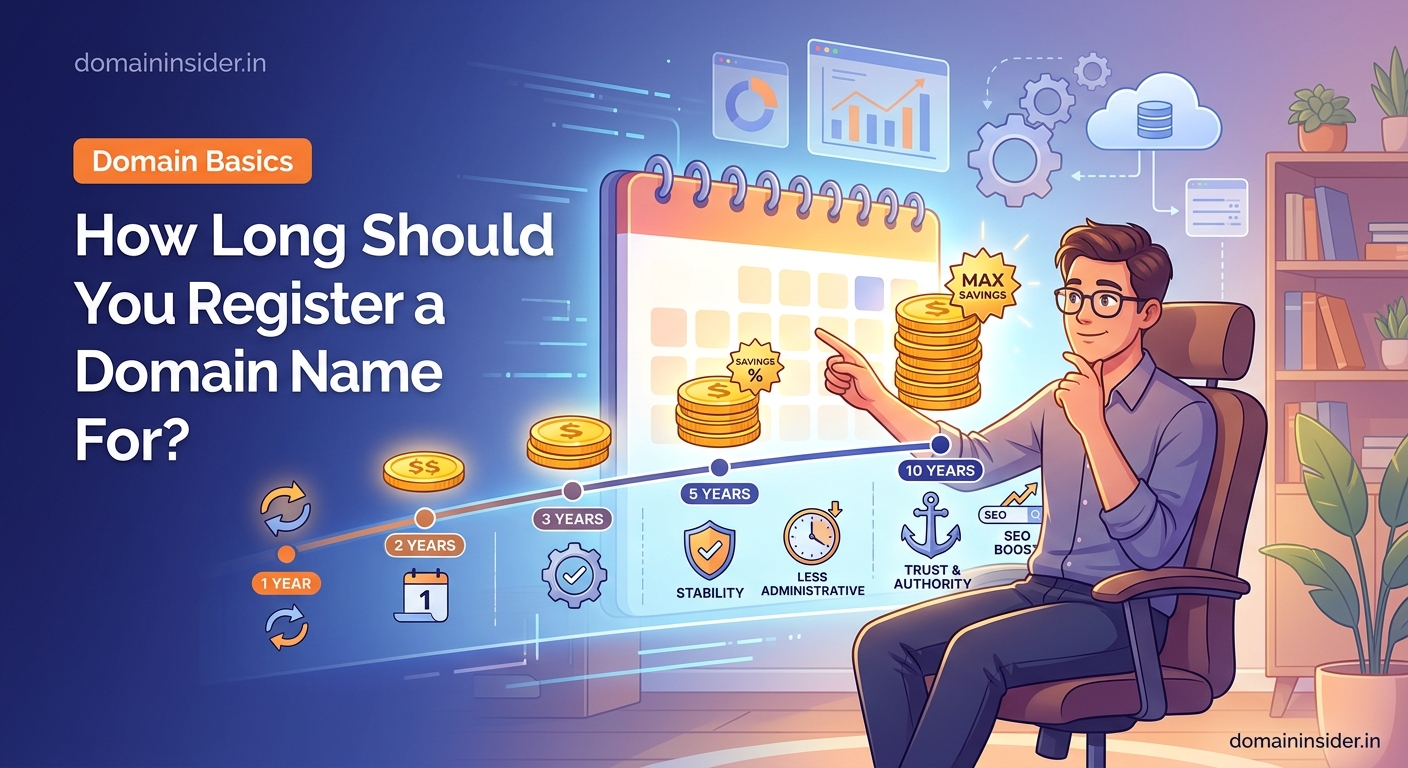
Registrars offer better pricing for longer terms. The per-year cost drops significantly when you commit to three, five, or ten years upfront. For a ₹800 annual domain, a five-year registration might cost ₹3,500 instead of ₹4,000.
The SEO Angle Everyone Asks About
Let’s address the elephant in the room. Does registration length affect rankings?
Google’s Matt Cutts mentioned years ago that registration period could be “one of many factors” in evaluating site quality. The keyword there is “one of many.” It’s not a magic ranking boost.
Think about it logically. Spammers typically register domains for one year because they expect those sites to get penalized or banned. Legitimate businesses usually register for longer periods because they’re building something lasting.
“Multi-year domain registration won’t skyrocket your rankings, but it’s part of the overall trust profile search engines build for your site. Combined with quality content, proper technical setup, and genuine backlinks, it contributes to your site’s credibility score.”
The SEO benefit is real but modest. Don’t register for ten years expecting page one rankings. Do consider it as part of your overall legitimacy signals.
Cost Analysis by Registration Period
Let’s compare actual costs across different time frames.
| Registration Period | Typical Annual Cost | Total Upfront | Per-Year Savings | Best For |
|---|---|---|---|---|
| 1 Year | ₹800 | ₹800 | ₹0 | Testing concepts, uncertain projects |
| 2 Years | ₹750/year | ₹1,500 | ₹50/year | New businesses, budget-conscious owners |
| 3 Years | ₹700/year | ₹2,100 | ₹100/year | Established sites, moderate commitment |
| 5 Years | ₹650/year | ₹3,250 | ₹150/year | Serious businesses, brand protection |
| 10 Years | ₹600/year | ₹6,000 | ₹200/year | Premium domains, long-term brands |
These numbers vary by registrar and domain extension. Understanding which extension suits your Indian business helps you budget more accurately.
The savings compound over time. That ₹200 annual saving over ten years puts ₹2,000 back in your pocket. For businesses managing multiple domains, the savings multiply fast.
How to Choose Your Registration Period
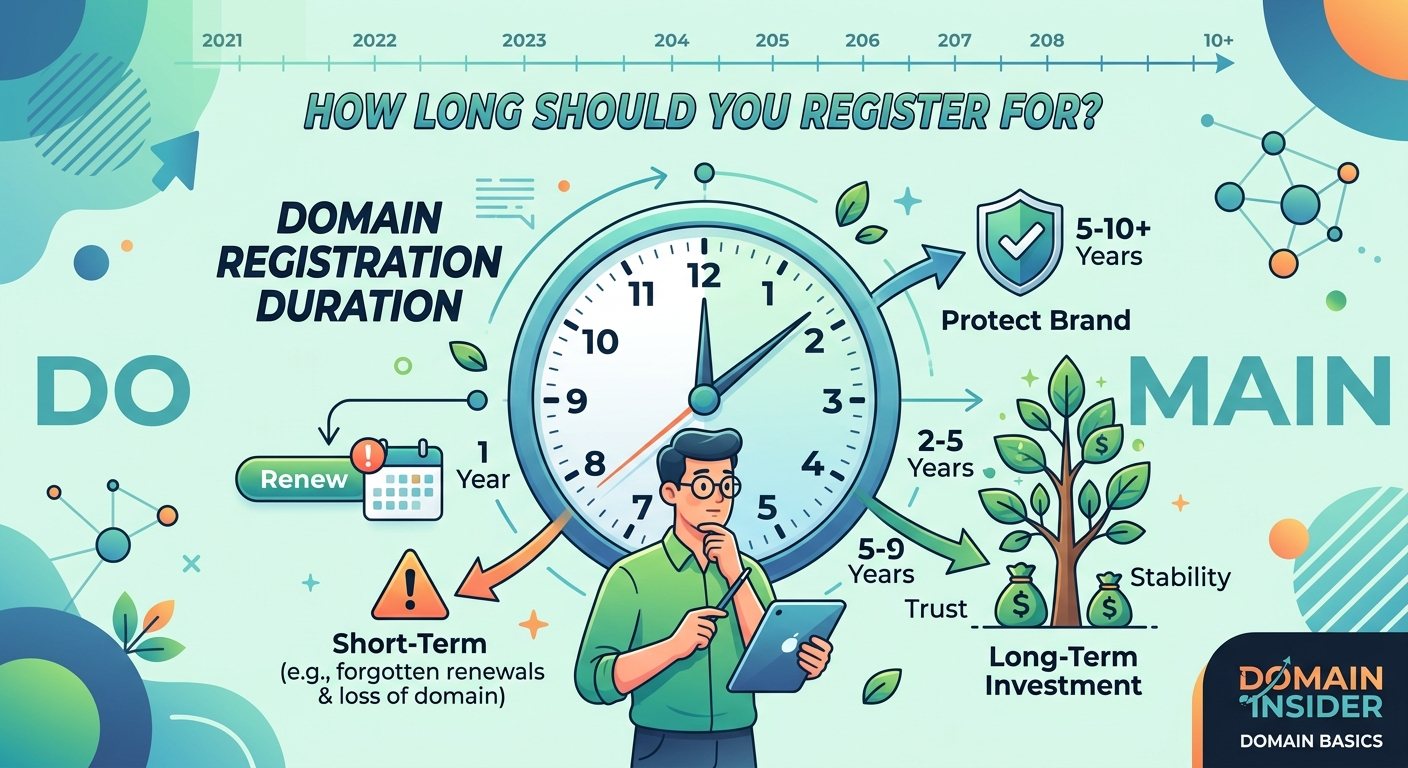
Your ideal registration length depends on several factors. Here’s a practical framework.
-
Assess your commitment level. Are you testing a side project or launching your main business? Testing ideas warrant one-year registrations. Your primary business deserves at least two years, preferably more.
-
Calculate your available budget. Multi-year registrations require larger upfront payments. If ₹800 is manageable but ₹4,000 isn’t, start with two years. You can extend later.
-
Consider your domain’s value. Premium or exact-match domains justify longer registrations. These names have resale value even if your project pivots. Generic domains for specific campaigns might only need one year.
-
Factor in renewal price increases. Registrars often offer promotional first-year pricing, then charge standard rates for renewals. Locking in multiple years at the promotional rate saves money. Check the renewal price before committing.
-
Evaluate your renewal management skills. Honest question: are you organized enough to remember annual renewals? If you’ve ever forgotten to pay a bill, register for longer periods. The peace of mind is worth it.
Common Registration Length Mistakes
Many new domain owners make predictable errors. Avoid these pitfalls.
Registering for just one year on important domains. Life gets busy. Businesses pivot. Email addresses change. A single year passes faster than you think. Then renewal notices go to an old email, and your domain expires. Competitors or squatters grab it within days.
Going too long on experimental projects. The opposite mistake. You register an untested business idea for ten years, spend ₹6,000, then realize the market doesn’t exist. Now you’re stuck with a useless domain and sunk costs. Start short for experiments.
Ignoring auto-renewal settings. Multi-year registration protects you, but only until that period ends. Always enable auto-renewal as a backup. Set calendar reminders for 60 days before expiry. Update your payment methods regularly.
Forgetting about privacy protection costs. That ₹650 per year domain might cost ₹850 with WHOIS privacy. Calculate the total cost including privacy protection, SSL certificates, and any other add-ons before committing to long registrations.
Not comparing registrar pricing. One registrar charges ₹800 per year. Another charges ₹600. Over five years, that’s ₹1,000 in savings. Negotiating domain prices applies to registrations too, especially for bulk purchases.
Special Situations That Change the Calculation
Certain scenarios warrant different approaches.
Building a domain portfolio. Investors buying multiple domains for resale face different math. Register portfolio domains for two years maximum. You’ll likely sell them before renewal anyway. The exception: truly premium domains worth holding long-term. Those justify five to ten-year registrations for credibility when approaching buyers.
Launching a startup. Early-stage startups operate in uncertainty. Your product might pivot. Your name might change. Register your primary domain for two years to show commitment without over-committing capital. As you gain traction and funding, extend to five years.
Protecting brand variations. Companies often register multiple domain variations (.com, .in, .co.in, common misspellings). Register defensive domains for one or two years. Your primary domain deserves longer registration, but defensive purchases need minimal commitment.
Acquiring expired domains. Buying expired domains with existing backlinks and history? Register for at least five years immediately. This signals to search engines that the domain is under legitimate new ownership, not a spam operation recycling expired domains.
Geographic expansion. Adding country-specific domains as you expand? Register new geographic domains for the same period as your main domain. Consistency across your domain portfolio looks more professional.
What Registrars Won’t Tell You
The domain industry has some quirks worth knowing.
Registrars make more money from annual renewals than long-term registrations. They’ll offer promotional pricing for the first year, hoping you forget to shop around at renewal time. Lock in multi-year rates when promotions run.
Some registrars charge different renewal rates based on registration length. A one-year renewal might cost ₹900, while adding five years costs ₹700 per year. Always check the bulk pricing before your domain expires.
Transfer fees complicate the math. Moving domains between registrars typically adds one year to your registration and costs ₹800-1,000. If you’re planning to transfer, don’t prepay for ten years at your current registrar.
Registry price increases affect all registrars simultaneously. When Verisign (the .com registry) raises prices, every registrar passes that increase to customers. Multi-year registrations lock in current pricing, protecting you from registry increases during your registration period.
The Auto-Renewal Safety Net
However long you register for, enable auto-renewal. This is non-negotiable.
Auto-renewal prevents the single biggest domain disaster: accidental expiry. Domains enter a grace period after expiration, then a redemption period with hefty recovery fees, then public auction. Your business name could end up owned by someone else.
Set up auto-renewal, but don’t rely on it exclusively. Add three calendar reminders:
- 90 days before expiry: review your domain needs and pricing
- 60 days before expiry: verify payment method and contact information
- 30 days before expiry: confirm auto-renewal is active
This layered approach catches failures. Credit cards expire. Email addresses change. Registrars have technical issues. Multiple reminders ensure nothing falls through the cracks.
Making Your Decision Today
Here’s the practical advice for different situations.
If you’re launching your first business website: Register for two years minimum. This shows search engines you’re serious without straining your startup budget. Enable auto-renewal and set reminders.
If you’re testing a business idea: One year is fine. Keep costs low while validating your concept. If it works, extend immediately to five years. If it doesn’t, you’ve minimized losses.
If you’re running an established business: Five years makes sense. You’re not going anywhere. The cost savings are significant. Your domain registration matches your business planning horizon.
If you own a premium domain: Ten years. Premium domains appreciate over time. Long registration adds credibility when potential buyers evaluate the domain. Checking your domain’s value helps justify the investment.
If you’re building a portfolio: Two years for speculative purchases, five to ten years for premium holdings. This balances flexibility with credibility. Building a profitable portfolio requires strategic registration planning.
Technical Considerations Behind the Scenes
The registration period affects more than just your renewal date.
WHOIS records display your registration expiry date publicly. Potential partners, customers, and competitors can see it. A domain expiring in three months raises questions. A domain valid for five more years builds confidence.
Search engines cache WHOIS data. When someone types your domain into their browser, multiple systems check your domain’s validity. Longer registration periods mean fewer verification checks and slightly faster resolution times.
Email deliverability services check domain age and registration length. Domains registered for longer periods face fewer spam flags. If you’re building an email list or sending transactional emails, this matters.
SSL certificate providers sometimes offer better rates for domains with longer registration periods. The domain registration signals stability, reducing the provider’s risk of issuing certificates for soon-to-expire domains.
Price Protection Strategies
Smart domain owners use registration length as a hedge against price increases.
Registry operators raise prices periodically. The .com registry has increased prices multiple times over the past decade. Each increase applies to renewals immediately but doesn’t affect existing multi-year registrations until they expire.
Register for five or ten years when registries announce upcoming price increases. You lock in current pricing for the entire period. This saved early adopters hundreds when .com prices jumped from $7.85 to $8.39 to $8.97 per year.
Promotional pricing creates another opportunity. Registrars run sales offering domains at ₹99 or ₹199 for the first year. The catch? Renewal costs ₹899. Register for the maximum period at promotional rates. You save ₹700 per year compared to those who registered for one year and renewed at standard pricing.
Watch for registrar switching promotions. Some registrars offer free transfers plus one year extension. Time your multi-year renewals around these promotions to maximize savings.
Regional Considerations for Indian Businesses
Indian businesses face unique factors when choosing registration periods.
.in domains have become increasingly popular for startups. The .in registry (NIXI) has stable pricing, making longer registrations a safe bet. No surprise price jumps in the middle of your registration period.
Payment methods matter. Some Indian registrars offer better pricing for UPI or net banking compared to credit cards. The payment processing fees affect total cost, especially for long-term registrations.
GST applies to domain registrations. Factor in the 18% GST when calculating multi-year costs. A ₹3,000 five-year registration actually costs ₹3,540 after tax.
Currency fluctuations affect international registrars. If you’re registering through a US-based provider, rupee depreciation increases your effective cost at renewal time. Multi-year registrations lock in the exchange rate, protecting against currency risk.
When Shorter Is Actually Better
Despite the benefits of long registrations, some situations call for shorter terms.
Domains for time-limited campaigns should match the campaign duration. Running a festival promotion? Register for one year. Planning a product launch event? One year is plenty.
Domains you’re not completely sure about deserve shorter commitments. That clever domain hack that seems brilliant at 2 AM might feel less clever after a week. Register for one year. If it proves valuable, extend it.
Domains in disputed territories or regulatory uncertainty warrant caution. If there’s any chance your domain violates trademarks or faces legal challenges, don’t prepay for ten years. Keep your exposure limited.
Experimental TLDs with uncertain futures shouldn’t get long commitments. New domain extensions launch regularly. Some thrive, others disappear. Stick to one or two-year registrations for experimental extensions until they prove staying power.
Your Domain Registration Checklist
Before you click that registration button, verify these points:
- You’ve checked the renewal price, not just the first-year promotional price
- Auto-renewal is enabled with a valid payment method
- Your contact information is current and you control the email address
- You’ve added calendar reminders for 90, 60, and 30 days before expiry
- You’ve compared prices across at least three registrars
- You’ve factored in privacy protection, SSL, and other add-on costs
- Your chosen registration period matches your business commitment level
- You have a backup plan if this domain doesn’t work out
This checklist prevents expensive mistakes and ensures you’re making an informed decision.
Extending Existing Registrations
Already own a domain registered for one year? You can extend it anytime.
Most registrars let you add years to your existing registration up to the maximum (usually ten years total). You don’t need to wait for renewal. Adding years now locks in current pricing and extends your protection immediately.
The best time to extend is during registrar promotions. Watch for renewal discount codes or bulk pricing offers. Adding five years during a 20% off sale saves significant money.
Some registrars offer loyalty discounts for long-term customers. If you’ve been with the same registrar for years, contact support before extending. They might offer better rates than the public website shows.
Building Long-Term Domain Security
Registration length is one piece of a larger security strategy.
Enable two-factor authentication on your registrar account. This prevents unauthorized transfers even if someone gets your password. Most domain hijackings happen through compromised accounts, not technical exploits.
Use registrar lock (also called domain lock or transfer lock). This prevents transfers without explicit approval. Combined with multi-year registration, it makes your domain extremely secure.
Maintain separate email addresses for domain management. Don’t use your primary business email for domain contacts. If your main email gets compromised, your domains remain protected.
Document your domain portfolio, registration dates, and renewal dates in a secure location. Share this information with at least one trusted partner or team member. If something happens to you, someone needs to maintain your domains.
The Registration Sweet Spot for Most Businesses
After weighing all factors, here’s what works for most business owners.
Register your primary business domain for three to five years. This balances cost, credibility, and flexibility. You’re committing enough to signal legitimacy without over-investing in an uncertain future.
Register defensive domains (common misspellings, alternate extensions) for two years. Long enough to prevent squatters, short enough to minimize costs for domains you’ll never actually use.
Register campaign or project-specific domains for one year initially. Extend them if the campaign succeeds and becomes permanent.
Review your entire domain portfolio annually. Extend domains that proved valuable. Let experimental domains expire if they didn’t work out. This keeps your portfolio lean and your costs under control.
Making Registration Length Work for Your Goals
Your domain registration strategy should align with your business goals, not arbitrary rules.
A solopreneur testing a content site has different needs than a funded startup launching a SaaS product. The solopreneur might start with one year and extend based on traction. The startup should register for five years immediately to maximize credibility with investors and customers.
Selling domains requires different thinking than using them. Domains for sale benefit from longer registrations because buyers see them as more valuable and legitimate.
Your comfort level with risk matters too. Risk-averse owners sleep better with ten-year registrations and multiple backup systems. Risk-tolerant owners might manage dozens of domains on annual renewals without breaking a sweat.
There’s no universal right answer. The right registration length is the one that matches your specific situation, budget, and goals.
Protecting Your Investment for the Long Haul
However long you register for, treat your domain as the valuable asset it is.
Your domain is your digital real estate. It’s where customers find you, where your brand lives, where your business exists online. Losing it because you registered for too short a period or forgot to renew would be devastating.
Multi-year registration is insurance. You’re paying a bit more upfront to protect against the catastrophic risk of losing your domain. When you frame it that way, the extra cost seems minimal compared to the protection it provides.
Choose a registration period you’re comfortable with, enable every available protection, set multiple reminders, and then focus on building your business. Your domain will be there, secure and stable, supporting your growth for years to come.
