You are running a home decor store based in Jaipur. Your website uses a .com domain. You blog about Rajasthani crafts, and you publish guides on Vastu-friendly decor. But when someone in Mumbai searches for “best home decor store in India,” your competitor in Pune shows up first. They use a .in domain. This is not a coincidence.
The choice between a .in and a .com domain is not just about availability or price. It is a signal. A signal to Google, and a signal to your audience, that your business is built for India. In 2026, with Google’s increasing focus on local relevance, that signal matters more than most marketers realise.
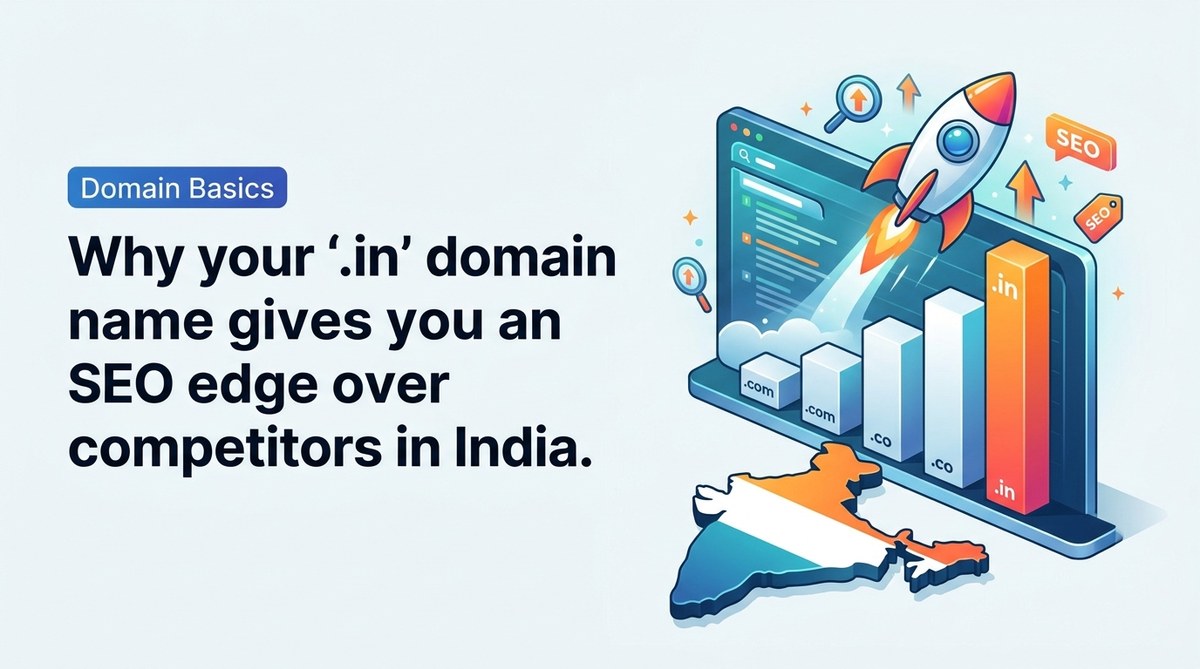
A .in domain acts as a strong geo-targeting signal for Google, helping your site rank higher for searches originating in India. While a .com domain is global by nature, the .in extension tells search engines you serve a local audience. This advantage is amplified when combined with local hosting, Indian backlinks, and region-specific content. For businesses targeting Indian customers, the .in domain is a strategic SEO asset, not just a branding choice.
Why Google treats .in domains differently
Google uses country-code top-level domains (ccTLDs) as a direct ranking signal. When someone searches from India, Google knows the user’s location. A .in domain is an explicit confirmation that the website is relevant to that country.
A .com domain, on the other hand, is neutral. It does not tell Google which country you serve. You can still rank in India with a .com, but you need to compensate with other signals like local backlinks, a Google My Business profile, and India-based hosting. The .in domain does some of that work for you from day one.
This is not speculation. Google’s own documentation confirms that ccTLDs help with geo-targeting. If you want to rank for “home decor store in India” and you use a .in domain, you start with a structural advantage that a .com domain does not have.
The real world impact on click-through rates
SEO is not just about ranking. It is about earning the click. When a user in India sees a search result with a .in domain, their brain registers familiarity. They trust it more because it feels local.
Consider these two search results:
- Yourjaipurstore.com
- Yourjaipurstore.in
Which one would you click if you were looking for a store in Jaipur? The .in version feels like it belongs. It signals that the business is registered, operates in India, and understands local needs. This psychological edge translates into higher click-through rates, which is a positive engagement signal for Google.
Comparing .in and .com for Indian SEO
Here is a breakdown of how the two extensions perform across key SEO factors:
| Factor | .in Domain | .com Domain |
|---|---|---|
| Geo-targeting signal | Strong. Explicitly tells Google you target India. | Weak. Requires additional setup. |
| Local trust | High. Indian users perceive it as local. | Neutral. Works globally but feels generic. |
| Availability | More options. Short keywords often available. | Highly saturated. Premium names cost more. |
| Renewal cost | Affordable. Usually between Rs 500 and Rs 800 per year. | Slightly cheaper in some cases, but premium names are expensive. |
| International reach | Limited. Not ideal for global audiences. | Excellent. Works for every country. |
| Backlink perception | Seen as a local authority. | Seen as a global authority. |
If your primary audience is in India, the .in domain wins on the first three factors. If you plan to expand globally later, you can always buy the .com version and redirect it.
Three practical steps to maximise your .in SEO advantage
Switching to a .in domain is not enough. You need to set it up correctly to get the full benefit. Here is a process that works:
-
Register your .in domain with a reliable registrar. Choose one that offers DNSSEC, free WHOIS privacy, and easy DNS management. Avoid registrars with hidden renewal fees. Check our guide on how to register a domain name in India for a detailed comparison.
-
Set up 301 redirects from your old .com domain. This tells Google that your site has permanently moved. Keep your old domain active for at least six months. Update your Google Search Console profile to reflect the new domain. Use the change of address tool.
-
Update all internal and external links. Change your website footer, email signatures, social media profiles, and business listings. If you have backlinks from Indian blogs, ask them to update the link to your .in domain. This preserves your link equity.
Common mistakes that kill the .in SEO advantage
Even with a .in domain, you can lose the ranking edge if you make these errors:
- Hosting your site on a server located outside India. Google considers server location as a geo-signal. A .in domain hosted in the US sends mixed signals. Use a hosting provider with servers in Mumbai, Bangalore, or Delhi.
- Using a .in domain but writing content in American English with US-centric examples. Localisation is not just about the extension. Your content must reflect Indian festivals, measurement units, currency, and cultural references.
- Neglecting local structured data. Add your business address, phone number, and operating hours using LocalBusiness schema. This reinforces your local relevance.
The .in domain and brand perception
Beyond SEO, a .in domain helps with brand recall. Indian customers are more likely to remember a short, relevant .in domain than a long .com domain with hyphens or numbers.
Take the example of a financial advisory firm. Compare “smartinvestmentsindia.com” with “smartinvest.in”. The second one is cleaner, easier to type, and instantly communicates the service location. This simplicity improves direct traffic, which is another signal Google uses to assess site quality.
For startups and small businesses in India, the .in domain is often the difference between looking like a local player and looking like an outsider. If you are competing with established brands, every small trust signal helps. The .in domain is one of the easiest trust signals to implement.
Expert advice: If your business name is available as a .in domain, register it even if you plan to keep your .com as the main domain. You can redirect the .in version to your .com site. This prevents competitors from buying it and protects your brand. It is a low-cost insurance policy.
How the .in domain fits into a broader local SEO strategy
The .in domain is a powerful tool, but it works best as part of a complete local SEO approach. Here are the other elements you need to get right:
- A verified Google My Business profile with accurate NAP (Name, Address, Phone) data.
- Citations on Indian business directories like Justdial, IndiaMART, and Sulekha.
- Backlinks from Indian news sites, educational institutions (.ac.in), and local blogs.
- Content that addresses Indian search intent, such as “best Diwali gift ideas” or “GST filing tips for small businesses.”
When you combine a .in domain with these signals, you create a strong local relevance profile that is hard for a .com competitor to beat.
Why some businesses hesitate to switch
The most common concern is the fear of losing existing search rankings. This is valid. If your .com site has strong authority, a poorly executed migration can cause a temporary drop in traffic.
But the risk is manageable. Follow the 301 redirect process carefully. Keep your old domain active. Monitor Google Search Console for errors. Most sites recover their rankings within four to eight weeks, and then begin to outperform the old domain for Indian searches.
Another concern is the perception that .in domains look less professional. This belief is fading. In 2026, major Indian brands like Swiggy, Zomato, and Ola all use .in domains or redirect to them. The stigma is gone. If anything, a .in domain now signals that you are serious about the Indian market.
Your next move for a stronger Indian SEO presence
If you are targeting customers in India, the .in domain gives you a clear, measurable SEO advantage. It simplifies geo-targeting, builds local trust, and improves click-through rates. It is not a magic bullet, but it is a foundational piece of a smart local SEO strategy.
Start by checking if your ideal domain name is available as a .in. If it is, register it today. If you already own a .com site, plan a migration. Use the three step process outlined above. Pair it with local hosting, Indian backlinks, and region-specific content.
The businesses that act on this now will be the ones ranking on page one when Indian customers search in 2026 and beyond. Do not let a generic domain extension hold your brand back from the audience that matters most.
