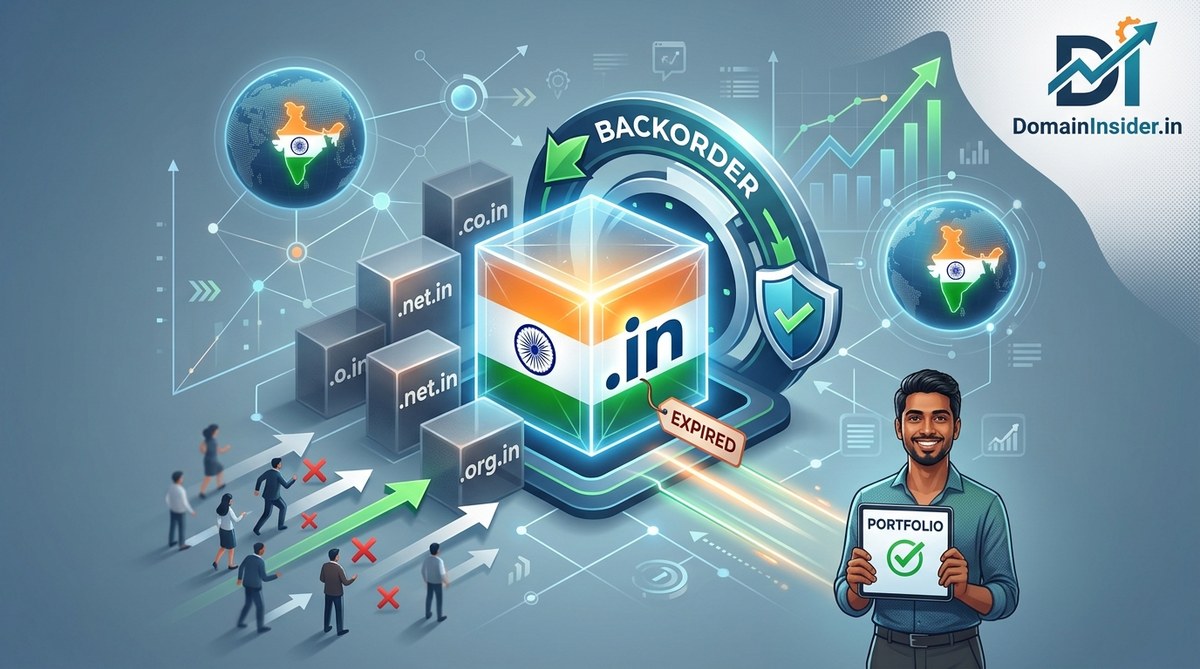
Imagine this: you finally think of the perfect name for your new business. You check the .in domain and it is taken. Not by an active website, but by someone who registered it years ago and forgot about it. You check domain marketplaces and the price is absurd. A broker wants a fee that feels like a down payment on a car. There is a better way. Domain backordering is the strategy that smart Indian business owners and startup founders use to grab these premium expired .in domains before anyone else. It is not gambling. It is preparation.
Domain backordering lets you claim an expiring domain before it becomes available to the public. You pay a small fee to place a backorder. The registrar tries to catch the domain the moment it drops. If successful, you get it at standard registration price. If not, you pay nothing. For Indian buyers, this is the most cost-effective way to acquire high-value .in domains without competing in open auctions or paying inflated marketplace prices.
What Domain Backordering Actually Means
Domain backordering is not a purchase. It is a reservation system. When a domain expires, the current owner has a grace period to renew. If they do not, the domain enters a redemption phase. After that, it becomes available for anyone to register. This moment is called the drop.
A backorder service monitors thousands of domains. When you place a backorder on a specific domain, the service tries to register it the instant it drops. If multiple people backorder the same domain, it goes to a private auction among those backorders. The winner gets the domain.
This is different from buying from a marketplace. On a marketplace, someone already owns the domain and sets a price. With backordering, you are competing for a domain that no one owns. The cost is usually much lower.
Why Indian Business Owners Should Care About Backordering
The Indian domain market is growing fast. More startups are launching every month. Many of them want short, memorable .in domains. The problem is that most of the good ones are already registered. Some are parked. Some are unused. Some belong to businesses that shut down during the pandemic.
These domains eventually expire. If you know how to backorder, you can get them for standard registration fees. A domain that would cost you ₹50,000 on a marketplace might cost you ₹799 plus a small backorder fee.
Think about the financial year end. Many small business owners let domains expire because they are cutting costs. March and April are excellent months to watch for drops.
How Domain Backordering Works Step by Step
Here is the exact process you will follow to backorder a .in domain:
-
Find your target domain. Use a domain backorder service or a drop catching platform. Look for domains that are in the redemption period or about to expire. You can also check the expiry date of a domain you want using WHOIS tools.
-
Place your backorder. Log in to your chosen registrar or backorder service. Enter the domain name. Pay the backorder fee. This is usually between ₹200 and ₹500 for a .in domain.
-
Wait for the drop. The domain will drop on a specific date. The backorder service tries to catch it at that moment. If only you placed a backorder, you get the domain. If others also placed backorders, a private auction starts.
-
Win the auction or pay nothing. If you win the auction, you pay the final bid amount plus the registration fee. If you lose, you get your backorder fee refunded.
-
Register the domain. Once caught, the domain is transferred to your account. You can use it immediately.
Backordering vs Buying from a Marketplace
Let us compare the two options side by side.
| Factor | Domain Backordering | Buying from Marketplace |
|---|---|---|
| Cost | Low backorder fee + standard registration | Often 10x to 100x higher |
| Competition | Only other backorders | Open to all buyers |
| Ownership risk | Domain is unowned | Domain is owned by a seller |
| Speed | Takes days to weeks | Instant purchase |
| Certainty | Not guaranteed | Guaranteed if you pay |
| Best for | .in, .co.in, and other ccTLDs | All extensions |
Backordering is not for every domain. If you need a domain today for a launch next week, buy it from a marketplace. But if you can wait a few weeks, backordering can save you a lot of money.
Common Mistakes Indian Buyers Make with Backordering
Avoid these errors to increase your success rate.
-
Ignoring the renewal grace period. A domain might show as expiring but the owner can still renew it. Do not assume it will drop. Wait until it enters the redemption phase.
-
Backordering without checking history. Some expired domains have bad backlinks or spam history. Use tools to check the domain’s past. Read our guide on how to value expired domains with existing backlinks before placing a backorder.
-
Forgetting about GST. If you are a business, you can claim input tax credit on domain purchases. Keep your invoices.
-
Using only one backorder service. Different services have different success rates for .in domains. Use multiple services to increase your chances.
-
Bidding too high in private auctions. Set a maximum bid before the auction starts. Do not get caught in a bidding war.
When Backordering Is the Smartest Choice
Backordering is ideal for these situations.
- You want a specific .in domain that is about to expire.
- You are building a brand and need a clean, short domain.
- You are on a tight budget and cannot afford marketplace prices.
- You are willing to wait for the right domain.
- You want to avoid the stress of live auctions.
It is less ideal when you need a domain immediately or when the domain is already in high demand with many backorders.
“The best domains I have acquired for my clients were not bought from marketplaces. They were backordered. One client saved over ₹80,000 on a single .in domain by waiting two weeks for it to drop.” – Rajesh Menon, Domain Consultant
Tools and Services for Backordering in India
Several registrars and platforms offer backordering for .in domains. Here are some you should consider.
- ResellerClub – One of the largest Indian registrars. Offers backordering through its platform.
- Dynadot – Supports .in backordering with a simple interface.
- GoDaddy Auctions – Has a backorder feature for many extensions including .in.
- Namecheap – Offers backordering for selected TLDs.
- Backorder services – Specialised platforms like Backorder.com and DropCatch also work for .in domains.
Each service has different pricing and success rates. Try a few to see which works best for your target domains.
A Simple Strategy to Start Backordering Today
You do not need to be an expert to start. Follow this plan.
- Make a list of 10 to 20 .in domains you would like to own. Use a spreadsheet.
- Check their expiry dates using WHOIS or a domain monitoring tool.
- Set a reminder for 30 days before each expiry date.
- Place backorders on the ones that enter the redemption phase.
- Monitor the private auctions. Do not exceed your budget.
- Celebrate when you catch one.
This method works for both single domains and building a portfolio. If you want to learn more about building a portfolio, read our guide on how to build a profitable domain portfolio with just ₹50,000.
What to Do After You Catch the Domain
You caught the domain. Now what?
First, secure it. Enable domain privacy protection. Set up auto-renewal so you never lose it. Read our article on domain privacy protection: do you really need it for your website? to decide.
Second, decide what to do with it. You can build a website, redirect it to your main site, or park it while you decide. Some people flip domains for profit. If that interests you, check out domain flipping in India: real case studies of 10x returns.
Third, check the domain history again. Make sure there are no penalties or spam links pointing to it. If there are, you can clean them up using Google Search Console.
A Note on .in vs .co.in
Many Indian businesses wonder whether to backorder a .in or a .co.in domain. The .in extension is shorter and more modern. It is also more expensive to register initially. The .co.in extension is cheaper but looks older.
Both can be backordered. The process is the same. The choice depends on your brand. If you want a clean, professional look, go with .in. If you want to save on registration costs, go with .co.in.
For a deeper comparison, read our article on should you buy a .co.in or .in domain for your Indian business?
Your First Backorder Is Waiting
You now know the process. You know the tools. You know the mistakes to avoid. The only thing left is to take action.
Start by finding one domain you want. Check its expiry. Place a backorder. See what happens. Even if you do not win, you will learn how the system works. That knowledge is valuable.
Domain backordering is not a secret. It is a method used by smart investors and business owners who understand that patience and preparation beat impulse buying. The next time you see a premium .in domain that is out of your budget, do not walk away. Backorder it.
