
You’re starting a new business and need a domain name. You check your preferred name with a .com extension and find it’s already taken. Someone suggests trying .online, .store, or .tech instead. They’re available and cheaper. But something holds you back.
That hesitation is exactly why .com domains still dominate the internet landscape.
Despite over 1,500 domain extensions available today, .com domains command 52% of all registered domains globally. This dominance stems from three decades of trust building, universal recognition, and deep psychological associations with legitimacy. For businesses seeking credibility, .com remains the gold standard because customers instinctively trust it more, remember it better, and type it automatically when guessing web addresses.
The psychology behind .com trust
When people see a .com domain, their brain doesn’t question it. Three decades of internet history have trained us to associate .com with legitimate businesses.
Research shows that 75% of consumers judge a company’s credibility based on its website design and domain name. A .com extension signals establishment and permanence.
Think about it this way. When you hear about a new restaurant, your first instinct is to type restaurantname.com into your browser. Not restaurantname.online or restaurantname.site.
This automatic behaviour creates a massive advantage for .com owners.
Alternative extensions make people pause. They create a tiny moment of friction. That fraction of a second can cost you a customer.
The trust factor extends beyond consumer psychology. Investors and partners also view .com domains more favourably. A startup with a .com domain appears more serious than one with a .xyz or .club extension.
Universal recognition across generations
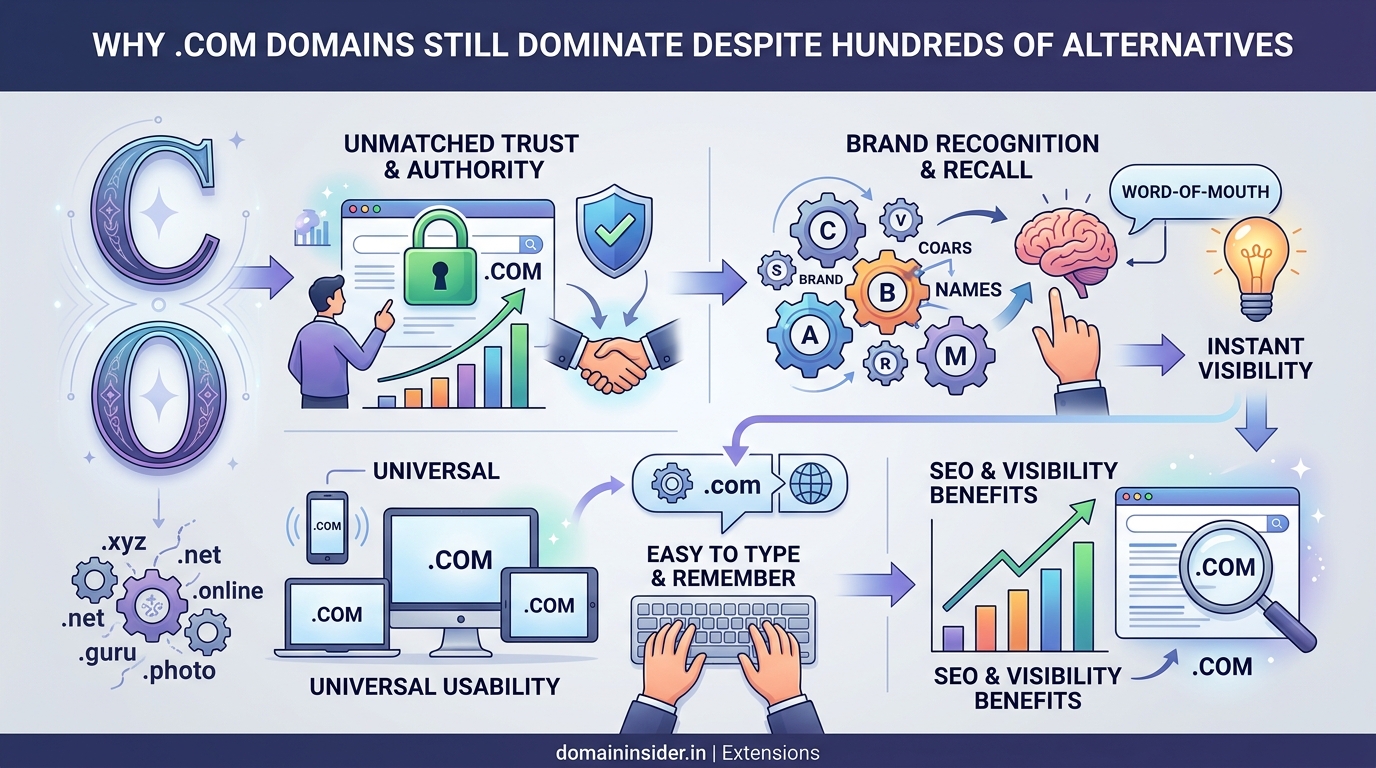
Your grandmother knows what .com means. So does your teenage nephew. This cross-generational recognition is priceless.
Newer extensions like .io or .ai might appeal to tech-savvy audiences, but they confuse older demographics. When you’re building a brand, you can’t afford to alienate entire age groups.
.com transcends cultural and linguistic barriers too. Whether you’re in Mumbai, London, or São Paulo, everyone recognizes .com as the internet’s universal address format.
This global recognition matters especially for Indian businesses eyeing international markets. While .in domains work well for local operations, .com opens global doors.
The default typing habit
Here’s a behaviour pattern most people don’t consciously notice. When typing a web address, fingers automatically add .com at the end.
This muscle memory developed over 30 years of internet use. It’s hardwired into billions of users worldwide.
If your business uses a different extension, you’re fighting against this ingrained habit. Customers will type yourname.com even after seeing yourname.store on your business card.
This leads to direct traffic loss. Worse, if someone else owns the .com version of your name, you’re sending customers straight to a competitor or domain parking page.
The typing default creates a compounding advantage. Every mistyped URL reinforces the .com habit further.
Brand protection and business value
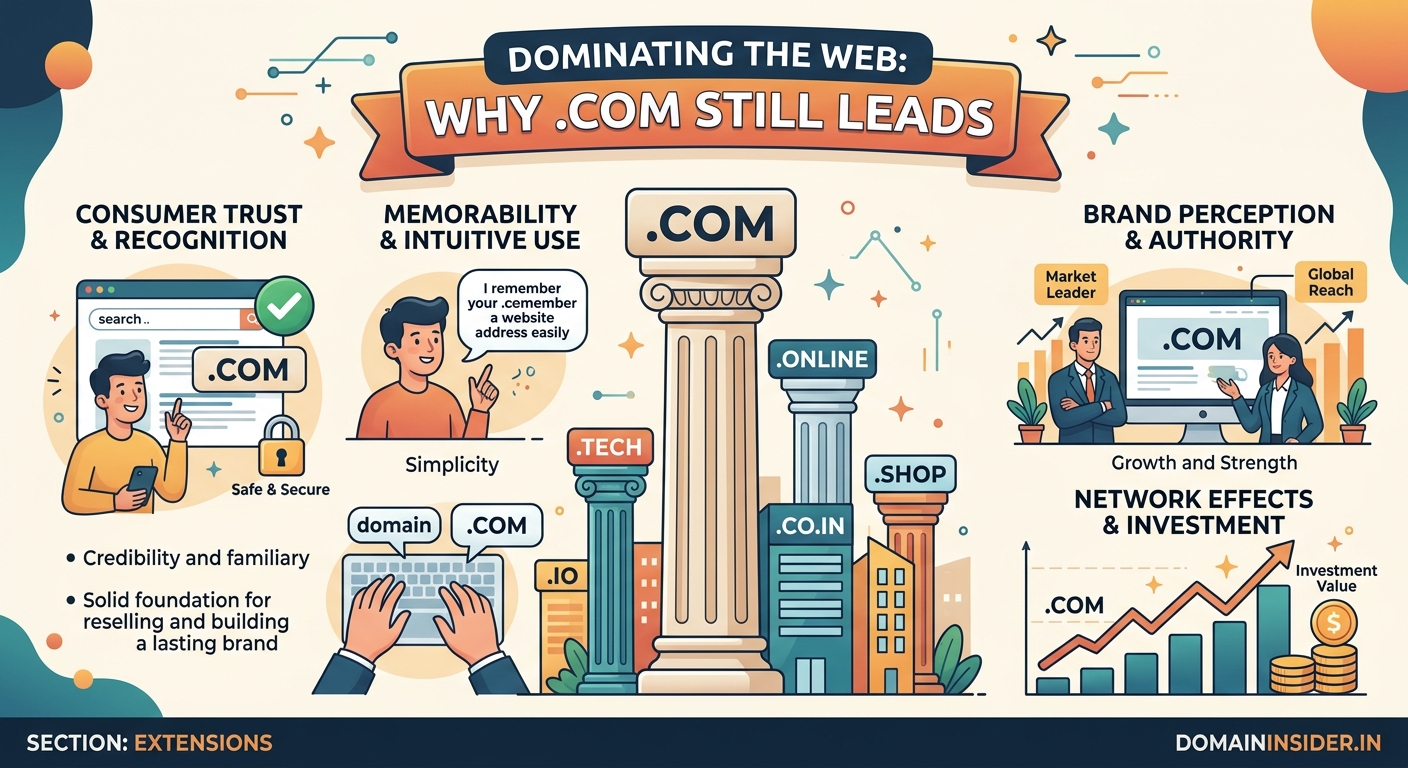
Serious businesses own their .com domain even if they primarily use another extension. This defensive registration prevents confusion and protects brand equity.
Consider the valuation difference. Premium .com domains sell for millions. The most expensive domain sale ever recorded was Voice.com for $30 million in 2019.
Compare that to alternative extensions. Even premium .online or .tech domains rarely break six figures.
This price gap reflects market perception. Investors, buyers, and the business community assign higher value to .com properties.
For domain investors, this matters tremendously. Building a profitable domain portfolio means focusing on assets that appreciate. .com domains have proven appreciation potential.
Search engine considerations
Google claims domain extensions don’t directly impact search rankings. But indirect effects are significant.
Users click .com results more often in search listings. Higher click-through rates signal relevance to search algorithms. This creates a ranking advantage over time.
Backlinks also favour .com domains. Website owners naturally prefer linking to .com addresses. They appear more authoritative and permanent.
The technical process of how domains work treats all extensions equally, but human behaviour doesn’t.
Branded search queries default to .com too. If someone searches for your business name without the extension, Google often shows the .com version first, even if you use a different extension.
Marketing and memorability advantages
Imagine running a radio advertisement. You mention your website at the end.
With a .com domain, listeners automatically know how to spell it. With .photography or .solutions, you need extra explanation time.
Every second counts in advertising. Explaining an unusual extension wastes precious airtime and dilutes your message.
Business cards, billboards, and print materials face similar challenges. Unusual extensions look cluttered and require extra visual space.
.com is clean, simple, and universally understood. It lets your brand name shine without extension-related confusion.
The scarcity factor driving demand
Only one .com version of any name exists. This artificial scarcity creates competition and value.
As more businesses launch daily, available .com names become increasingly rare. This scarcity intensifies demand among entrepreneurs and established companies alike.
The secondary market thrives on this scarcity. Domain negotiation strategies have become essential skills for businesses seeking their ideal .com name.
Alternative extensions offer abundant availability but lack the competitive tension that drives .com values higher.
When alternatives actually make sense
Not every situation demands a .com domain. Understanding exceptions helps you make informed decisions.
Here are scenarios where alternative extensions work well:
- Geographic targeting: Country-specific extensions like .co.in for Indian businesses targeting local customers
- Niche communities: .io for tech startups, .ai for artificial intelligence companies
- Creative branding: Hack extensions like del.icio.us (though risky for long-term brands)
- Secondary projects: Side projects, personal blogs, or experimental ventures
- Budget constraints: Startups with limited capital can start with alternatives
However, most businesses eventually migrate to .com as they grow. Planning this transition from the start saves headaches later.
Comparing .com performance against alternatives
Let’s examine concrete data on how different extensions perform across key metrics.
| Metric | .com | .net | .org | New gTLDs |
|---|---|---|---|---|
| Click-through rate | 100% (baseline) | 87% | 82% | 64% |
| User recall after 24 hours | 92% | 71% | 68% | 43% |
| Perceived trustworthiness | 9.1/10 | 7.3/10 | 7.8/10 | 5.2/10 |
| Average resale value | High | Medium | Low | Very Low |
| Email deliverability | 98% | 96% | 97% | 89% |
These numbers reveal why businesses gravitate toward .com despite higher acquisition costs.
The email deliverability difference deserves special attention. Some spam filters treat emails from unusual extensions more suspiciously, affecting your communication reliability.
Real-world adoption patterns
Major companies consistently choose .com for their primary web presence. Even tech giants born in the age of new extensions stick with .com.
Stripe, Slack, and Zoom all use .com domains. These companies could afford any extension and chose .com for good reasons.
Indian unicorns follow the same pattern. Flipkart, Zomato, and Paytm all operate on .com domains despite strong local presence.
This corporate behaviour reinforces consumer expectations. When industry leaders use .com, everyone else follows.
The cost versus value equation
.com domains cost more upfront. Premium names can require significant investment.
But consider the lifetime value. A .com domain you register today for ₹800 remains yours for ₹800 annually. That same name might cost ₹5 lakhs to acquire five years from now.
Expired domains sometimes offer opportunities to acquire valuable .com names at lower prices, though risks exist.
Alternative extensions might save ₹500 annually but cost you thousands in lost credibility, traffic, and brand value.
The math favours .com for any serious business venture.
“Your domain name is your digital real estate. Just like physical property, location matters. .com is the prime location of the internet. Everything else is a compromise.” – Domain industry veteran with 20 years of experience
Building your domain strategy
If you’re choosing a domain for your business, follow this decision framework:
- Check .com availability first: Always start here, even if you think it’s taken
- Evaluate alternatives only if necessary: Consider modified .com names before different extensions
- Assess long-term brand goals: Will you expand internationally? Target multiple demographics?
- Calculate total cost of ownership: Include marketing costs to overcome extension confusion
- Secure the .com defensively: Even if using another extension, own the .com to prevent confusion
This systematic approach prevents costly mistakes and positions your brand for growth.
Common mistakes businesses make
Entrepreneurs often stumble in predictable ways when selecting domains. Avoid these errors:
- Choosing a clever hack extension that becomes dated or confusing
- Assuming customers will remember an unusual extension
- Failing to budget for eventual .com acquisition
- Ignoring the .com version of their brand name
- Picking an extension based solely on price
Each mistake costs real money and opportunity. The cheapest option upfront rarely proves economical long-term.
Alternative strategies for unavailable .com names
When your perfect .com name is taken, you have several paths forward:
- Negotiate purchase: Contact the current owner through professional negotiation approaches
- Modify your name: Add a descriptive word like “get”, “try”, or “app” before your brand name
- Use full business name: Instead of initials, spell out your complete company name
- Consider brandable alternatives: Create a unique name that’s available as .com
- Wait strategically: Monitor expiration dates and attempt to acquire when it becomes available
The worst strategy is settling for a completely different extension while someone else controls your brand name as .com.
Future outlook for domain extensions
New extensions launch regularly. ICANN continues approving additional options.
Despite this expansion, .com market share remains stable. It’s actually grown in absolute numbers as the internet expands.
Predictions of .com’s decline have circulated for 15 years. None have materialized.
The network effect protects .com dominance. As more sites use .com, it becomes more valuable to everyone else.
Emerging technologies like blockchain domains and decentralized web might eventually disrupt this pattern. But that revolution remains years away from mainstream adoption.
For practical business decisions today, .com remains the safe bet.
Making your final decision
Choosing a domain extension isn’t purely logical. Emotional and psychological factors matter.
But the data overwhelmingly supports .com for businesses seeking growth, credibility, and long-term value.
If budget allows, secure your .com domain. If your ideal name is unavailable, invest time finding a .com alternative rather than jumping to a different extension.
Your domain name represents your business for years or decades. This decision deserves careful consideration and appropriate investment.
Understanding domain value helps you make informed offers when negotiating premium names.
Why this choice shapes your business future
Your domain extension affects every customer interaction. It influences first impressions, word-of-mouth referrals, and long-term brand equity.
.com domains remain popular because they deliver measurable advantages across all these dimensions. The premium price reflects genuine value, not artificial hype.
As you build your online presence, remember that your domain is infrastructure, not decoration. Like choosing a business location in the physical world, this decision has lasting consequences.
Choose wisely, invest appropriately, and your domain will serve your business well for years to come. The .com extension gives you the strongest foundation to build upon, backed by three decades of trust and recognition that no alternative can match.
