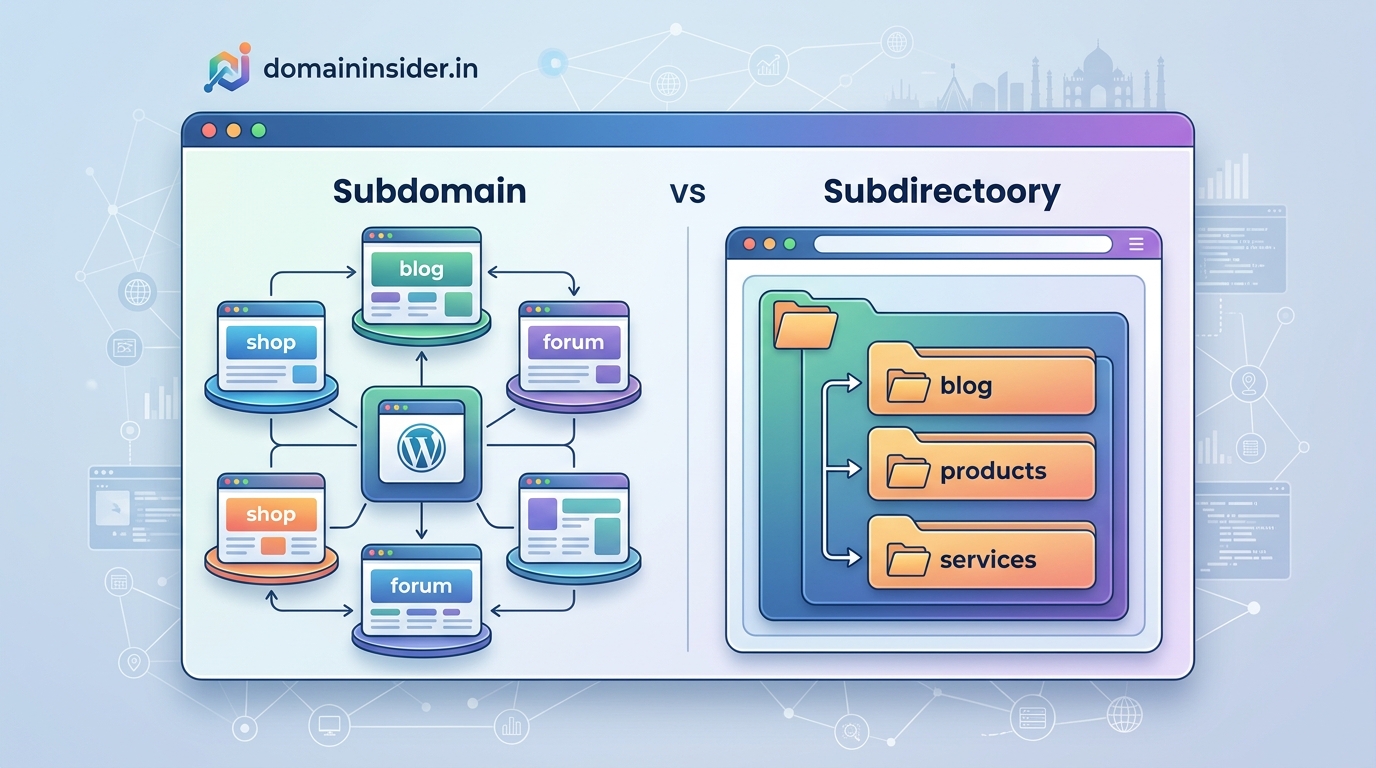
Choosing between a subdomain and a subdirectory can feel like picking between two roads that look almost identical. Both get you where you need to go, but the journey and destination differ in subtle yet significant ways. Your decision affects how search engines view your content, how users navigate your site, and how much control you have over your web presence.
Subdirectories (example.com/blog) keep all SEO authority under one roof and work best for most websites. Subdomains (blog.example.com) act as separate entities, ideal for distinct platforms or international sites. Your choice depends on whether you want unified authority or independent sections. Most businesses benefit from subdirectories unless they need technical separation or brand distinction.
Understanding the basic structure
A subdirectory lives inside your main domain like a folder on your computer. Think of example.com/shop or example.com/resources. Everything stays under the same roof.
A subdomain sits beside your main domain as a separate address. Picture blog.example.com or shop.example.com. Search engines often treat these as distinct properties.
The technical difference matters less than the practical impact. When someone types [a domain name in your https://domaininsider.in/what-exactly-happens-when-you-type-a-domain-name-in-your-browser/), the DNS system processes both structures differently. Subdirectories inherit the main domain’s authority automatically. Subdomains start fresh in many ways.
Your hosting setup changes too. Subdirectories typically need no extra configuration. Subdomains often require separate DNS records and sometimes separate hosting accounts.
How search engines treat each option
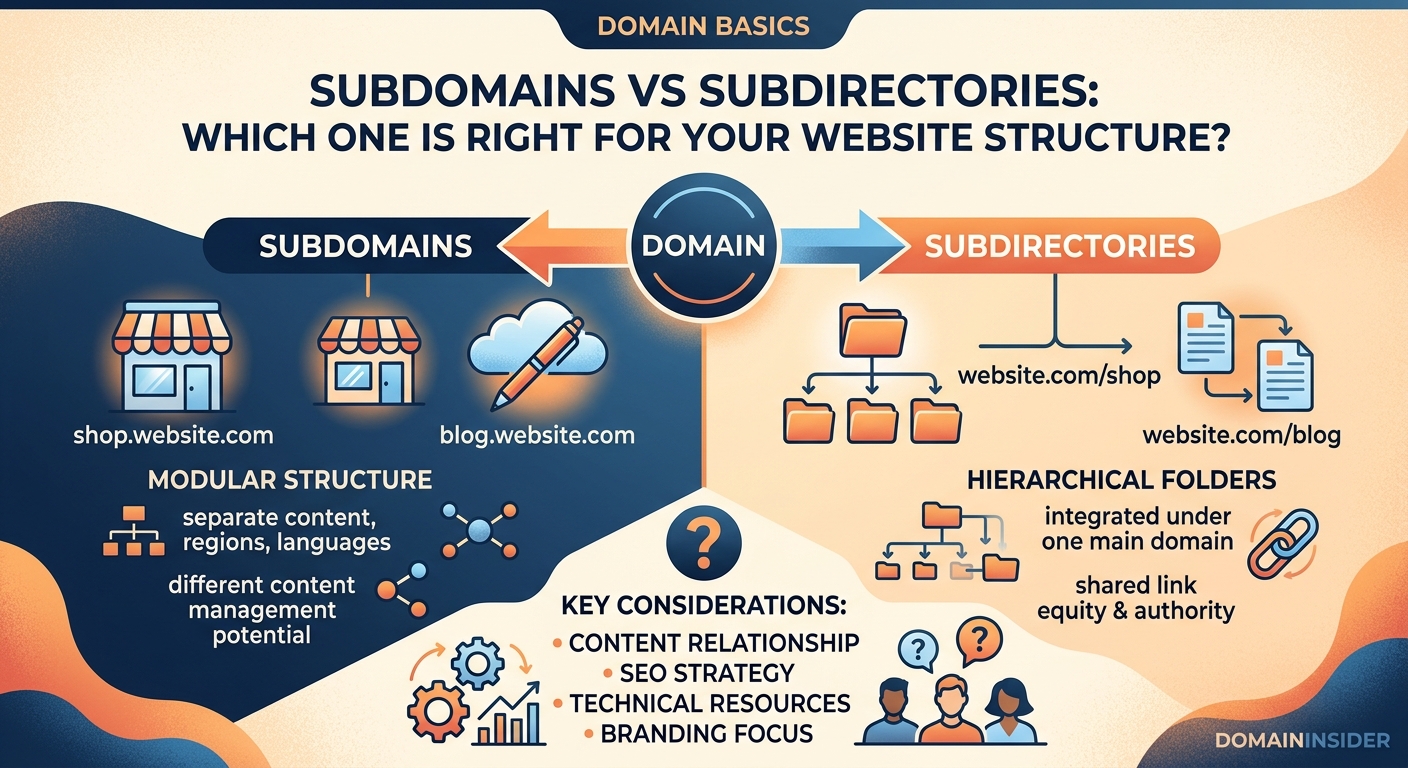
Google has stated that it can handle both structures well. But real world data tells a more nuanced story.
Subdirectories benefit from domain authority immediately. If your main site has strong backlinks and trust signals, every page in a subdirectory inherits that strength. Launch a new section at example.com/guides and it starts with your domain’s existing credibility.
Subdomains face a steeper climb. Search engines may view blog.example.com as a separate site from example.com. You essentially start building authority from scratch. Backlinks to your main domain do not automatically boost your subdomain.
This matters enormously for SEO professionals and site owners. Creating content on a subdirectory means each new page contributes to your overall domain strength. Creating content on a subdomain splits your efforts across multiple properties.
“Most websites should default to subdirectories unless they have a specific reason to separate content. The SEO benefits of unified authority outweigh the flexibility of subdomains in 90% of cases.”
When subdirectories make perfect sense
Use subdirectories when you want everything under one umbrella. Most blogs, resource centres, product pages, and service sections belong here.
Your company blog fits naturally at example.com/blog. Your knowledge base works well at example.com/help. Your online shop thrives at example.com/shop.
Here are the main advantages:
- Simplified SEO management with one property to track
- Automatic authority transfer to new content
- Easier analytics setup and reporting
- Lower maintenance overhead
- Unified brand presence across all pages
- Single SSL certificate covers everything
- Consolidated link building efforts
Small businesses and startups especially benefit from subdirectories. You have limited resources and need every piece of content working together. Splitting authority across subdomains wastes potential.
When subdomains actually work better
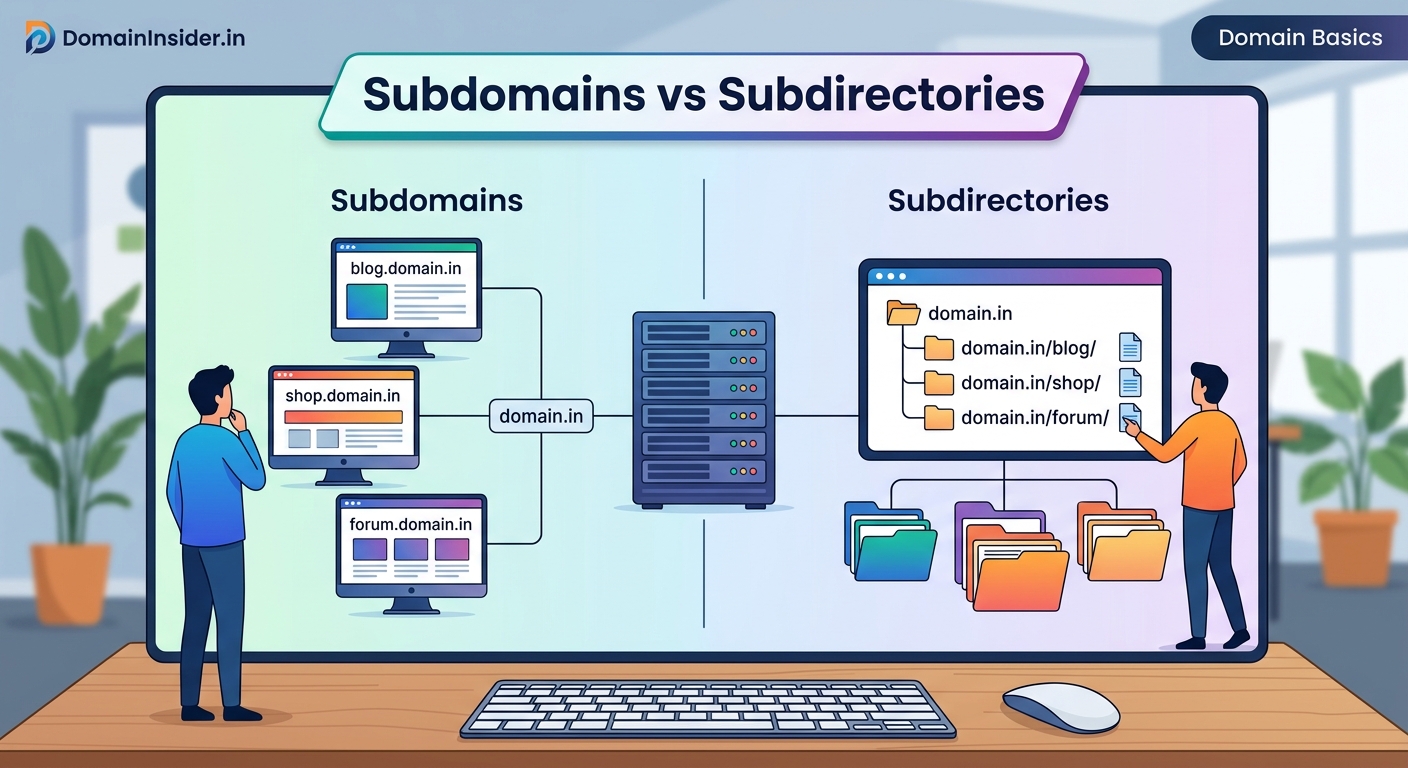
Subdomains shine in specific scenarios where separation provides value.
Running a platform that serves user generated content? Subdomains let you give each user their own space like username.yourplatform.com. This approach works for portfolio sites, community platforms, and SaaS applications.
Operating in multiple countries with distinct content? Regional subdomains like in.example.com or uk.example.com make geographical targeting clearer. Search engines can associate each subdomain with a specific location more easily.
Managing completely different products or services? A subdomain creates clear separation. Think of how Google uses mail.google.com for Gmail and drive.google.com for Drive. Each product stands alone.
Technical requirements sometimes demand subdomains. Running different applications on different servers becomes easier. Your main WordPress site stays at example.com while your custom app runs at app.example.com on a separate infrastructure.
Comparing the practical implications
| Aspect | Subdirectory | Subdomain |
|---|---|---|
| SEO authority | Inherits from main domain | Builds independently |
| Setup complexity | Simple, no DNS changes | Requires DNS configuration |
| SSL certificates | One certificate covers all | May need separate certificates |
| Analytics tracking | Single property tracking | Multiple properties or filters |
| Brand perception | Unified experience | Distinct sections |
| Hosting requirements | Same server and setup | Can use different servers |
| Migration difficulty | Easy to restructure | Complex to merge later |
The migration row deserves attention. Moving from subdirectories to subdomains causes minimal disruption. Moving from subdomains to subdirectories requires careful redirects and often loses some SEO value during transition. Start with the structure you plan to keep.
Making your decision in three steps
-
Assess your content relationship: Does your new section relate directly to your main site’s purpose? Use a subdirectory. Is it a completely separate product or platform? Consider a subdomain.
-
Evaluate your resources: Can you dedicate time to building authority for a separate property? Do you have the technical expertise to manage multiple DNS records and hosting configurations? Limited resources point toward subdirectories.
-
Project five years ahead: Will you want this content contributing to your main domain’s authority? Will you potentially sell this section separately? Will you need to run it on different infrastructure? Your long term vision guides the choice.
Most website owners overthink this decision. The default answer for blogs, resources, shops, and standard content sections is almost always subdirectories.
Common mistakes that hurt performance
Website owners make predictable errors when structuring their sites.
Splitting content unnecessarily: Creating blog.example.com when example.com/blog works better fragments your authority. Every backlink to your blog could strengthen your entire domain instead.
Inconsistent structure: Using both subdomains and subdirectories randomly confuses users and search engines. Pick one approach and stick with it unless you have a compelling reason to mix.
Ignoring redirect implications: Changing from one structure to another requires proper 301 redirects. Missing these loses traffic and rankings. Many site owners underestimate the technical work involved.
Forgetting about SSL: Each subdomain typically needs its own SSL certificate unless you use a wildcard certificate. This adds cost and complexity that subdirectories avoid.
Overlooking analytics setup: Tracking subdomains as separate properties in Google Analytics fragments your data. You lose the ability to see your complete user journey easily.
Real scenarios from Indian businesses
A Mumbai based startup launched their blog at blog.company.com instead of company.com/blog. Six months later, they noticed their blog posts ranked poorly despite good content. Their main domain had decent authority, but the subdomain started from zero. Migration to a subdirectory took three months and required redirecting hundreds of URLs.
A Delhi ecommerce brand chose shop.brand.com for their online store. This made sense because they ran the shop on Shopify while their main site used WordPress. The technical separation justified the subdomain approach. They treated each property distinctly in their marketing.
A Bangalore SaaS company used subdirectories for everything initially. As they grew, they moved their application to app.company.com. This let them scale the app infrastructure independently while keeping marketing content on the main domain. The split served a clear technical purpose.
These examples show that context matters more than blanket rules. Understanding why .in domains work well for Indian businesses helps, but structure decisions depend on your specific situation.
Technical considerations for developers
Developers need to think about implementation beyond just SEO.
Subdirectories require consistent technology across your site. If your main site runs on WordPress, your blog typically does too. This simplifies updates and security but limits flexibility.
Subdomains allow technology diversity. Run your marketing site on a static generator, your blog on WordPress, and your app on Node.js. Each subdomain operates independently.
Cookie handling differs between structures. Cookies set on example.com work across all subdirectories automatically. Cookies on blog.example.com do not transfer to shop.example.com without explicit configuration. This affects user sessions and tracking.
CDN configuration becomes simpler with subdirectories. One CDN setup covers your entire site. Subdomains might need separate CDN configurations depending on your provider.
Version control and deployment pipelines benefit from subdirectories when you want unified releases. Subdomains let you deploy different sections independently, which helps large teams working on distinct products.
The authority consolidation advantage
Think of domain authority like reputation in your neighbourhood. When you build a subdirectory, every improvement strengthens your main address. Positive signals accumulate in one place.
Subdomains split this reputation. Your main domain might have excellent standing, but your subdomain starts as an unknown quantity. Building two separate reputations takes twice the effort.
This matters tremendously for newer websites. You already face an uphill battle establishing credibility. Fragmenting your efforts across subdomains makes that battle harder.
Established sites with strong authority have more flexibility. If your main domain already ranks well and attracts consistent traffic, a subdomain can survive on its own more easily. But even then, you sacrifice the compounding benefits of unified authority.
Link building illustrates this clearly. Every backlink to example.com/guide strengthens example.com overall. A backlink to guide.example.com helps only that subdomain. Your outreach efforts yield better returns when they benefit your entire property.
Managing multiple languages and regions
International sites present unique challenges where subdomains sometimes make sense.
Using in.example.com for Indian content and uk.example.com for British content creates clear geographical signals. Search engines can target each subdomain to its intended region more precisely.
However, subdirectories with language codes work well too. Try example.com/in/ or example.com/en-gb/. Google explicitly supports this structure and many international sites use it successfully.
The subdirectory approach keeps all your authority unified while still providing regional targeting. You can set geographical targets in Google Search Console for specific subdirectories.
Subdomains make more sense when regional operations function independently. If your Indian team manages completely separate content and infrastructure from your UK team, subdomains provide natural separation.
Content overlap between regions favours subdirectories. If 70% of your content applies globally with only 30% localized, subdirectories prevent authority fragmentation while allowing regional customization.
Migration paths and flexibility
Starting with subdirectories gives you more options later. You can always split content into subdomains if needed. The reverse migration proves much harder.
Moving from example.com/blog to blog.example.com requires:
- Setting up new hosting or DNS records
- Migrating all content to the new location
- Implementing 301 redirects for every URL
- Updating internal links across your site
- Changing sitemap submissions
- Modifying analytics tracking
- Updating social media references
- Informing search engines of the change
This process takes weeks or months depending on your site size. You typically lose some SEO value during transition, even with perfect redirects.
Going from blog.example.com to example.com/blog involves similar steps but often causes more ranking disruption. Search engines must reassess your content’s relationship to the main domain.
Starting with the right structure saves this headache. Most sites never need to migrate if they choose wisely upfront.
What site structure means for your growth
Your URL structure affects more than just SEO. It shapes how users perceive your brand and how easily you can expand.
Subdirectories create a cohesive brand experience. Users see example.com in their address bar regardless of which section they visit. This builds trust and reinforces your brand identity.
Subdomains can create confusion. Users might not realize blog.example.com and shop.example.com belong to the same company. This matters less for large brands but hurts smaller businesses trying to establish recognition.
Adding new sections becomes trivial with subdirectories. Launch example.com/podcast or example.com/courses without any technical setup. Just create the pages.
Subdomains require configuration each time. You need new DNS records, potentially new hosting, separate SSL certificates, and additional tracking setup. This overhead slows expansion.
For businesses planning to build a profitable domain portfolio, understanding these structural choices helps evaluate potential acquisitions. A site built on subdirectories typically holds more consolidated value than one split across subdomains.
Your path forward
Most websites should use subdirectories as the default choice. The SEO benefits, simplified management, and unified authority make this the smart option for blogs, resources, shops, and standard content sections.
Choose subdomains only when you have specific needs: separate platforms, distinct technical requirements, user generated content with custom addresses, or completely independent products that benefit from brand separation.
Your decision shapes your site’s future. Take time to consider your long term plans, available resources, and content strategy. The structure you pick today affects your growth trajectory for years to come.
Start with subdirectories unless you have a compelling reason to do otherwise. You can always split content later if needed, but you cannot easily merge subdomains without cost. Make the choice that keeps your options open and your authority unified.
