
Buying your first domain name feels exciting.
You’re finally taking that big step to launch your website, start your business, or build your personal brand. But here’s the thing: one wrong move during domain selection can haunt you for years. You might end up with a name that’s hard to remember, impossible to spell, or worse, legally problematic. The good news? Most of these mistakes are completely avoidable once you know what to watch out for.
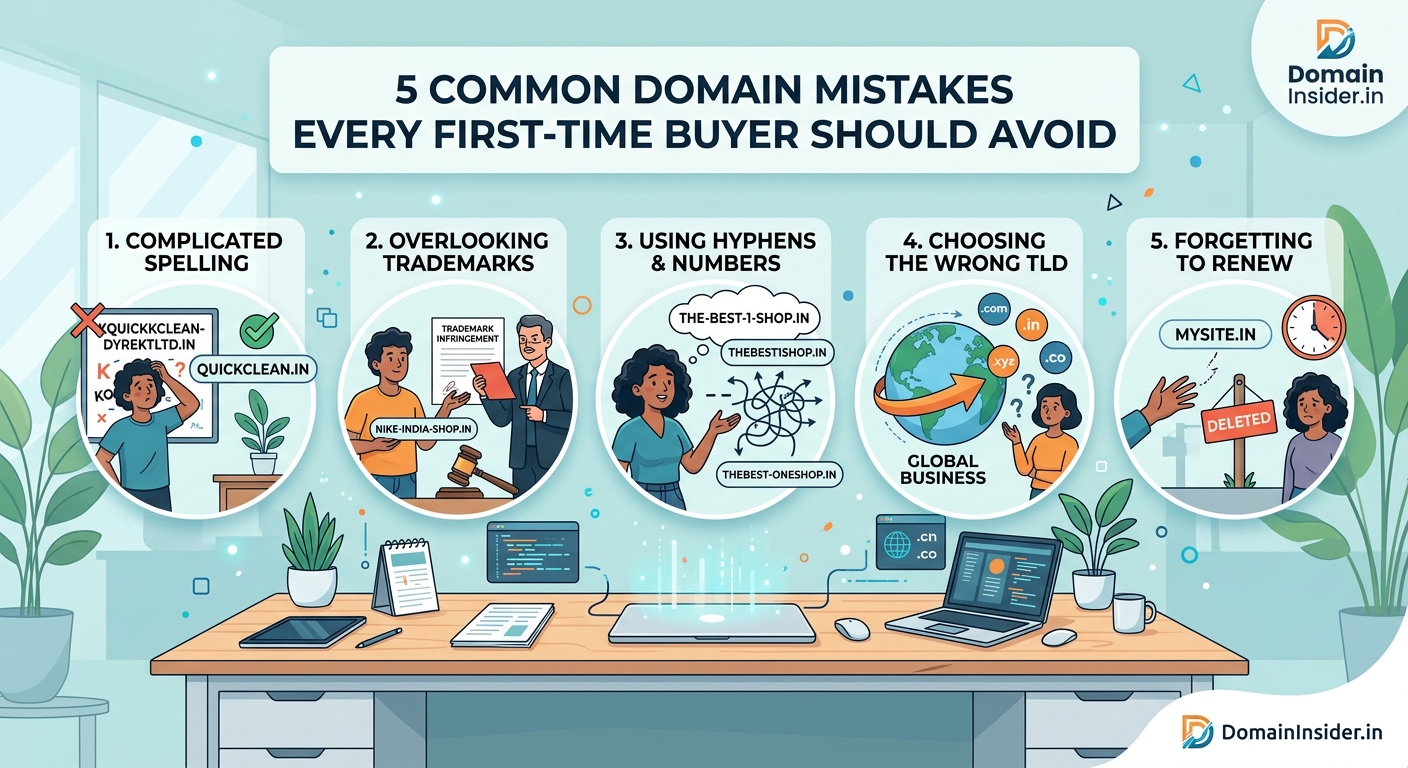
First-time domain buyers often make five critical mistakes: choosing overly complex names, ignoring trademark issues, selecting the wrong extension, skipping renewal settings, and buying from untrustworthy registrars. Avoiding these pitfalls saves you money, protects your brand, and ensures your domain works for your business goals from day one.
Choosing a name that’s too long or complicated
Your domain name is your digital address.
If people can’t remember it or spell it correctly, they won’t find you. Yet many first-time buyers fall in love with elaborate names that sound impressive but fail in practice.
Consider this: when someone hears your domain name at a networking event or on a podcast, can they type it correctly on their first try? If your answer involves explaining the spelling or repeating it multiple times, you’ve got a problem.
Here are the most common complexity mistakes:
- Using numbers that could be confused with words (4 vs four)
- Adding hyphens that people forget when typing
- Including multiple words without clear separation
- Mixing different languages or slang terms
- Creating names longer than 15 characters
A domain like “bestqualityhomemadeorganicsoaps.com” might describe your business perfectly, but it’s a nightmare to type and remember. Compare that to “soapcraft.in” or “puresoaps.in”. The shorter versions are memorable, easy to spell, and professional.
The two-second rule works well here. If someone can’t remember and type your domain name within two seconds of hearing it, simplify it.
Think about how understanding what happens when you type a domain name in your browser can help you appreciate why simplicity matters. Every extra character is another chance for a typo.
Ignoring trademark and copyright issues
This mistake can cost you everything.
Imagine spending months building your website, creating content, and promoting your brand. Then you receive a legal notice demanding you transfer the domain because it infringes on someone’s trademark. You lose the domain, the traffic, and potentially face legal fees.
It happens more often than you’d think.
Many first-time buyers assume that if a domain is available for purchase, it’s legally safe to use. That’s not true. Domain availability and trademark clearance are two completely different things.
Before you buy any domain, follow these steps:
- Search the trademark database for your country (in India, check the IP India website)
- Run a Google search for the exact phrase to see if established businesses are using it
- Check social media platforms to see if the name is already claimed
- Look for similar spellings or variations that might cause confusion
- Consider consulting a trademark attorney if you’re planning a serious business
Here’s a real example: buying “amazonshopping.in” might seem clever, but Amazon’s legal team will come after you faster than you can say “cease and desist”. Even variations like “amazone” or “amazin” could land you in trouble.
Always remember: trademark rights trump domain ownership. The person who owns the trademark can force you to give up the domain, regardless of when you bought it or how much you paid.
The cost of a trademark search is minimal compared to the cost of rebranding after a legal dispute.
Selecting the wrong domain extension
The domain extension (also called a TLD or top-level domain) matters more than most beginners realize.
Your extension affects credibility, search rankings, and user trust. Yet many first-time buyers simply grab whatever’s available without thinking through the implications.
Let’s break down the most common extensions and when to use them:
| Extension | Best For | Avoid If |
|---|---|---|
| .com | International businesses, general websites | You’re specifically targeting India only |
| .in | Indian businesses, local services | You plan to expand globally soon |
| .co.in | Indian companies, established businesses | You want a shorter, simpler domain |
| .org | Non-profits, community organizations | You’re running a commercial business |
| .net | Tech companies, network services | You’re in retail or services |
| .info | Informational sites, blogs | You want maximum credibility |
The .com extension still carries the most credibility worldwide. People type it automatically. If your .com is taken but .net is available, think twice. Users will likely type the .com version out of habit and land on someone else’s website.
For Indian businesses, choosing between .co.in or .in domain requires careful thought about your target audience and business goals.
Avoid trendy or obscure extensions like .xyz, .club, or .guru unless you have a specific branding reason. They might be cheaper, but they often look unprofessional and raise trust issues among visitors.
Here’s a practical test: Tell someone your domain name with the extension. If they look confused or ask you to repeat the extension, it’s probably not the right choice.
Some extensions also come with restrictions. For example, .edu is reserved for educational institutions, and .gov is for government entities. Make sure you’re eligible for any restricted extension before you try to register it.
Forgetting about renewal settings and auto-renewal
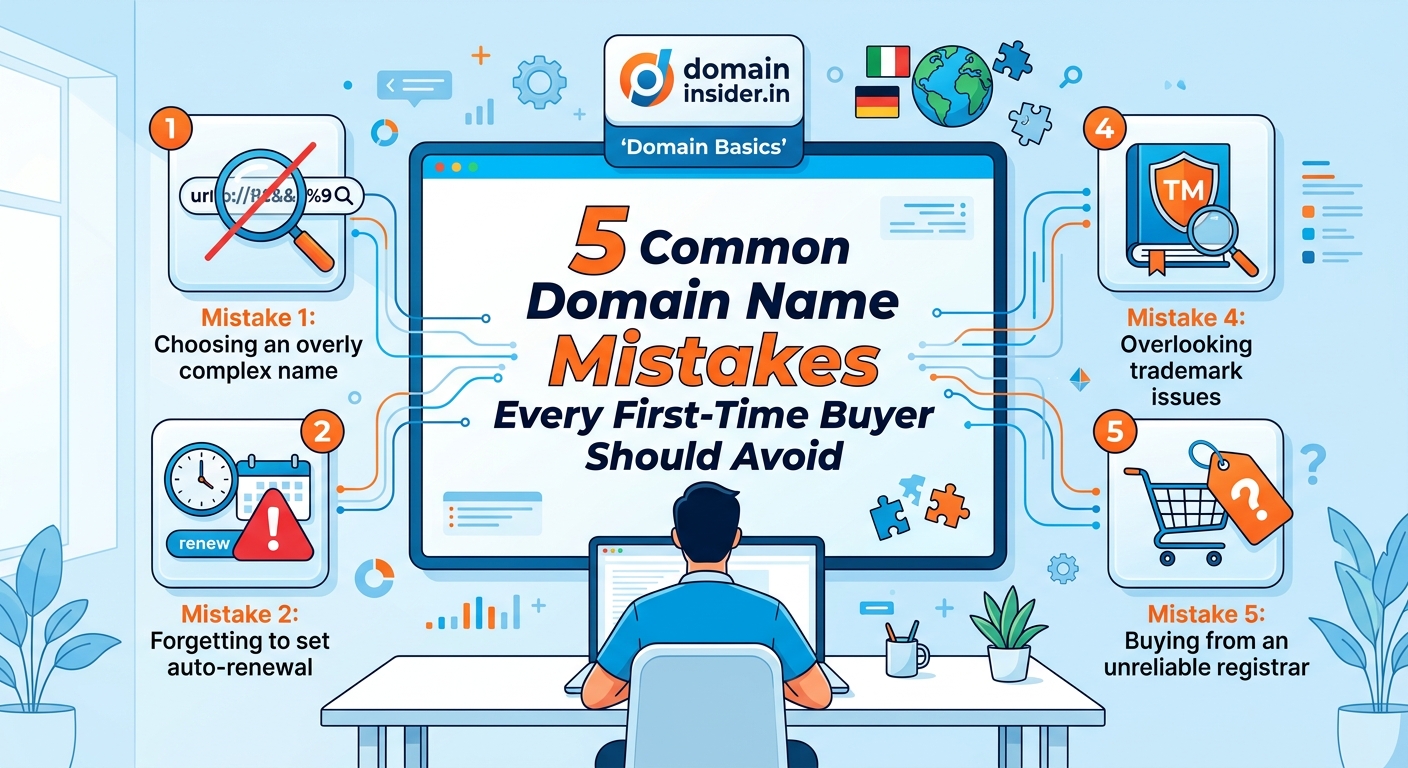
Losing your domain because you forgot to renew it ranks among the most frustrating mistakes.
It’s also completely preventable.
When you register a domain, you’re not buying it forever. You’re essentially renting it for a specific period, usually one year. If you don’t renew before it expires, you lose it. And once it expires, domain squatters often grab it immediately, hoping to sell it back to you at an inflated price.
I’ve seen business owners lose domains they’d been using for five years because they changed email addresses and missed the renewal notices. The domain got snatched up within hours of expiring, and they had to negotiate domain prices to get it back, paying ten times what they originally paid.
Here’s how to protect yourself:
Set up auto-renewal immediately. Every reputable registrar offers this feature. Enable it as soon as you complete your purchase.
Use a dedicated email address for domain management. Don’t use your work email if you might change jobs. Don’t use a free email account that you rarely check. Create a specific email just for domain-related notifications.
Register for multiple years upfront. Most registrars offer discounts for multi-year registrations. Buying three to five years at once gives you breathing room and often saves money.
Set calendar reminders. Even with auto-renewal enabled, set manual reminders 60 days before expiration. This gives you time to verify your payment method is still valid.
Keep your payment information current. If your credit card expires or you change banks, update your registrar account immediately.
Some registrars also offer a grace period and a redemption period after expiration. But these come with extra fees, and there’s no guarantee you’ll recover the domain. Prevention is always better than scrambling to fix the problem later.
Buying from untrustworthy or expensive registrars
Not all domain registrars are created equal.
Some charge reasonable prices and provide excellent service. Others load up your purchase with hidden fees, make it nearly impossible to transfer your domain later, or provide terrible customer support when you need help.
First-time buyers often choose a registrar based on whoever shows up first in search results or offers the lowest advertised price. But that initial low price often hides expensive renewal rates, mandatory add-ons, or poor security features.
Here’s what separates good registrars from bad ones:
Transparent pricing: The renewal price should be clearly stated upfront. Be wary of registrars offering ₹99 first-year domains that jump to ₹1,500 at renewal.
Easy domain transfers: You should be able to transfer your domain to another registrar without excessive fees or artificial delays. Some shady registrars make transfers deliberately difficult to lock you in.
Included privacy protection: Your domain registration includes your contact information in the public WHOIS database. Good registrars include privacy protection (also called WHOIS protection) for free. Bad ones charge extra for this essential security feature.
Reliable customer support: When something goes wrong with your domain, you need help fast. Look for registrars with multiple support channels (email, chat, phone) and good response times.
Security features: Two-factor authentication, domain locking, and security alerts should be standard features, not premium add-ons.
Before choosing a registrar, read recent reviews from actual customers. Check how they handle disputes. Look for complaints about billing practices or transfer difficulties.
Also consider where you’ll host your website. Some people prefer keeping domains and hosting with the same company for convenience. Others prefer separating them for security and flexibility. Neither approach is wrong, but think through your preference before buying.
If you’re planning to build a domain portfolio or eventually sell your domain, choosing a reputable registrar becomes even more critical. Transfer complications can kill deals and frustrate potential buyers.
Additional mistakes that catch first-time buyers
Beyond the five major mistakes above, several smaller issues trip up newcomers.
Buying too many variations: You don’t need to buy every possible spelling variation, plural version, and extension of your domain. Focus on your primary domain and perhaps one or two strategic variations. Buying 15 versions of the same name wastes money without providing real protection.
Neglecting to check domain history: If you’re buying a previously owned domain, check its history. It might have been used for spam, adult content, or other activities that got it blacklisted by search engines. Tools exist to check domain history before you buy.
Choosing based solely on SEO: Some buyers pick domains stuffed with keywords thinking it helps search rankings. While keywords in domains can help slightly, user experience and brand memorability matter more. “mumbai-best-plumber-services-cheap.in” is worse than “reliableplumbing.in” in every way that counts.
Skipping the mobile test: Type your potential domain name on a smartphone keyboard. Some names that look fine on desktop are nightmares on mobile, especially if they require switching between letters and numbers or use uncommon characters.
Ignoring cultural and language considerations: A domain that sounds great in English might have unfortunate meanings in other languages. If you plan to operate internationally or in multilingual markets, check your domain name across relevant languages.
Understanding why .in domains are becoming popular can help you make smarter choices about extensions and positioning.
Making your domain purchase count
Getting your domain name right from the start saves you headaches, money, and missed opportunities.
Take your time with this decision. A domain is one of the few elements of your online presence that’s difficult and expensive to change later. Everything from your business cards to your social media profiles to your email addresses will include this domain.
Before you click that purchase button, run through this mental checklist: Can people spell it after hearing it once? Is it trademark-clear? Does the extension make sense for your goals? Have you enabled auto-renewal? Is the registrar trustworthy?
If you can answer yes to all those questions, you’re ready to move forward with confidence. Your domain will serve as a solid foundation for everything you build online. And you’ll avoid the costly mistakes that plague so many first-time buyers.
Remember, checking your domain name value becomes easier when you start with a quality domain that avoids these common pitfalls. Make the smart choice now, and your future self will thank you.
