
Selling a domain name is part art, part science. Price it too high, and it sits on the marketplace for months. Price it too low, and you leave thousands of rupees on the table. The sweet spot exists, and finding it requires understanding market data, buyer psychology, and timing.
Pricing domains for faster sales requires balancing three factors: objective valuation using tools and comparables, strategic positioning 10 to 20 percent below market peaks, and flexible pricing tiers that encourage buyer action. Data-driven pricing beats guesswork every time, helping you move inventory while capturing fair value from motivated buyers.
Understanding what drives domain value
Before slapping a price tag on your domain, you need to know what makes one domain worth ₹5,000 and another worth ₹5 lakh.
Length matters tremendously. Short domains command premium prices. A three-letter .com will always outperform a 15-character alternative. Each additional character reduces perceived value.
Extension plays a massive role. A .com domain typically sells for 3 to 5 times more than the same name with a .net or .info extension. For Indian buyers, .in and .co.in domains carry strong local appeal and often sell faster within the domestic market.
Keyword relevance drives buyer interest. Domains containing high-value search terms in industries like finance, healthcare, or technology attract more inquiries. Generic terms like “insurance” or “loans” have universal appeal.
Brandability affects pricing too. Made-up words that sound professional (think Spotify or Zillow) can command surprising prices if they’re memorable and easy to pronounce.
Traffic and backlinks add tangible value. If your domain receives organic visitors or has quality backlinks pointing to it, you can justify a higher asking price. These assets provide immediate SEO benefit to buyers.
Using valuation tools as your starting point
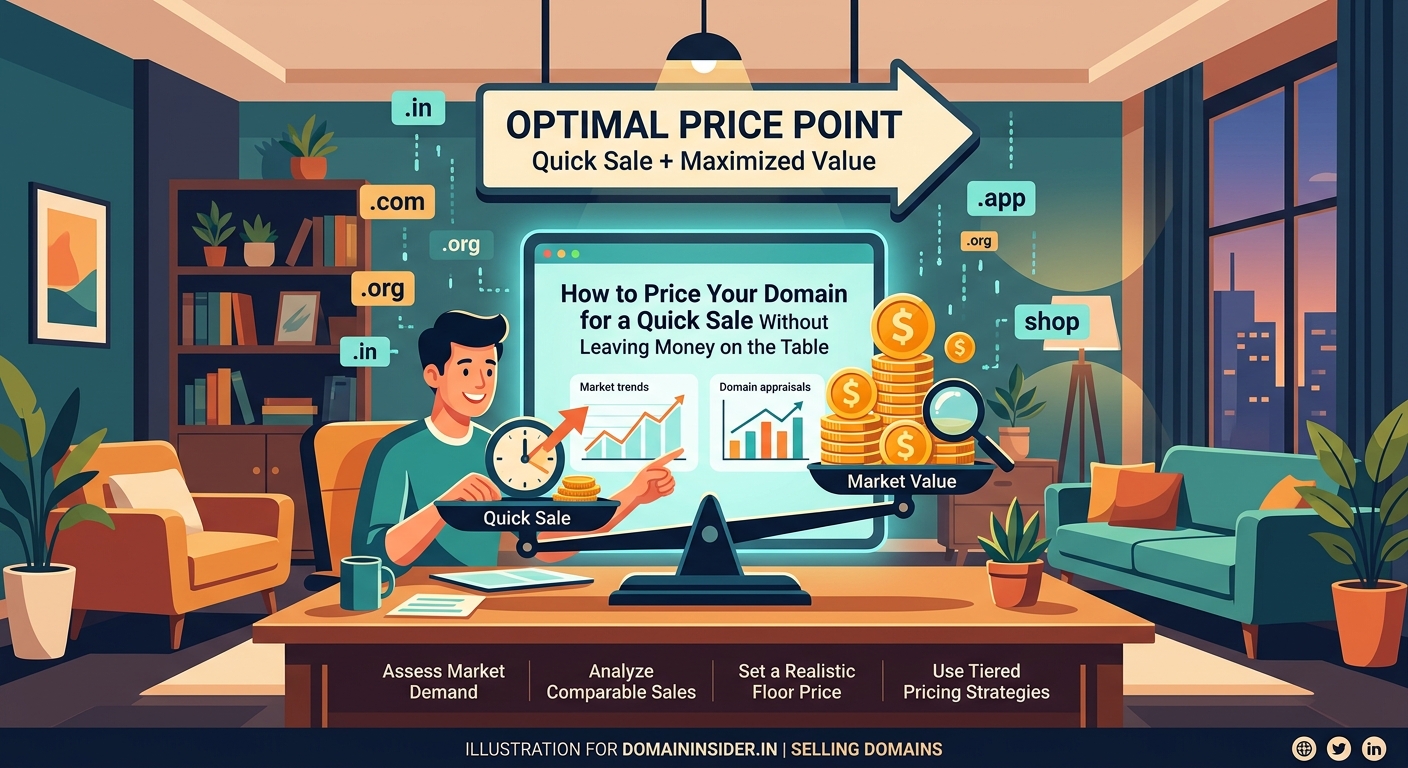
Automated valuation tools provide a baseline, though they’re not perfect.
Start by running your domain through multiple free valuation tools. Each algorithm weighs factors differently, giving you a range rather than a single number.
GoDaddy’s appraisal tool considers length, extension, and keyword data. Estibot provides detailed breakdowns including comparable sales. NameBio offers historical sales data for similar domains.
Take the average of three to five tools. This gives you a rough market estimate.
But here’s the truth: these tools often overvalue or undervalue domains. They can’t account for current market trends, buyer urgency, or niche-specific demand.
Use automated valuations as a starting point, not gospel. Real market data matters more.
Researching comparable sales
Comparable sales (comps) give you real-world pricing data.
Visit marketplaces like Sedo, Flippa, and NameBio. Search for domains similar to yours in length, extension, and keyword type.
Filter by recent sales (last 6 to 12 months). Older data doesn’t reflect current market conditions.
Look for patterns:
– What did three-word .com domains in your niche sell for?
– How much did .in domains with similar traffic sell for?
– What price range do brandable names in your character count achieve?
Create a spreadsheet. List 10 to 15 comparable domains with their sale prices, dates, and key features.
Calculate the median sale price. This number is often more reliable than the average, as it isn’t skewed by outlier sales.
If comparable domains sold for ₹50,000 to ₹1.5 lakh, you know your pricing ballpark.
The strategic pricing formula
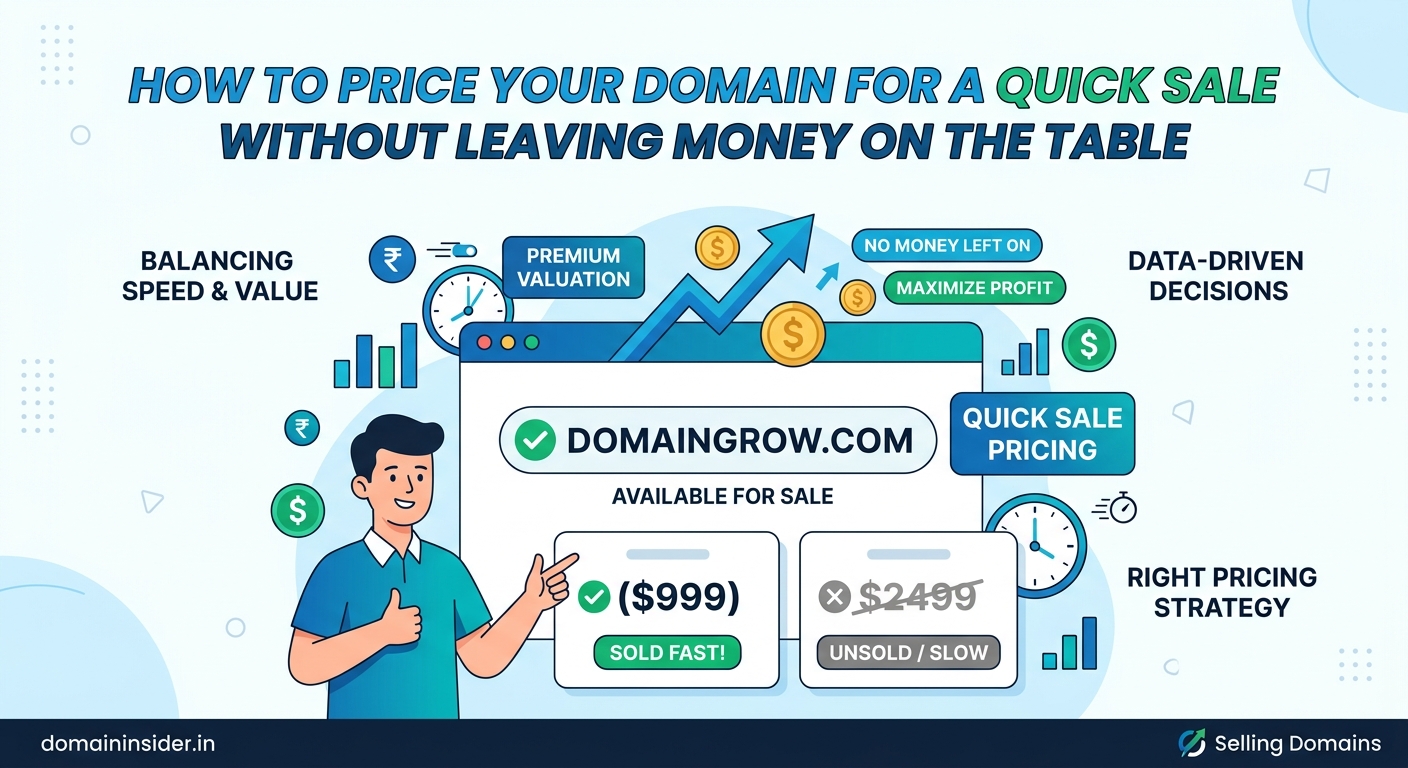
Now combine your data into a pricing strategy.
Here’s a proven approach:
- Take your automated valuation average
- Compare it against your comparable sales median
- Choose the lower of the two numbers as your baseline
- Add 10 to 20 percent if your domain has traffic, backlinks, or aged history
- Subtract 15 to 25 percent for a faster sale
That final number becomes your listing price.
Why subtract for speed? Buyers browse hundreds of domains. Pricing slightly below market expectations makes your listing stand out. It signals you’re a motivated seller, not someone hoping for a miracle offer.
This approach typically moves domains within 30 to 90 days rather than sitting for 6 to 12 months.
Creating pricing tiers
Smart sellers use tiered pricing to capture different buyer types.
Set three price points:
Buy Now Price: Your ideal sale price, positioned competitively based on your research. This should be 10 to 15 percent below what you think the domain is truly worth.
Make Offer Minimum: Set this at 60 to 70 percent of your Buy Now price. This filters out lowball offers while leaving room for negotiation.
Walk-Away Price: Know your absolute minimum privately. Never share this number, but be prepared to accept offers at this level if the buyer seems serious.
This structure gives buyers options. Some will pay your asking price immediately. Others will negotiate, but you’ve already built in acceptable margins.
| Pricing Strategy | Target Sale Speed | Risk Level | Best For |
|---|---|---|---|
| 20% below market | 30 to 60 days | Low | Investors needing cash flow |
| Market rate | 90 to 180 days | Medium | Quality domains with patience |
| 20% above market | 180+ days | High | Premium brandables only |
| Auction format | 7 to 14 days | Medium | Domains with clear demand |
Timing your listing
When you list matters almost as much as how you price.
List during business days, Tuesday through Thursday. Weekend listings get less initial traction.
Avoid major holiday periods. December sales slow dramatically as buyers focus elsewhere. The same applies during Diwali or other major festivals.
January and September see increased domain buying activity. New year budgets and business quarter planning drive purchases.
If you’re holding a premium domain, waiting for the right market conditions can mean thousands in additional profit. But for average domains, listing immediately beats waiting for perfect timing.
Adjusting prices based on market feedback
Your initial price isn’t permanent.
Track these metrics:
– Views on your listing
– Number of inquiries or offers
– Time since listing
If you’re getting views but no offers after 30 days, your price is likely too high. Drop it by 10 to 15 percent.
If you’re getting multiple lowball offers (30 to 40 percent of asking), buyers see value but think you’re overpriced. Reduce by 10 percent and emphasize your domain’s strengths in the description.
If you’re getting no views, your domain might be listed on the wrong marketplace or your keywords aren’t optimized. Relist with better tags and descriptions before adjusting price.
“The best domain price is one that attracts serious buyers within 60 days. If you’re not seeing quality inquiries by then, the market is telling you something. Listen to it.” – Domain investor with 15 years of sales experience
Platform-specific pricing strategies
Different marketplaces attract different buyer types.
Sedo attracts professional domain investors and businesses. You can price 10 to 15 percent higher here because buyers expect premium inventory.
Flippa draws website buyers and entrepreneurs. Bundle your domain with basic content or social accounts to justify higher prices.
GoDaddy Auctions work well for mid-range domains. Set reasonable reserves and let bidding competition drive the final price.
Afternic provides broad exposure through registrar networks. Price competitively here since your domain appears alongside thousands of alternatives.
Direct outreach to potential end users allows premium pricing. A business that desperately wants your exact domain name will pay 2 to 5 times marketplace rates.
Consider listing on multiple platforms with consistent pricing. More visibility typically means faster sales.
Common pricing mistakes that kill sales
Avoid these errors:
Emotional pricing: Your domain isn’t worth more because you thought of a brilliant business idea for it. Buyers pay for actual value, not your dreams.
Ignoring extension reality: Your .net isn’t worth the same as the .com version. Accept that truth and price accordingly.
Anchoring too high: Starting at ₹10 lakh and dropping to ₹1 lakh over months makes buyers suspicious. They wonder what’s wrong with the domain.
Round number syndrome: Pricing at exactly ₹1,00,000 looks arbitrary. ₹87,500 feels researched and negotiable.
Refusing all offers: If every buyer is offering 40 to 50 percent of your asking price, your asking price is wrong. Adjust it.
Hiding pricing: “Make offer” with no guidance frustrates buyers. Give them a number to react to.
The psychology of domain pricing
Understanding buyer psychology helps you price effectively.
Buyers anchor to the first number they see. Make sure your listing price is reasonable because even if they negotiate down, they’re negotiating from your starting point.
Odd numbers feel more precise. ₹73,000 suggests calculation, while ₹75,000 feels like a guess.
Buyers want deals, not steals. Pricing too low makes them suspicious about trademark issues, traffic quality, or hidden problems.
Creating urgency helps. Mention if you’re considering other offers or have a timeline for accepting bids. But never lie about this.
Transparency builds trust. If your domain has existing traffic, show stats. If it has backlinks, mention the count. Data justifies pricing.
Factoring in your costs and timeline
Your situation affects pricing decisions.
Calculate your total investment:
– Original purchase price
– Renewal fees paid
– Marketplace listing fees
– Time invested in development or marketing
Add 20 to 30 percent profit margin to your costs. That’s your minimum acceptable price.
But also consider opportunity cost. If your ₹50,000 domain has sat for two years, you’ve lost potential returns from investing that money elsewhere. Sometimes accepting a smaller profit to free up capital makes financial sense.
Your urgency matters. Need cash for building a larger portfolio? Price aggressively. Can you wait for the right buyer? Price for maximum profit.
Testing price points
If you’re unsure about pricing, test different approaches.
List similar domains at different price points. See which gets more interest.
Start higher for the first 30 days. You can always reduce, but increasing price after listing looks desperate.
Use auction formats for price discovery. Set a reasonable reserve and let the market determine value.
Monitor which price points generate the most serious inquiries. Adjust your other listings accordingly.
Special considerations for premium domains
If you’re holding a truly premium domain (short, generic, high-traffic), different rules apply.
Premium domains justify premium prices. Don’t discount heavily just for speed.
Target end users directly. A business that needs your exact domain will pay multiples of what an investor offers.
Consider broker assistance. Professional domain brokers have buyer networks and can often achieve 20 to 40 percent higher sales prices. Their commission (typically 10 to 20 percent) pays for itself.
Be patient with premium inventory. The right buyer might take 6 to 18 months to appear, but the wait often means tens of thousands in additional profit.
Learning from successful sales
Study successful domain flips to understand what works.
Domains that sell fastest typically:
– Are priced 15 to 20 percent below comparable sales
– Have clear, professional listings with benefits highlighted
– Appear on multiple marketplaces simultaneously
– Respond to inquiries within 24 hours
– Show flexibility during negotiations
Domains that sit unsold often:
– Are priced based on owner’s wishes rather than market data
– Have minimal or generic descriptions
– Appear only on one platform
– Have sellers who ignore offers or respond slowly
– Show no willingness to negotiate
Building pricing confidence
The more domains you sell, the better your pricing instincts become.
Start with lower-value domains. Practice your pricing strategy on ₹10,000 to ₹30,000 domains before tackling premium inventory.
Track every sale. Note your listing price, final sale price, time to sale, and number of offers received.
Adjust your formula based on results. If you consistently sell within two weeks, you might be pricing too low. If sales take four months, you’re probably pricing too high.
Join domain investor communities. Forums and groups share real-time market insights that help calibrate your pricing.
Pricing for the sale you want
Your pricing strategy should match your goals.
Need immediate cash? Price 20 to 25 percent below market and expect offers within weeks.
Building a reputation as a fair seller? Price at market rates and respond professionally to all inquiries.
Holding premium inventory? Price for value and wait for serious buyers.
Testing a new niche? Price one domain aggressively to gauge interest, then adjust pricing on similar domains.
There’s no single “right” price. The right price for you depends on your financial needs, timeline, and portfolio strategy.
Making pricing work for you
Pricing domains for faster sales isn’t about racing to the bottom. It’s about understanding market dynamics, positioning strategically, and responding to feedback.
Use data, not emotions. Research comparable sales. Test your pricing. Adjust based on market response.
The goal isn’t just selling fast. It’s selling at a price that respects your investment while attracting serious buyers. That balance exists, and with the right approach, you’ll find it consistently.
Start with one domain. Apply these principles. Track your results. Then scale what works across your portfolio. Your next sale might be closer than you think.
