
Two domains with identical keywords can sell for wildly different prices. One might fetch ₹5,000 while the other commands ₹5 lakh or more. The difference? Brand potential.
Most domain investors focus purely on metrics like search volume, exact match keywords, or extension popularity. They miss the invisible force that often drives the biggest sales: how easily a domain can become a memorable brand.
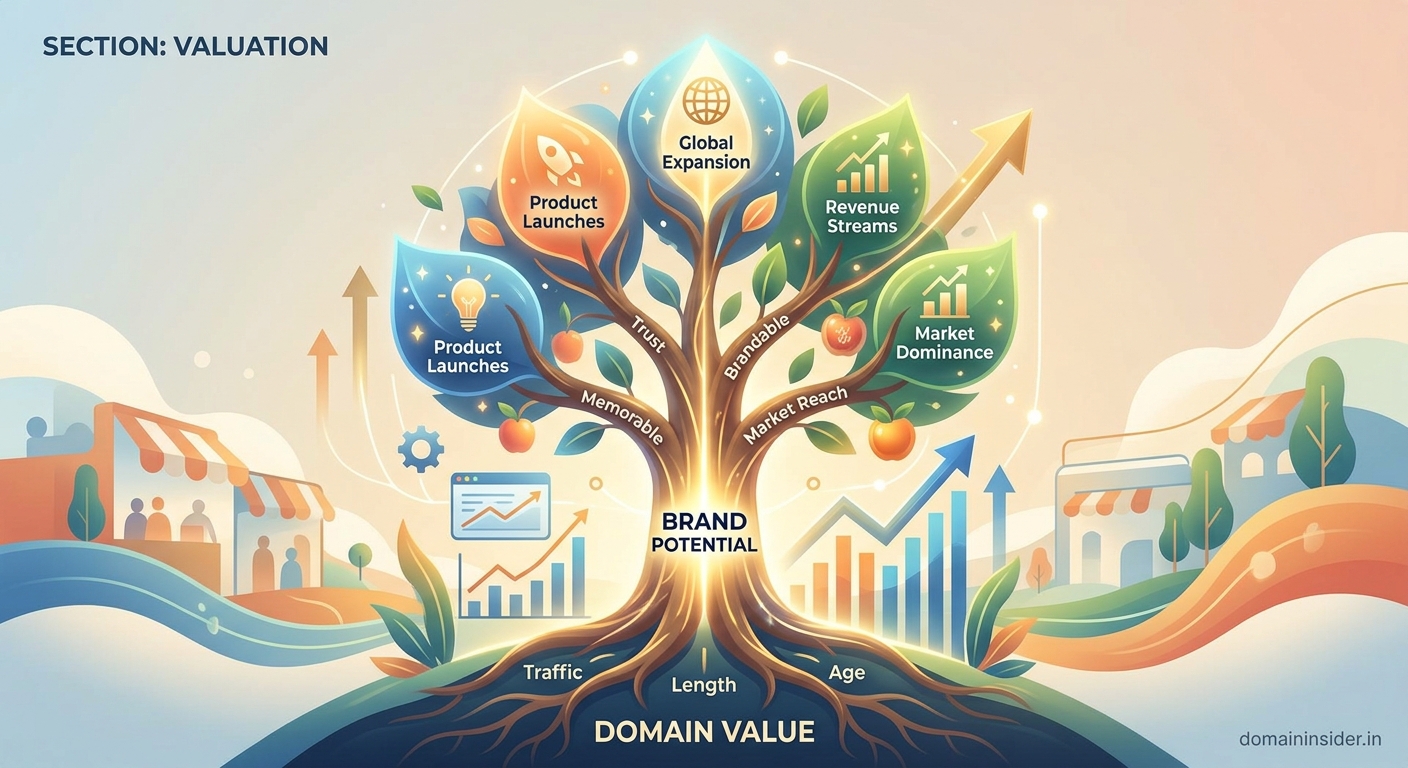
Brand potential dramatically impacts domain value beyond keyword metrics. Domains that are short, pronounceable, memorable, and emotionally resonant command premium prices because they reduce marketing costs and build customer trust faster. Understanding brandability helps investors identify undervalued domains and helps businesses justify higher acquisition budgets for names that will appreciate over time and strengthen market position.
What makes a domain brandable
Brandability isn’t about having a dictionary word or perfect SEO match. It’s about creating mental stickiness.
A brandable domain has several qualities working together. It sounds good when spoken aloud. People can spell it after hearing it once. It doesn’t confuse listeners with multiple possible spellings.
Consider “Flipkart” versus “OnlineShoppingIndia.com”. The first is shorter, unique, and memorable. The second describes exactly what it does but lacks personality. Flipkart became a household name partly because the domain itself worked as a brand asset.
Phonetic clarity matters enormously. Domains with ambiguous pronunciations create friction. If you need to spell out your domain every time someone asks about your business, you’re losing potential traffic and word-of-mouth referrals.
Visual appeal plays a role too. Some letter combinations just look cleaner than others. Repeated letters, awkward consonant clusters, or numbers mixed with letters all reduce brandability.
The premium pricing factors

Brandable domains command higher prices for measurable reasons.
Length and simplicity top the list. Single-word .com domains in English regularly sell for six or seven figures. Two-word combinations follow close behind. Three words or more? The price drops significantly unless there’s exceptional keyword value.
Memorability translates directly to marketing efficiency. A business using a memorable domain spends less on repeat advertising. Customers can find them again without searching. This long-term value justifies higher acquisition costs.
Versatility across industries increases buyer competition. A domain like “Swift.in” could work for logistics, software, finance, or dozens of other sectors. Generic brandable names attract more bidders than niche-specific alternatives.
Emotional resonance creates psychological value. Domains that evoke positive feelings or aspirational qualities sell better. “Zenith”, “Spark”, “Thrive” all carry emotional weight that pure keyword domains lack.
Here’s how different domain types typically compare:
| Domain Type | Average Value Range | Brand Potential | Best For |
|---|---|---|---|
| Single dictionary word | ₹2L – ₹50L+ | Excellent | Established businesses |
| Invented brandable | ₹50K – ₹10L | Very good | Startups, tech companies |
| Exact match keyword | ₹20K – ₹5L | Moderate | SEO-focused sites |
| Hyphenated keywords | ₹5K – ₹50K | Low | Budget projects |
| Long descriptive | ₹2K – ₹20K | Very low | Temporary use |
How investors spot brand potential
Successful domain investors use specific techniques to identify undervalued brandable names.
-
Test the radio rule: If you can’t easily communicate the domain over a phone call without spelling it out, it fails the brandability test. Say it aloud. Would someone remember it an hour later?
-
Check trademark databases: Domains similar to existing trademarks might face legal issues, but names in completely unused brandable space have clear runway. Search both Indian and international databases.
-
Assess pronunciation across languages: For Indian businesses, domains should work in both English and major regional languages. Avoid words that sound inappropriate or confusing when pronounced in Hindi, Tamil, or other languages.
-
Look for .in opportunities: While .com remains king globally, .in domains are becoming the first choice for Indian startups because they signal local presence and often cost less than their .com equivalents for the same brandable term.
-
Evaluate extension fit: Some brandable names work better with specific extensions. Tech startups might prefer .io, while traditional businesses stick with .com or .in. Extension choice affects perceived value.
The best brandable domains feel inevitable once you see them. They make you think “how was this still available?” That gut reaction often signals genuine brand potential worth paying for.
Real pricing differences in action
Let me show you concrete examples from recent Indian domain sales.
“PolicyBazaar.com” sold for an undisclosed premium amount, but the brand value it created is worth crores. Compare that to “InsuranceComparisonIndia.com” which might cost ₹20,000 but would never become a household name.
“Zomato.com” started as “Foodiebay.com” before the founders realized they needed a unique brandable name. The rebrand required buying a premium domain, but it enabled their growth into a multi-billion dollar company.
“Cred.in” works as both a short, memorable brand and a relevant term (credibility, credit). This dual function justifies premium pricing. A similar domain focused purely on keywords like “CreditCardRewards.in” would sell for a fraction of the price.
Investors who build profitable domain portfolios typically allocate 30-40% of their budget to brandable names rather than pure keyword plays. The returns often exceed keyword domains over time.
Measuring brand value objectively
You can’t rely purely on gut feeling when valuing brandable domains.
Several objective factors help quantify brand potential:
- Character count: Each additional character typically reduces value by 5-10%. Domains under 6 characters command exponential premiums.
- Global Alexa rank of similar brands: If successful companies use similar naming patterns, it validates the approach.
- Social media handle availability: A domain worth less if the matching Twitter, Instagram, and Facebook handles are taken.
- Google search results: Fewer existing results for the exact term means cleaner brand positioning.
Professional appraisers use these metrics alongside comparable sales data. Tools that check domain name value incorporate brandability scoring, though human judgment still matters for final pricing.
Common brandability mistakes
Even experienced investors make these errors when evaluating brand potential.
Overvaluing personal preferences: Just because you love a name doesn’t mean the market will. Test names with people outside your industry to get unbiased reactions.
Ignoring cultural context: A domain that sounds great in English might have unfortunate meanings in other languages. “Pett.in” might work for pet supplies in English-speaking markets but sounds odd in Hindi contexts.
Confusing creativity with confusion: Unusual spellings like “Lyft” or “Fiverr” work for venture-backed companies with massive marketing budgets. For smaller businesses, they create unnecessary friction.
Neglecting extension perception: A brandable name on .info or .biz will never achieve the same value as the .com version. Extension choice matters more for brandable domains than keyword domains.
Underestimating length impact: Adding even one word to make a domain “more descriptive” can cut brand value in half. “Spark.in” is worth far more than “SparkIdeas.in” despite the latter being more specific.
Strategic acquisition for businesses
If you’re buying a domain for your business rather than investment, brand value calculations change.
Calculate lifetime marketing savings. A memorable domain reduces customer acquisition costs every month. If a better domain saves you ₹10,000 monthly in advertising efficiency, it pays for itself in under two years even at a ₹2 lakh purchase price.
Consider competitive positioning. If your main competitor has a weak, forgettable domain, investing in a strong brandable name creates immediate differentiation. This advantage compounds over years.
Think about exit value. Businesses with strong domain names sell for higher multiples. The domain becomes part of your brand equity. Future buyers pay for that accumulated trust and recognition.
Negotiating domain prices for brandable names requires different tactics than keyword domains. Sellers know brand value is subjective and harder to comp, giving them negotiating leverage.
The technical side of brand domains
Brand value isn’t purely subjective. Technical factors influence it too.
Domain age affects trust signals. Older domains have established history with search engines. A 10-year-old brandable domain carries more authority than a freshly registered one, even with identical names.
Backlink profiles matter. A domain with clean, relevant backlinks from the previous owner adds value. One with spammy links requires cleanup work that reduces effective value.
Extension availability impacts brand protection. If you buy “Brand.in” but someone else owns “Brand.com”, you’ll face ongoing confusion and potential traffic loss. Securing multiple extensions increases total investment but protects brand integrity.
Previous usage history can help or hurt. A domain previously used for a failed business might carry negative associations. One that was parked or unused offers a clean slate for brand building.
Building value after acquisition
Buying a brandable domain is just the start. You need to activate its value.
Consistent usage across all platforms maximizes brand recognition. Use the same name for your website, email, social media, and business cards. Every touchpoint reinforces the brand.
Content quality determines whether the domain’s brand potential translates to actual brand value. A premium domain with poor website content wastes the investment. Match your content quality to your domain quality.
Customer experience shapes brand associations. The domain creates first impressions, but the product and service determine whether those impressions become lasting brand loyalty.
When you’re ready to exit, selling your domain faster depends heavily on demonstrating the brand value you’ve built. Traffic stats, revenue multiples, and social media following all provide evidence of realized brand potential.
Regional considerations for Indian domains
Indian market dynamics create unique brand value factors.
Language flexibility increases value in India’s multilingual market. Domains that work across Hindi, English, and regional languages reach broader audiences. “Bazaar” works better than “Market” because it’s understood across language groups.
Local extension preference varies by sector. E-commerce and tech companies increasingly prefer .in domains for Indian operations, while service businesses still favor .com for perceived professionalism. Understanding your sector’s preferences helps with choosing between .co.in or .in domains.
Cultural relevance creates emotional connection. Domains incorporating Indian concepts, festivals, or values resonate more strongly with local audiences. “Diwali.in” has brand potential that “Festival.in” lacks despite being more specific.
Price sensitivity affects acquisition strategies. Indian businesses often have tighter budgets than Western counterparts. A domain worth ₹5 lakh might sit unsold while a ₹50,000 domain with slightly less brand potential finds buyers immediately.
Future trends in brand value
Several shifts are changing how branding affects domain value.
Voice search increases the importance of pronounceability. As more people use voice assistants, domains that are easy to say and understand verbally gain advantage. Complex spellings or ambiguous pronunciations create friction in voice-first interactions.
Global brand building favors shorter, simpler names. As businesses target international markets from day one, domains that work across cultures and languages command premiums. Single-word invented names like “Zomato” or “Ola” travel better than culture-specific terms.
Extension proliferation creates both opportunities and confusion. Hundreds of new extensions (.tech, .store, .online) offer brandable options at lower prices than .com equivalents. But they also dilute brand protection, requiring businesses to secure multiple extensions.
Blockchain domains and Web3 naming systems might eventually compete with traditional DNS. For now, they remain niche, but investors watching long-term trends should monitor this space.
Your brand investment strategy
Understanding how branding affects domain value transforms your approach to both buying and selling.
For investors, allocate portfolio space to brandable domains alongside keyword plays. They appreciate differently and sell to different buyers, creating diversification.
For business owners, view domain acquisition as brand infrastructure investment, not just a technical requirement. The right domain reduces marketing costs and increases business value for years.
For marketers, recognize that domain choice affects every campaign you run. A strong brandable domain amplifies your marketing efforts while a weak one creates drag on every initiative.
The domains that command the highest prices aren’t always the ones with the best keywords or highest search volume. They’re the ones that become inseparable from the brands they represent. That’s the power of brand potential in domain valuation.
