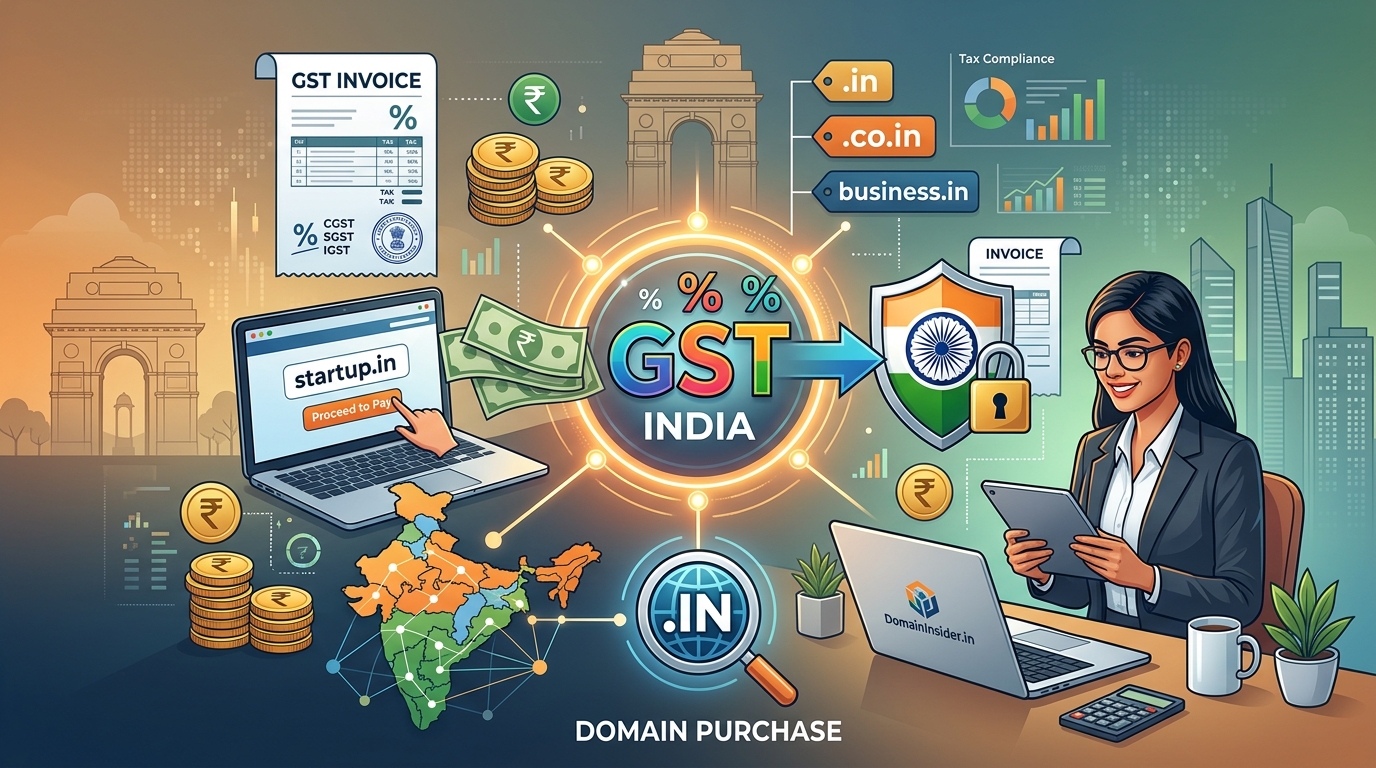
Buying a domain name in India isn’t just about picking the perfect name and paying the registrar. There’s a tax component that catches many first-time buyers off guard. Whether you’re launching a startup, expanding your business, or building a personal brand, understanding GST on domain purchase India will save you from compliance headaches and help you claim legitimate tax benefits.
Domain purchases in India attract 18% GST on the total transaction value. Indian businesses can claim input tax credit if they’re registered under GST and use the domain for business purposes. International registrars may not charge GST directly, but Indian buyers must still comply with reverse charge mechanism rules. Proper invoice documentation is essential for claiming credits and maintaining compliance with tax authorities.
Understanding GST applicability on domain transactions
Domain names fall under the category of intangible goods or services in India’s GST framework. The tax treatment depends on where you buy the domain and how you plan to use it.
When you purchase from an Indian registrar, they charge 18% GST on top of the domain price. This appears as a separate line item on your invoice. The registrar collects this tax and remits it to the government.
International registrars present a different scenario. If you buy from GoDaddy, Namecheap, or other foreign platforms, they typically don’t charge Indian GST. But that doesn’t mean you’re exempt.
Under the reverse charge mechanism (RCM), Indian businesses registered for GST must self-assess and pay the tax. You become responsible for calculating and depositing 18% GST on the domain purchase value.
Individual buyers who aren’t GST-registered don’t need to pay tax under RCM. But they also can’t claim any input credit, which we’ll cover shortly.
Current GST rates for different domain services
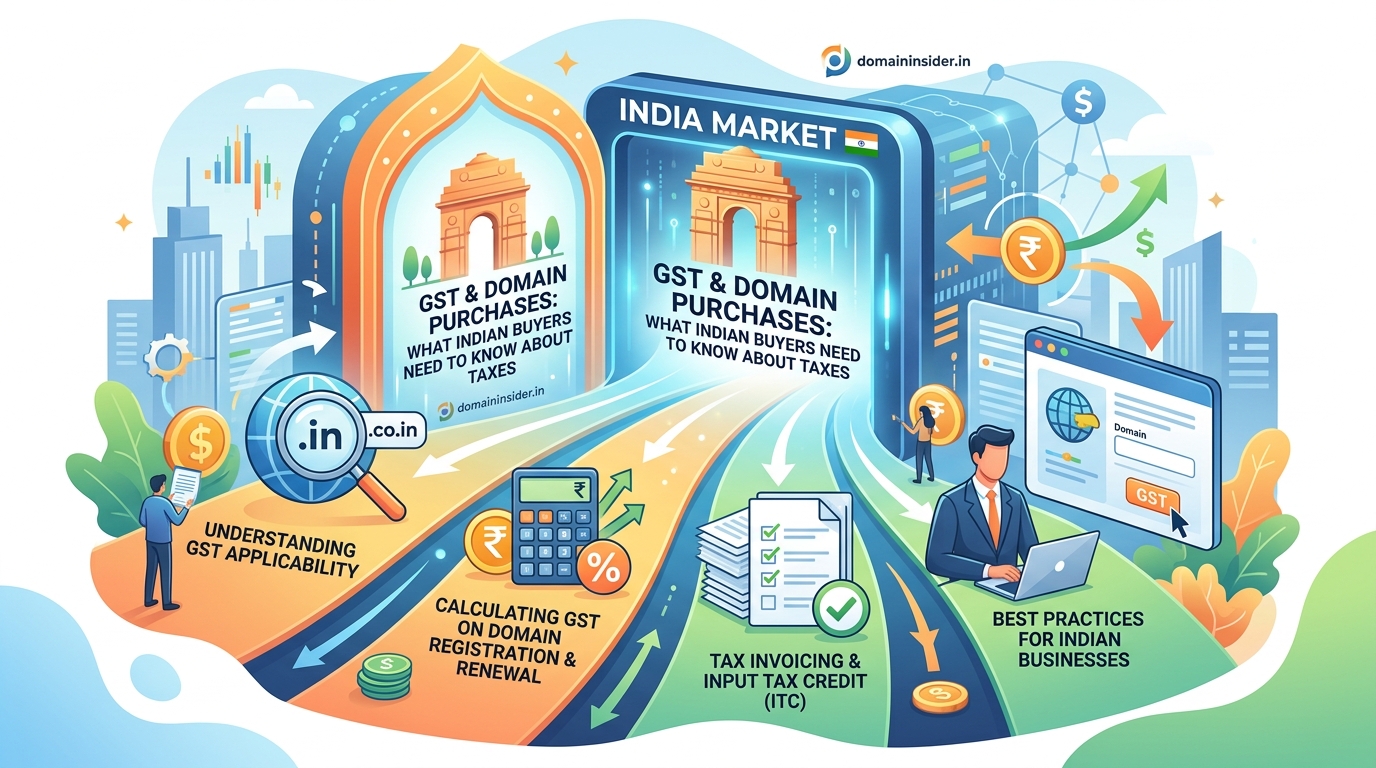
Not all domain-related expenses attract the same tax treatment. Here’s what you need to know:
| Service Type | GST Rate | Notes |
|---|---|---|
| New domain registration | 18% | Applies to all TLDs including .com, .in, .co.in |
| Domain renewal | 18% | Same rate as new registration |
| Domain transfer | 18% | Charged when moving between registrars |
| Privacy protection | 18% | WHOIS privacy services |
| DNS management | 18% | Premium DNS hosting services |
| Domain parking revenue | 18% | Tax on income from parked domains |
The 18% rate has remained consistent since the GST rollout in 2017. There’s no difference between popular extensions like .com and country-specific ones like .in or .co.in.
Before making a purchase, avoid common domain name mistakes that could lead to unnecessary expenses and tax complications.
How to claim input tax credit on domain purchases
Here’s where GST-registered businesses get a significant advantage. Input Tax Credit (ITC) allows you to offset the GST you paid on domain purchases against the GST you collect from your customers.
The process works like this:
- Purchase your domain from a GST-compliant registrar who provides a proper tax invoice
- Ensure the invoice contains your correct GSTIN (GST Identification Number)
- Verify that the domain purchase is for business purposes, not personal use
- File your GST returns (GSTR-3B) and claim the input credit in the appropriate period
- Maintain all invoices and payment records for at least six years as per GST regulations
The credit reduces your overall tax liability. If you paid ₹1,180 for a domain (₹1,000 base price + ₹180 GST), you can claim that ₹180 against the GST you owe on your sales.
There’s one critical requirement: the domain must be used for business purposes. Using it for a personal blog or hobby project doesn’t qualify for ITC. Tax authorities can disallow credits during audits if they find personal use.
Many businesses miss out on these credits simply because they don’t maintain proper documentation. Don’t be one of them.
Documentation requirements for tax compliance
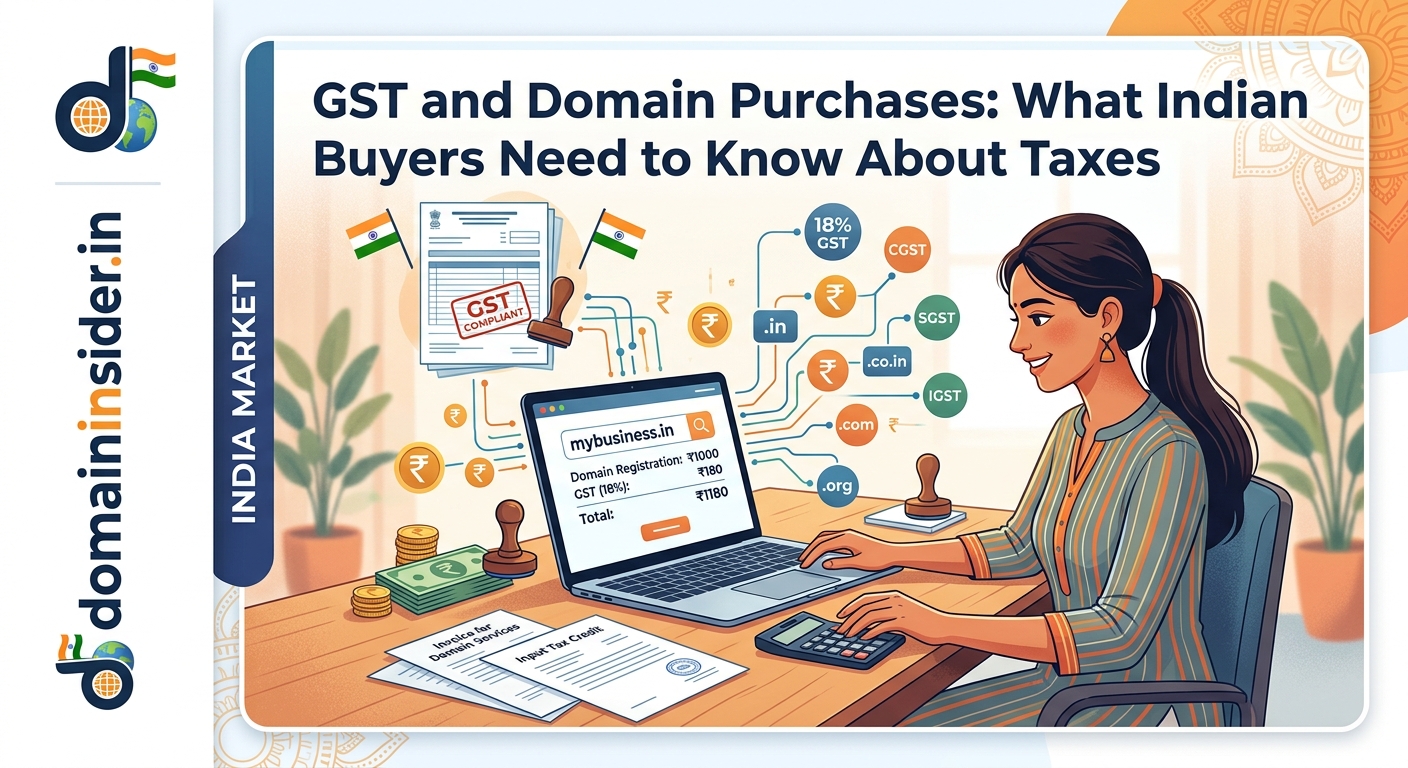
Tax authorities are particular about documentation. Missing or incorrect paperwork can lead to credit denials and penalties.
Your domain purchase invoice must include:
- Seller’s legal name and GSTIN (for Indian registrars)
- Your business name and GSTIN
- Invoice number and date
- Description of service (domain registration/renewal)
- Domain name being purchased
- Taxable value (base price)
- GST rate and amount
- Total amount including tax
- Place of supply
For international purchases under RCM, you need to create a self-invoice. This document serves as proof of your tax payment and supports your ITC claim.
Keep digital and physical copies of all invoices. Store them systematically by financial year. During audits, you’ll need to produce these within hours, not days.
Payment receipts are equally important. Bank statements showing the exact payment amount help verify your claims. Credit card statements work too, but ensure they clearly show the merchant name and transaction amount.
Reverse charge mechanism for foreign registrars
Buying from international platforms requires extra steps. The reverse charge mechanism shifts tax responsibility from the seller to you.
Here’s how to handle RCM correctly:
- Calculate 18% GST on the domain purchase value at the current exchange rate
- Pay this amount to the government through the GST portal
- File GSTR-3B showing the payment under the RCM column
- Claim the same amount as input credit in the same return (if eligible)
- Maintain currency conversion records and payment proof
The interesting part: if you’re eligible for full ITC, the cash outflow is effectively zero. You pay the tax and immediately claim it back. But the compliance burden remains.
Many businesses find this process confusing. Missing the RCM payment can trigger notices from tax authorities. The penalty for non-compliance ranges from 10% to 100% of the tax amount, depending on intent and delay.
“Always maintain a separate folder for international domain purchases. The documentation requirements are stricter, and you’ll need everything organized if questions arise during filing or audits.” – Tax compliance expert
Special considerations for bulk domain purchases
Domain investors and businesses buying multiple domains face unique challenges. The tax implications multiply with volume.
Bulk purchases from Indian registrars are straightforward. You get one consolidated invoice with the total GST amount. Claiming credit is simple if you maintain proper records.
International bulk purchases require individual RCM calculations. If you buy 50 domains from a foreign registrar, you technically need to account for each transaction separately. This creates significant paperwork.
Some strategies help manage this:
- Use Indian resellers who handle GST compliance for you
- Consolidate purchases into fewer transactions when possible
- Maintain a spreadsheet tracking each domain, its cost, and tax paid
- Consider the administrative burden when comparing Indian versus international pricing
For domain investors, there’s another consideration. If you’re buying domains to resell, you’ll charge GST when you sell them. Proper input credit claims on purchases directly impact your profit margins.
Understanding how to build a profitable domain portfolio includes factoring in these tax implications from the start.
Common mistakes that trigger tax notices
Tax authorities have become increasingly sophisticated at identifying non-compliance. These mistakes frequently trigger notices:
- Claiming ITC without proper invoices or with incorrect GSTIN
- Failing to pay RCM on international purchases
- Using personal GST numbers for business domain purchases
- Not maintaining supporting documents for claimed credits
- Mixing personal and business domain expenses
- Incorrect reporting of place of supply
- Claiming credit on domains used for exempt supplies
One particularly common error: businesses claim full ITC on domains they use partially for personal purposes. If your business website also hosts your personal blog, the tax treatment becomes complex.
The safest approach is maintaining clear separation. Business domains should serve only business purposes. Personal projects should use separately purchased domains without ITC claims.
Another frequent mistake involves timing. You must claim ITC in the same financial year or by the September return of the following year, whichever is earlier. Missing this deadline means losing the credit permanently.
GST implications when selling domains
Selling domains creates a tax liability. Whether you’re flipping domains for profit or selling a single domain you no longer need, GST applies.
When you sell a domain, you must:
- Charge 18% GST on the selling price
- Issue a tax invoice to the buyer
- Collect the GST amount from the buyer
- Deposit it with the government through your GST returns
- Report the transaction in your GSTR-1
The sale price minus the purchase price gives you the profit. But GST applies to the entire sale price, not just the profit.
For example, if you bought a domain for ₹10,000 (including GST) and sell it for ₹50,000, you must charge ₹9,000 as GST (18% of ₹50,000). Your customer pays ₹59,000 total.
You can claim ITC on the original purchase GST if you haven’t already. This offsets part of your tax liability on the sale.
Individual sellers who aren’t GST-registered face different rules. If your annual turnover from all sources exceeds ₹20 lakhs (₹10 lakhs for special category states), you must register for GST. Selling even one premium domain could push you over this threshold.
State-specific variations and interstate transactions
Domain purchases are generally treated as interstate supplies because most registrars operate from specific states. This means Integrated GST (IGST) applies rather than Central GST (CGST) and State GST (SGST).
The practical difference for buyers is minimal. The total rate remains 18%. But it affects how the tax is distributed between central and state governments.
For businesses, interstate purchases require:
- Ensuring the place of supply is correctly identified
- Reporting in the appropriate sections of GST returns
- Matching with the supplier’s GSTR-1 data for ITC claims
E-way bills aren’t required for domain purchases since they’re intangible services. But proper documentation of the interstate nature helps during audits.
How domain renewals and transfers are taxed
Annual renewals follow the same tax treatment as new purchases. You pay 18% GST on the renewal fee.
This creates an ongoing tax obligation. A domain costing ₹1,000 annually means ₹180 in GST every year. Over ten years, that’s ₹1,800 in taxes alone.
Businesses can claim ITC on each renewal if the domain continues serving business purposes. Maintain separate invoices for each renewal period.
Domain transfers between registrars also attract GST. The transfer fee, typically ranging from ₹500 to ₹1,500, includes 18% GST. You’re essentially paying for the service of moving your domain, and that service is taxable.
Transfers between individuals or businesses don’t automatically trigger GST unless money changes hands. If you sell the domain during transfer, GST applies to the sale price as discussed earlier.
Impact of GST on domain pricing strategies
Tax considerations should influence your purchasing decisions. When comparing domain prices, factor in the total cost including GST.
Some registrars advertise attractive base prices but the final amount after GST may exceed competitors. Always compare the final invoice amount, not just the advertised price.
For businesses claiming full ITC, the effective cost difference narrows. If Registrar A charges ₹800 + GST and Registrar B charges ₹1,000 + GST, the actual difference after claiming credit is just ₹200, not ₹200 plus the GST differential.
Individual buyers without GST registration should be more price-sensitive since they bear the full tax cost.
Promotional offers sometimes include or exclude GST. Read the fine print carefully. “₹99 domain” might actually cost ₹117 after tax.
Record keeping best practices for domain portfolios
Managing multiple domains requires systematic record keeping. Create a spreadsheet tracking:
- Domain name and extension
- Purchase date and registrar
- Base price and GST amount
- Invoice number and GSTIN used
- Renewal dates and costs
- Purpose (business/personal)
- ITC claimed (yes/no)
- Sale details if applicable
Update this spreadsheet with every transaction. It becomes invaluable during tax filing and audits.
Store all invoices in a dedicated folder structure:
Domain_Purchases/
2023-24/
Registrations/
Renewals/
Transfers/
2024-25/
Registrations/
Renewals/
Transfers/
Cloud storage ensures you don’t lose records due to hardware failures. Services like Google Drive or Dropbox work well.
Set calendar reminders for renewal dates. Last-minute renewals often miss the invoice download window, creating documentation gaps.
Planning your domain purchases around tax efficiency
Strategic timing can optimize your tax position. If you’re planning bulk purchases, consider your overall tax liability for the year.
Businesses with high GST liability might prefer purchasing domains in months when they need more input credits. This helps balance cash flow.
The financial year-end (March 31) is crucial. Purchases made in March allow ITC claims in the same financial year. Delaying to April pushes the credit to the next year, affecting your tax planning.
For finding undervalued premium domains, factor in the tax cost when evaluating potential returns. A domain that seems like a great deal might be less attractive after accounting for GST and compliance costs.
Consider registrar location too. Indian registrars simplify compliance but might charge higher base prices. International registrars offer competitive pricing but add RCM complexity. Choose based on your comfort with tax procedures and volume of purchases.
What happens during GST audits for domain expenses
Tax audits scrutinize domain purchases more closely now than in early GST years. Authorities understand that businesses sometimes misuse domain purchases for personal projects while claiming business credits.
Auditors typically examine:
- Whether the domain name relates to your business activities
- If the website built on the domain serves business purposes
- Consistency between claimed business use and actual content
- Proper documentation and invoice compliance
- Timely RCM payments on international purchases
- Correlation between domain purchases and business growth
Having a clear business justification helps. If you run a restaurant and bought “bestfood.com,” the connection is obvious. But “johndoe.com” for a corporate entity raises questions.
Prepare explanations for each domain in your portfolio. Document how each serves your business strategy, even if you haven’t developed the website yet.
Auditors may request website screenshots, business plans, or marketing strategies showing domain utilization. Maintain these records proactively.
Making tax compliance work for your business
GST on domain purchases doesn’t need to be complicated. With proper systems, you can maintain compliance while maximizing legitimate tax benefits.
Start by choosing registrars who provide GST-compliant invoices automatically. This eliminates manual follow-up and ensures you have documentation when needed. Register all business domains under your company’s GSTIN, never personal details. Set up a simple tracking system from your first purchase, not after you’ve accumulated dozens of domains.
The input credit benefit is real money saved. A business buying ₹50,000 worth of domains annually saves ₹9,000 in taxes through proper ITC claims. That’s significant for startups and small businesses operating on tight budgets.
Stay updated on GST rule changes. Tax laws evolve, and what works today might need adjustment tomorrow. Following reliable tax advisory sources or consulting a CA annually keeps you compliant and optimized.
Your domain portfolio is a business asset. Treat the tax component with the same attention you give to selecting the right domain in the first place. Proper tax management protects your investment and keeps your business running smoothly.
