
Rahul from Pune bought a domain for ₹800 in 2019. Three years later, he sold it for ₹85,000. That’s a 106x return on a simple internet address. Stories like these are not rare in the world of domain flipping in India. They’re happening every month, often to people who started with less capital than a weekend trip to Goa.
Domain flipping in India offers genuine opportunities for 10x returns with minimal investment. Success depends on identifying trending keywords, understanding local market demand, and timing your sales correctly. Indian entrepreneurs have turned ₹500 purchases into lakhs by focusing on .in domains, regional language keywords, and emerging business sectors. The barrier to entry remains low, but knowledge and patience separate profitable flippers from those who lose money.
What Makes Domain Flipping Work in India Right Now
The Indian digital economy added 90 million internet users between 2021 and 2023. Every new user creates demand for online businesses. Every new business needs a domain name.
This growth creates a supply problem. Good domain names disappear fast. Businesses that waited too long now face premium prices or awkward alternatives.
That gap between registration cost and resale value is where domain flippers make money.
A .in domain costs ₹399 to ₹699 per year. A .com typically runs ₹799 to ₹999. Your total investment for five domains stays under ₹5,000. But one successful sale can return ₹50,000 or more.
The math works because businesses value their online identity. They’ll pay 50x or 100x the registration cost for the right name. They’ll pay even more if that name matches their brand exactly.
Five Real Case Studies from Indian Domain Flippers
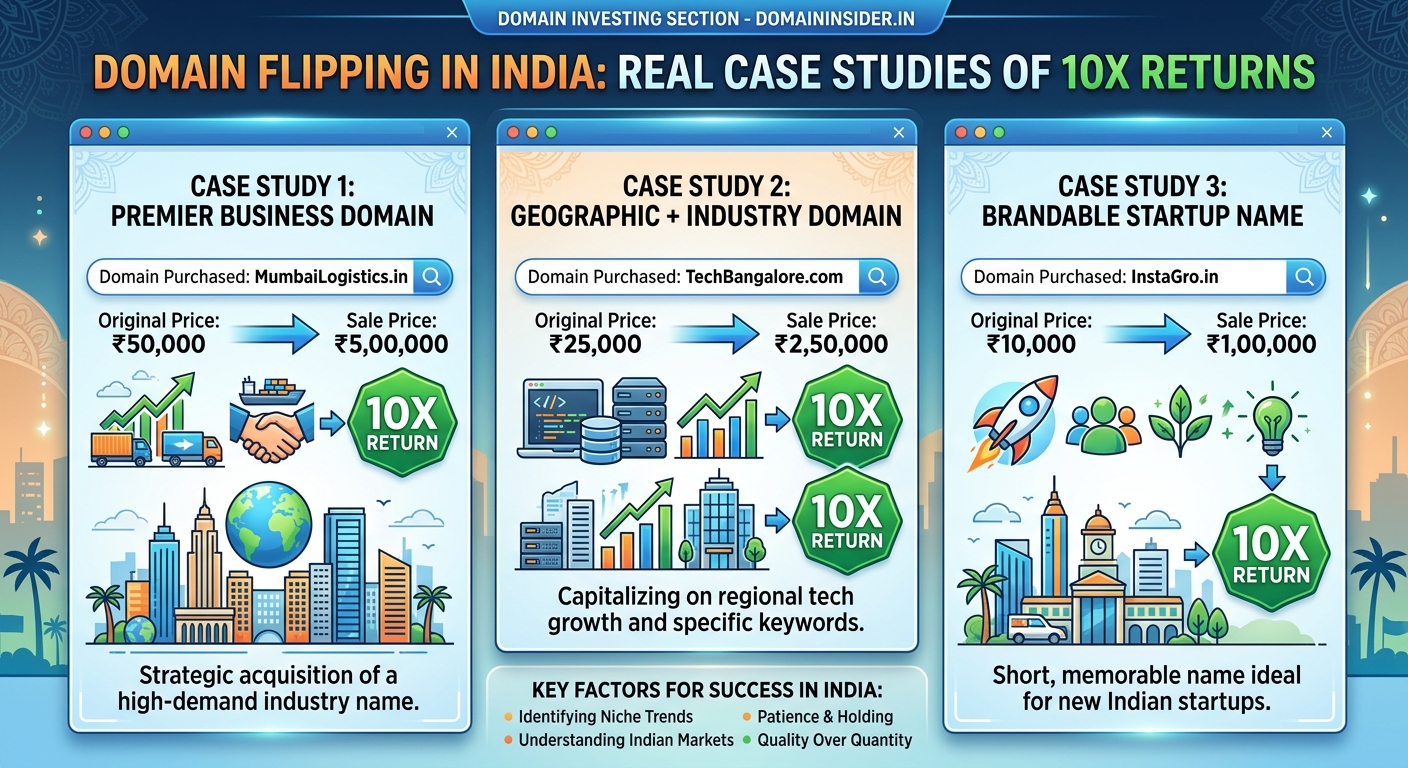
Case Study 1: ₹600 to ₹72,000 in 18 Months
Priya from Bangalore registered quickcommerce.in in early 2022. She paid ₹599.
She noticed grocery delivery apps growing fast. Terms like “quick commerce” appeared in news articles weekly. She registered the domain and listed it on a marketplace at ₹1.2 lakh.
A logistics startup contacted her in August 2023. They needed the exact domain for a new service line. After negotiation, she sold for ₹72,000. That’s a 120x return.
Her strategy was simple. She followed business news. She registered domains around trending concepts before they became mainstream.
Case Study 2: Regional Language Domains Pay Off
Amit from Jaipur focused on Hindi domains. He registered hindikhabar.in, hindishiksha.in, and hindifinance.in in 2020. Total investment: ₹1,800.
Regional content platforms exploded during the pandemic. A media company approached him in 2021 for hindikhabar.in. He sold for ₹45,000.
The other two domains sold within six months for ₹28,000 and ₹35,000 respectively. His total return was ₹1,08,000 on an ₹1,800 investment. That’s a 60x multiple.
Regional language domains remain undervalued. Most flippers chase English keywords. Amit saw the gap and filled it.
Case Study 3: The Patience Game with Premium Keywords
Vikram from Mumbai bought insurtech.in in 2018 for ₹699. He held it for four years.
During that time, he paid renewal fees totaling ₹2,800. His total investment reached ₹3,499.
In 2022, an insurance technology startup offered ₹2.5 lakh. He accepted. His net profit was ₹2,46,501. That’s a 70x return on his total investment.
Vikram’s case teaches patience. Premium category domains take longer to sell but command higher prices. Understanding how to build a profitable domain portfolio with just ₹50,000 helped him manage holding costs while waiting for the right buyer.
Case Study 4: Micro-Niche Wins Big
Sneha from Hyderabad registered petgroomingdelhi.in for ₹499 in 2021. She sold it eight months later for ₹18,000.
Her strategy focused on location plus service combinations. She registered 20 similar domains across major cities. Total investment: ₹10,000.
Within two years, she sold 12 domains. Average sale price: ₹15,000. Total revenue: ₹1,80,000. Her return on investment exceeded 18x.
Micro-niche domains work because local businesses search for exact match names. They want domains that tell customers exactly what they do and where they operate.
Case Study 5: Timing the Startup Boom
Karthik from Chennai tracked startup funding news. When a new sector received major investment, he registered related domains.
In 2020, edtech funding surged. He registered onlinetuition.in, elearningindia.in, and studyonline.in. Total cost: ₹2,100.
All three sold within 14 months. Combined sale price: ₹95,000. His return hit 45x.
Karthik’s method required daily news monitoring. But the effort paid off because he moved faster than most flippers. Speed matters when trends emerge.
How to Pick Domains That Actually Sell
Not every domain sells. Most sit unused, draining renewal fees year after year.
Successful flippers follow specific criteria:
Relevance to Growing Markets
Your domain must connect to an expanding sector. Education, healthcare, fintech, and logistics all grew 30% or more in recent years. Domains in these spaces sell faster.
Easy to Spell and Remember
Complicated spellings kill sales. financeguru.in sells. fynancegooroo.in does not. Keep it simple. Keep it obvious.
Short Length
Domains under 15 characters perform better. Shorter names are easier to type and remember. They also look cleaner on business cards and marketing materials.
Clear Commercial Intent
Generic names work better than creative ones. websitedesign.in beats pixelmagic.in for resale value. Businesses want clarity, not creativity.
Local Extensions Matter
Why .in domains are becoming the first choice for Indian startups in 2024 explains the preference shift. Indian businesses trust .in extensions. They signal local presence and commitment to the Indian market.
The Step-by-Step Process to Start Flipping Domains

-
Research trending keywords using Google Trends. Filter by India. Look for steady upward growth over 12 months. Avoid temporary spikes.
-
Check domain availability on major registrars. GoDaddy, BigRock, and Namecheap all serve Indian customers. Compare prices before buying.
-
Register 5 to 10 domains in your first batch. Spread your investment across different sectors. This reduces risk if one sector underperforms.
-
List your domains on marketplaces immediately. Sedo, Flippa, and Afternic all accept Indian sellers. Set prices at 50x to 100x your purchase cost initially.
-
Monitor inquiries and adjust prices monthly. If nobody contacts you in 60 days, reduce your asking price by 20%. Keep adjusting until you find the market rate.
-
Respond to buyer inquiries within 24 hours. Fast responses increase sale probability. Buyers often contact multiple sellers. First responder usually wins.
-
Use escrow services for transactions above ₹25,000. Escrow.com and Dan.com both support Indian transactions. They protect both buyer and seller.
Common Mistakes That Lose Money
Most beginners make predictable errors. Avoid these to protect your capital:
| Mistake | Why It Fails | Better Approach |
|---|---|---|
| Buying too many domains at once | Renewal costs pile up fast | Start with 5 to 10, expand after first sale |
| Choosing creative over generic names | Businesses want clarity | Pick obvious, descriptive domains |
| Ignoring renewal dates | Domains expire, you lose investment | Set calendar reminders 60 days before expiry |
| Overpricing from day one | No inquiries means no feedback | Start high but adjust based on market response |
| Skipping market research | You buy domains nobody wants | Spend 80% of time researching, 20% buying |
| Not using valuation tools | You either undercharge or overprice | Check 7 free tools to check your domain name value in 2024 before listing |
How to Price Your Domains for Maximum Profit
Pricing separates profitable flippers from those who never sell.
Start with the comparable sales method. Search sold domain databases for similar names. Sedo and NameBio publish sale prices. Look for domains with similar length, extension, and keyword value.
If comparable sales show ₹30,000 to ₹50,000, list yours at ₹45,000. You can always negotiate down.
Consider the buyer’s alternative cost. If a business wants marketingagency.in but it’s taken, they might settle for digitalmarketingagency.in or marketingagencyindia.in. Price your domain below what they’d spend on a less perfect alternative.
Factor in your holding costs. If you’ve renewed a domain three times, add those costs to your minimum acceptable price. Never sell at a loss unless the domain has zero future potential.
Use the 50x rule as a baseline. If you paid ₹599, list at ₹30,000 minimum. This gives you room to negotiate while still hitting a 40x return.
Learning how to negotiate domain prices like a pro and save thousands helps when buyers counter your initial price. Most sales involve negotiation. Be ready to justify your price with market data.
Where to Sell Your Domains in India
Domain Marketplaces
Sedo, Flippa, and Afternic reach global buyers. List your domains on all three. Each platform charges commission only after sale. Sedo takes 10% to 15%. Flippa charges 10%. Afternic takes 15% to 20%.
Direct Outreach
Find businesses that might want your domain. Send personalized emails explaining why your domain fits their brand. Keep messages short. Include your asking price upfront.
Social Media Groups
Facebook and LinkedIn host domain trading groups. Indian Domain Investors and Domain Flippers India both have active communities. Post your domains with clear pricing.
Local Business Networks
Attend startup meetups and business networking events. Many entrepreneurs need domains but don’t know where to buy. Face-to-face conversations build trust faster than online listings.
Domain Parking with For Sale Pages
Park your domain with a registrar that displays “For Sale” messages. Include your contact information. Some buyers search domains directly rather than browsing marketplaces.
Understanding 7 proven strategies to sell your domain name faster in 2024 accelerates your sales timeline. Faster sales mean less holding cost and better returns.
Tax and Legal Considerations for Domain Flippers
Domain flipping counts as business income in India. You must report profits on your income tax return.
If you flip domains occasionally, report under “Income from Other Sources.” If you flip regularly and systematically, register as a sole proprietor or company. Report under “Business Income.”
GST Registration
If your annual turnover exceeds ₹20 lakh (₹10 lakh for special category states), GST registration becomes mandatory. Domain sales count toward this threshold.
Capital Gains vs Business Income
The tax treatment depends on frequency and intent. If you buy and hold for years, it might qualify as capital gains. If you flip within months, it’s business income. Consult a CA for your specific situation.
Documentation
Keep records of all purchases, renewal fees, and sales. Save email correspondence with buyers. Maintain a spreadsheet tracking each domain’s cost basis, holding period, and sale price.
International Transactions
Selling to foreign buyers involves forex regulations. Payments above $25,000 require additional documentation. Use PayPal or Wise for smaller transactions. Use bank transfers with proper FEMA compliance for larger deals.
Building a Sustainable Domain Flipping Business
One-off sales are nice. Consistent monthly income is better.
Successful flippers treat domain investing like a portfolio business. They buy regularly, sell regularly, and reinvest profits.
Set Monthly Budgets
Allocate ₹5,000 to ₹10,000 monthly for new acquisitions. This keeps your portfolio fresh without overextending your capital.
Track Performance Metrics
Monitor your sell-through rate. If you’re selling 20% of domains within 12 months, you’re doing well. Below 10% means your selection criteria need adjustment.
Reinvest Profits Strategically
Use 50% of sale proceeds to buy more domains. Save 30% for renewal costs. Keep 20% as profit. This balance sustains growth while protecting against dry spells.
Specialize in Niches
Generalists struggle against specialists. Pick two or three sectors. Become the go-to person for fintech domains or healthcare domains. Deep knowledge improves selection and pricing accuracy.
Build Buyer Relationships
When someone buys a domain, stay in touch. They might need more domains later. They might refer other buyers. Repeat customers and referrals reduce your marketing costs.
Tools and Resources Every Flipper Needs
Domain Research Tools
– Google Trends for keyword research
– Namecheap’s Beast Mode for bulk availability checking
– ExpiredDomains.net for dropped domains with existing traffic
Valuation Tools
– Estibot for automated valuations
– GoDaddy Appraisals for second opinions
– NameBio for historical sale data
Portfolio Management
– Spreadsheets work fine for under 50 domains
– DomainIQ for larger portfolios
– Atom.com for professional portfolio websites
Payment Processing
– Escrow.com for secure high-value transactions
– PayPal for international buyers
– Bank transfers for Indian buyers
Knowing what exactly happens when you type a domain name in your browser helps you explain domain value to skeptical buyers. Technical knowledge builds credibility.
Emerging Opportunities in 2024 and Beyond
Several trends are creating new opportunities for Indian domain flippers:
Regional Language Domains
Hindi, Tamil, Telugu, and Bengali domains are undervalued. As regional content grows, these domains will appreciate. Register now while prices stay low.
New gTLD Extensions
.store, .online, and .tech extensions are gaining acceptance. They cost less than .com but offer good resale potential for the right keywords.
Web3 and Blockchain Domains
.crypto and .eth domains trade on blockchain marketplaces. This market is volatile but offers high returns for early movers.
Voice Search Optimization
As voice search grows, natural language domains gain value. “best pizza in mumbai” might become more valuable than “mumbaimizza.com.”
AI and Automation Keywords
Artificial intelligence, machine learning, and automation are hot sectors. Related domains will appreciate as more businesses enter these fields.
Deciding should you buy a .co.in or .in domain for your indian business affects your flipping strategy. Understanding buyer preferences helps you stock the right inventory.
Risk Management for Domain Investors
Domain flipping carries risks. Smart investors manage them actively.
Diversification
Never put all capital into one sector. Spread across industries, extensions, and price points. If one sector crashes, others protect your portfolio.
Holding Cost Control
Calculate maximum holding time before a domain becomes unprofitable. If a ₹699 domain costs ₹699 annually to renew, and you expect to sell for ₹20,000, you can hold for five years before profit disappears.
Trademark Research
Before buying, search trademark databases. Buying trademarked names invites legal trouble. Use the Indian Trademark Registry and WIPO database.
Market Timing
Some sectors are cyclical. Wedding-related domains sell better before wedding season. Tax-related domains sell better in March. Time your acquisitions and listings accordingly.
Exit Strategy
Set a maximum holding period for each domain. If it doesn’t sell within that timeframe, let it expire. Sunk cost fallacy traps many flippers into endless renewals.
“The best domain flippers I know spend 80% of their time researching and 20% buying. They understand that selection determines success more than negotiation skills or marketing tactics. If you buy the right domains, they sell themselves.” — Rajesh Kumar, domain investor with 15 years experience
Your First 30 Days as a Domain Flipper
Here’s a realistic action plan for your first month:
Week 1: Education and Research
– Read domain flipping case studies
– Join Indian domain investor communities
– Study sold domain databases
– Identify three sectors showing growth
Week 2: Market Analysis
– Use Google Trends for keyword research
– Check domain availability for 50+ keywords
– Create a spreadsheet ranking potential purchases
– Set your initial budget (₹5,000 to ₹10,000)
Week 3: First Purchases
– Register your top 5 to 8 domains
– Set up parking pages with contact information
– List domains on Sedo, Flippa, and Afternic
– Join domain trading Facebook groups
Week 4: Outreach and Optimization
– Identify 10 businesses that might want your domains
– Send personalized outreach emails
– Adjust pricing based on initial feedback
– Document everything in your tracking spreadsheet
Why Some Domains Sell in Days While Others Never Sell
The difference often comes down to three factors:
Market Timing
A domain for “cryptocurrency” sold easily in 2021. The same domain struggled in 2022. Timing matters as much as selection.
Price Realism
Overpriced domains never sell. Buyers have alternatives. If your price exceeds their alternative cost, they’ll walk away. Research comparable sales before setting prices.
Visibility
Domains listed on multiple platforms with good descriptions sell faster. Domains parked with no marketing rarely sell. You must make buyers aware your domain exists.
The Reality Check: What Returns to Actually Expect
Case studies show 10x to 100x returns. But averages tell a different story.
Most domain flippers see 30% to 40% of their domains sell within two years. The other 60% to 70% either sell later or expire.
Of domains that sell, 50% return 5x to 15x the purchase price. Another 30% return 15x to 50x. Only 20% achieve the 50x+ returns featured in case studies.
Your effective return depends on your sell-through rate. If you buy 20 domains for ₹10,000 total, and sell four for ₹60,000, your return is 6x. The other 16 domains represent sunk costs unless they sell later.
Realistic expectations prevent disappointment. Most successful flippers need 12 to 18 months to see consistent profits. The first six months are learning. The next six months are optimization. Profits accelerate in year two.
Why Domain Flipping Fits Indian Entrepreneurs Perfectly
Low capital requirements make domain flipping accessible. You can start with ₹5,000. Compare that to ₹5 lakh for a retail shop or ₹50,000 for most franchises.
Location independence matters in a country where commuting eats hours daily. You can flip domains from anywhere with internet access.
Flexible time commitment suits side hustlers. You can research during lunch breaks. List domains after dinner. Respond to buyers on weekends.
The learning curve is manageable. Unlike coding or design, domain flipping requires market knowledge more than technical skills. Most people grasp the basics within a month.
Scalability allows growth without proportional effort. Managing 50 domains takes only slightly more time than managing 10. Your income can grow faster than your time investment.
Making Your First Sale Happen Faster
Your first sale builds confidence and funds future purchases. Speed it up with these tactics:
Price Aggressively
Your first sale matters more than maximum profit. Price 20% below comparable sales. Accept lower margins to build momentum.
Focus on High-Demand Niches
Education, healthcare, and finance domains sell faster than obscure niches. Start where demand is proven.
Improve Your Listings
Write clear descriptions explaining why your domain matters. Include relevant keywords. Add pricing justification based on market data.
Respond Instantly
Set up mobile notifications for marketplace messages. Reply within one hour. Speed wins deals.
Offer Flexible Payment Terms
Accept installments for high-value domains. This expands your buyer pool to include cash-strapped startups.
Turning Domain Flipping into Long-Term Wealth
Domain flipping can evolve beyond side income. Some investors build six-figure portfolios generating passive income through domain parking and lease arrangements.
Parking Revenue
Park domains with ad networks. Traffic generates small monthly payments. While not significant per domain, 100 parked domains can generate ₹10,000 to ₹30,000 monthly.
Domain Leasing
Lease premium domains to businesses. They pay monthly fees for usage rights. You retain ownership. This creates recurring revenue without selling assets.
Premium Portfolio Building
Shift from flipping to holding premium domains. As your capital grows, buy higher-value domains that appreciate long-term. Think of them as digital real estate.
Consulting and Services
Your expertise becomes valuable. Businesses pay for domain selection advice. Brokers pay for deal sourcing. Knowledge compounds into multiple income streams.
When Domain Flipping Becomes Your Primary Income
The transition from side hustle to full-time income happens gradually.
Most successful full-timers followed this path:
Months 1-6: Learning and first sales while keeping day job
Months 7-12: Consistent monthly sales, reinvesting all profits
Months 13-18: Monthly income reaches ₹30,000 to ₹50,000
Months 19-24: Income stabilizes at ₹75,000+, consider full-time transition
The key is building a large enough portfolio that monthly sales become predictable. With 200+ domains, selling 5 to 8 per month becomes normal. At average sale prices of ₹25,000, that’s ₹1.25 lakh to ₹2 lakh monthly.
Subtract renewal costs (roughly ₹15,000 monthly for 200 domains) and new acquisitions (₹20,000 monthly), and you net ₹90,000 to ₹1.65 lakh. That’s a viable full-time income.
The Mindset Shift That Separates Winners from Quitters
Domain flipping tests patience more than intelligence.
Winners accept that most domains won’t sell immediately. They view their portfolio as a garden that needs time to grow. They water it with smart acquisitions and prune it by letting poor performers expire.
Quitters expect instant results. They buy domains Monday and expect sales by Friday. When nothing happens, they assume the model doesn’t work. They let good domains expire and miss out on future profits.
Winners track metrics. They know their sell-through rate, average sale price, and return on investment. They adjust based on data, not emotions.
Quitters fly blind. They don’t track performance. They can’t identify what works. They repeat mistakes because they never analyzed failures.
Winners network. They join communities, attend events, and build relationships. They learn from others’ successes and failures.
Quitters work in isolation. They miss trends, overpay for domains, and underprice sales. They reinvent wheels instead of learning from those who came before.
Your Path Forward Starts with One Domain
The case studies in this guide are real. The returns are achievable. But they require action.
Start small. Register three domains this week. Pick keywords from growing sectors. Keep them simple and relevant.
List them on marketplaces. Set prices at 50x your cost. Adjust monthly based on feedback.
Track everything. Document your research, purchases, and results. Learn from each domain whether it sells or expires.
Stay patient. Your first sale might take three months or six months. That’s normal. The second sale comes faster. The third faster still.
Domain flipping in India rewards those who combine research, patience, and consistent action. The opportunity is real. The barrier to entry is low. The potential returns justify the effort.
Your first 10x return starts with a ₹699 domain and the willingness to learn as you go.
