Understanding how much profit your investments generate is one of the most important skills in business. Whether you’re buying domain names, launching marketing campaigns, or investing in equipment, knowing your return on investment helps you make smarter decisions. The good news? Calculating ROI is simpler than most people think.
ROI measures profit relative to cost using a simple formula: subtract your initial investment from your final value, divide by the initial investment, then multiply by 100 for a percentage. This metric helps you compare different investments, track performance over time, and make data-driven decisions. Understanding ROI calculation empowers you to evaluate opportunities objectively and allocate resources more effectively across your business or portfolio.
The Basic ROI Formula You Need to Know
Return on investment is calculated using a straightforward formula that anyone can apply.
The basic formula looks like this:
ROI = (Net Profit / Cost of Investment) × 100
You can also express this as:
ROI = ((Final Value – Initial Investment) / Initial Investment) × 100
Both formulas give you the same result. The second version just breaks down net profit into its components.
Let’s say you purchased a domain name for ₹10,000 and sold it six months later for ₹15,000. Your calculation would be:
ROI = ((15,000 – 10,000) / 10,000) × 100 = 50%
That means you earned a 50% return on your investment.
The percentage makes it easy to compare different opportunities. A 50% ROI is better than a 20% ROI, regardless of the absolute rupee amounts involved.
Breaking Down the Components
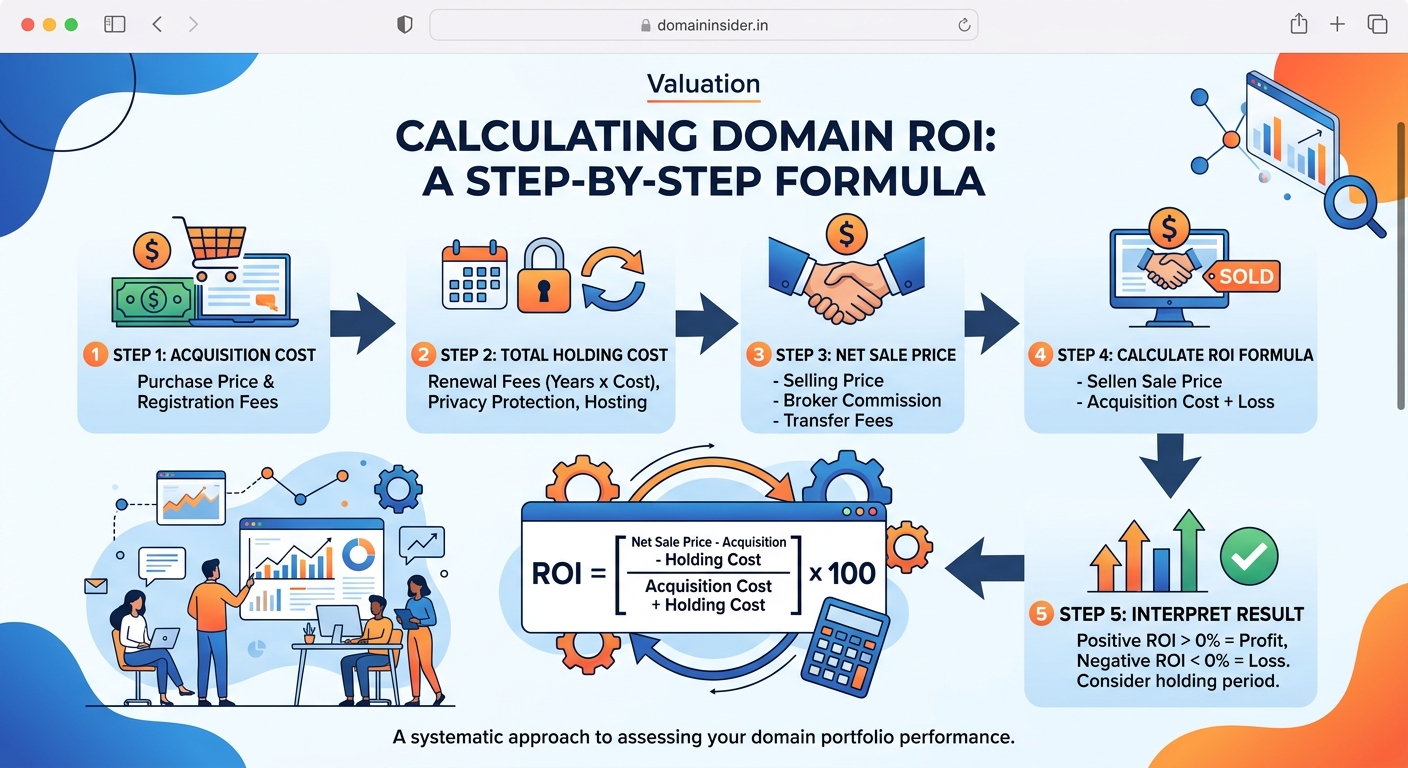
Understanding each part of the formula helps you apply it correctly.
Net Profit is the money you gained from the investment after subtracting all costs. This includes the initial purchase price plus any additional expenses.
For domain investors, costs might include:
- Purchase price
- Renewal fees
- Marketplace listing fees
- Transfer costs
- Payment processing fees
Cost of Investment represents everything you spent to acquire and maintain the asset until you realized the return.
Many people make the mistake of only counting the purchase price. This inflates their ROI calculation and gives them a false sense of success.
Always include every rupee spent related to that investment. This gives you an accurate picture of performance.
Step-by-Step Process for Calculating ROI
Follow these steps to calculate ROI for any investment.
-
Identify your initial investment amount. Add up every cost associated with acquiring the asset. Include purchase price, fees, and any immediate expenses.
-
Track all ongoing costs. Document renewal fees, maintenance costs, marketing expenses, or any other spending related to this investment. Keep detailed records throughout the holding period.
-
Determine your final value. This is the amount you received when you sold the asset or the current market value if you’re calculating unrealized ROI.
-
Subtract total costs from final value. This gives you your net profit. If the number is negative, you have a loss instead of a profit.
-
Divide net profit by total investment. This gives you the return as a decimal number.
-
Multiply by 100 to convert to percentage. This final step gives you the ROI percentage that’s easy to communicate and compare.
Let’s work through a domain investment example using these steps.
You bought a premium .in domain for ₹25,000. You paid ₹800 per year in renewal fees for three years. You listed it on a marketplace that charged ₹1,500 in fees. You finally sold it for ₹45,000.
Total costs: ₹25,000 + (₹800 × 3) + ₹1,500 = ₹28,900
Net profit: ₹45,000 – ₹28,900 = ₹16,100
ROI: (₹16,100 / ₹28,900) × 100 = 55.7%
Common ROI Calculation Mistakes to Avoid
Even experienced investors sometimes calculate ROI incorrectly. Here are the most common errors and how to avoid them.
| Mistake | Why It’s Wrong | Correct Approach |
|---|---|---|
| Ignoring holding costs | Inflates ROI by excluding renewal fees, maintenance, and opportunity costs | Include every expense from purchase to sale |
| Forgetting transaction fees | Marketplace and payment fees reduce actual profit | Subtract all fees from final sale price |
| Not accounting for time | A 50% ROI over five years is very different from 50% in six months | Calculate annualized ROI for long-term investments |
| Using gross revenue instead of net profit | Overstates returns by not subtracting costs | Always use net profit in the numerator |
| Mixing up percentage and multiplier | Saying “2x ROI” when you mean 100% ROI | Be clear about whether you’re expressing as percentage or multiple |
The time factor deserves special attention. A 100% ROI sounds impressive, but if it took ten years to achieve, your annualized return is much lower.
To calculate annualized ROI:
Annualized ROI = ((1 + ROI)^(1/years)) – 1
If you earned 100% over five years:
Annualized ROI = ((1 + 1.00)^(1/5)) – 1 = 0.1487 or 14.87% per year
This gives you a more accurate picture of investment performance over time.
Practical Applications for Different Investment Types
ROI calculations work across various investment categories, though the details change slightly.
Domain Names
When you’re building a profitable domain portfolio with just ₹50,000, tracking ROI helps you identify which types of domains perform best. You might find that short .in domains generate higher returns than longer alternatives.
Include registration, renewal, and listing fees in your cost basis. If you developed the domain with a simple landing page, include those development costs too.
Marketing Campaigns
Calculate ROI for each marketing channel separately. This shows you which channels deserve more budget allocation.
For a social media campaign, your costs include ad spend, content creation, and management time. Your return is the revenue generated from customers acquired through that channel.
Business Equipment
When buying equipment, calculate ROI based on the additional revenue or cost savings the equipment generates.
If you spend ₹50,000 on a laptop that helps you complete projects 20% faster, estimate the additional revenue from that extra capacity over the laptop’s useful life.
Using ROI to Compare Investment Opportunities
One of ROI’s greatest strengths is enabling apples-to-apples comparisons.
Imagine you’re considering three domain purchases:
- Domain A: Costs ₹5,000, expected to sell for ₹8,000 (60% ROI)
- Domain B: Costs ₹20,000, expected to sell for ₹30,000 (50% ROI)
- Domain C: Costs ₹50,000, expected to sell for ₹85,000 (70% ROI)
Based purely on ROI, Domain C offers the best return. But you also need to consider:
- Your available capital
- Time to sell
- Risk level
- Liquidity needs
Domain C might have the highest ROI, but if it takes three years to sell while Domain A sells in three months, the annualized returns tell a different story.
“ROI is a powerful tool, but it’s just one metric. Always consider risk, time horizon, and opportunity cost alongside raw ROI numbers. The best investment isn’t always the one with the highest percentage return.”
Advanced ROI Considerations
Once you master basic ROI calculations, you can refine your approach with more sophisticated methods.
Risk-Adjusted ROI
Two investments with identical ROI percentages aren’t equally attractive if one carries significantly more risk.
Higher-risk investments should generate higher returns to compensate for that additional risk. A 30% ROI on a speculative domain purchase isn’t as impressive as a 30% ROI on a stable, established domain with predictable demand.
Opportunity Cost
Every investment ties up capital that could be deployed elsewhere. If you can reliably generate 15% annual returns through one strategy, any new investment should beat that benchmark.
Calculate the difference between your actual ROI and your opportunity cost to determine whether the investment truly added value.
Tax Implications
In India, domain sale profits may be subject to capital gains tax depending on your holding period and tax situation. Your after-tax ROI matters more than your pre-tax ROI.
Consult with a tax professional to understand how investment income affects your tax liability. This helps you calculate true net returns.
Tools and Resources for ROI Tracking
You don’t need fancy software to calculate ROI, but the right tools make tracking easier.
Spreadsheets
A simple spreadsheet can track all your investments, costs, and returns. Create columns for:
- Investment name
- Purchase date
- Initial cost
- Ongoing costs
- Sale date
- Sale price
- ROI percentage
- Annualized ROI
Update it regularly to monitor your portfolio performance.
Domain Valuation Tools
If you’re calculating unrealized ROI on domains you still own, free tools to check your domain name value in 2024 can help you estimate current market value. This lets you track performance even before selling.
Portfolio Management Software
As your investments grow, dedicated portfolio management tools can automate calculations and generate performance reports. Look for software that handles multiple asset types if you invest beyond domains.
Interpreting Your ROI Results
Knowing your ROI percentage is just the starting point. You need to interpret what those numbers mean for your strategy.
What’s a Good ROI?
This depends entirely on your industry, risk tolerance, and time horizon.
For domain investments:
- 20-50% ROI: Solid return for relatively safe, established domains
- 50-100% ROI: Excellent return indicating good market timing or undervalued purchase
- 100%+ ROI: Outstanding return, often from premium domains or lucky timing
For marketing campaigns:
- 100-200% ROI: Acceptable for most businesses
- 200-500% ROI: Strong performance
- 500%+ ROI: Exceptional results worth scaling
Remember that higher ROI often comes with higher risk. Consistent 30% returns might be better than occasional 200% returns mixed with frequent losses.
Negative ROI
Not every investment works out. A negative ROI means you lost money.
Calculate the magnitude of your loss: ROI = ((5,000 – 10,000) / 10,000) × 100 = -50%
This tells you that you lost half your investment. Use this information to:
- Identify what went wrong
- Adjust your investment criteria
- Improve your evaluation process
- Cut losses on underperforming assets
Creating an ROI Tracking System
Consistent tracking turns ROI from a one-time calculation into a powerful decision-making framework.
Start by documenting every investment decision. Write down:
- Why you made the investment
- Your expected ROI and timeline
- Key assumptions about market conditions
- Exit strategy
After you close the investment, calculate actual ROI and compare it to your projection. This feedback loop improves your forecasting over time.
Review your portfolio quarterly. Calculate:
- Individual investment ROI
- Category-level ROI (all domains, all marketing, etc.)
- Overall portfolio ROI
- Best and worst performers
This regular review helps you spot patterns. You might notice that domains purchased through negotiation strategies that save thousands consistently outperform domains bought at asking price.
ROI in Domain Investment Strategy
Domain investors face unique ROI considerations that affect buying and selling decisions.
Acquisition Strategy
Calculate projected ROI before purchasing. Estimate:
- Purchase price and fees
- Annual holding costs
- Expected sale price
- Probable time to sale
If your projected ROI doesn’t meet your minimum threshold, skip the purchase.
Some investors use a minimum 100% ROI target for speculative domains. More established domains might justify a 30-50% ROI target because they carry less risk.
Portfolio Optimization
Review your domain portfolio annually. Calculate ROI for:
- Sold domains (realized ROI)
- Current domains (unrealized ROI based on current market value)
Domains with negative unrealized ROI after several years might be candidates for dropping. The renewal fees could be better spent on new acquisitions.
Selling Strategy
When selling your domain name faster in 2024, consider your target ROI. You might accept a lower ROI to free up capital for better opportunities.
Calculate the breakeven price (where ROI = 0%) so you know your absolute minimum acceptable offer.
Measuring ROI Beyond Financial Returns
While ROI traditionally measures financial returns, you can apply the concept to other valuable outcomes.
Time ROI
If an investment saves you time, calculate the value of that time and include it in your return calculation.
A tool that costs ₹10,000 annually but saves you 5 hours per week has significant time ROI. Value those hours at your hourly rate to quantify the benefit.
Learning ROI
Some investments generate knowledge and skills rather than immediate financial returns. A domain investment that loses money but teaches you valuable market insights has educational ROI.
This is harder to quantify but still valuable, especially early in your investing journey.
Network ROI
Certain investments connect you with valuable contacts and communities. The relationships you build might generate opportunities worth far more than the initial investment.
Putting ROI Calculations to Work
Now you understand how to calculate ROI, track it consistently, and use it to make better investment decisions.
Start by calculating ROI for your past investments. This gives you a baseline and helps you identify what’s worked well. Then apply ROI projections to future opportunities before committing capital.
Remember that ROI is a tool, not a crystal ball. It helps you make informed decisions, but it can’t predict the future with certainty. Combine ROI analysis with market research, risk assessment, and your own judgment.
The investors who succeed long-term are those who track their performance honestly, learn from both wins and losses, and continuously refine their approach. Your ROI calculations give you the data you need to do exactly that.
