
You found the perfect domain name for your business. It’s memorable, brandable, and exactly what you need. There’s just one problem: it’s not listed for sale anywhere. The owner seems to be using it, or maybe it’s just parked with a basic landing page. Either way, there’s no “Buy Now” button in sight.
Here’s the good news: unlisted domains get sold every single day. The owner might not have thought about selling until you reached out. Or they might be open to the right offer at the right time. The key is knowing how to approach them professionally and make an offer they’ll actually consider.
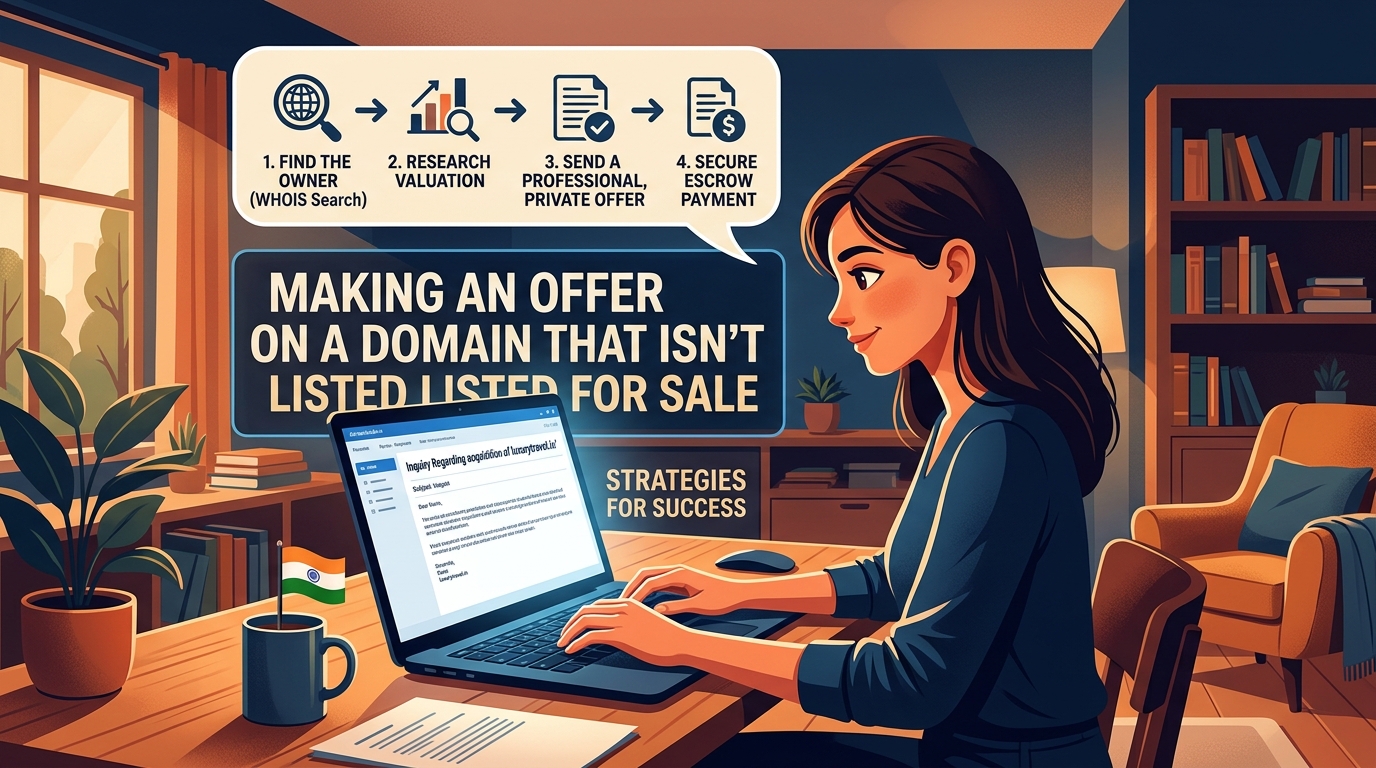
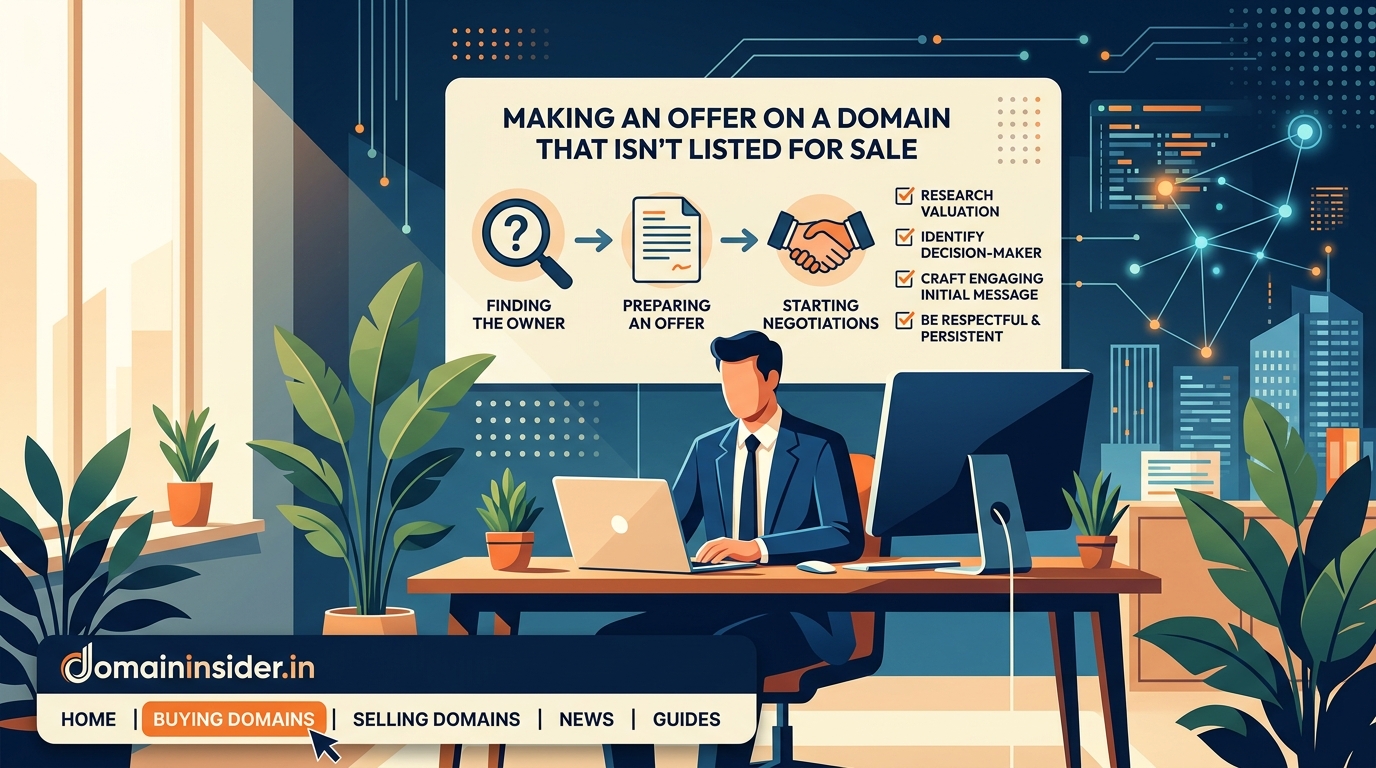
Making an offer on an unlisted domain requires research, professional outreach, and strategic negotiation. Start by finding the owner’s contact details through WHOIS lookup, craft a personalised email that shows genuine interest, research comparable domain sales to determine fair value, and be prepared to negotiate patiently. Most unlisted domain deals close between 30 to 90 days after first contact, so persistence and professionalism matter more than your initial offer amount.
Finding who actually owns the domain
Before you can make any offer, you need to know who to contact. Domain ownership information is usually public, though some owners use privacy protection services.
Start with a WHOIS lookup. Every registered domain has WHOIS records that show registration details. Tools like WHOIS.com, ICANN WHOIS, or your preferred domain registrar’s lookup tool will show you the registered owner’s name and contact information.
If you see privacy protection enabled, don’t give up. The privacy service will forward emails to the actual owner. You can still send your inquiry through the masked email address provided.
Check the domain’s website for contact information. Many owners list their email address in the footer, contact page, or about section. This direct contact often works better than going through privacy services.
Look at the domain’s nameservers and hosting information. Sometimes this reveals the company or individual managing the domain, giving you another avenue for contact.
Social media can help too. Search for the domain name or business name on LinkedIn, Twitter, or Facebook. You might find the owner’s profile and a way to reach them directly.
Researching the domain’s value before reaching out
Never make an offer without understanding what the domain is actually worth. Your research determines whether you’ll overpay, insult the owner with a lowball offer, or strike the right balance.
Check recent sales of similar domains. Platforms like NameBio track domain sales data. Look for domains with similar length, extension, keyword value, and industry relevance. If comparable .com domains in your niche sold for ₹2 lakhs, that gives you a baseline.
Consider these value factors:
- Domain length (shorter is usually more valuable)
- Extension (.com typically commands premium prices)
- Keyword search volume and commercial intent
- Brandability and memorability
- Existing traffic or backlinks
- Industry demand
Tools like 7 free tools to check your domain name value in 2024 can help you estimate fair market value. Don’t rely on just one tool. Cross-reference multiple sources.
Check if the domain has existing backlinks or traffic using tools like Ahrefs or SEMrush. Domains with quality backlinks carry more value, especially if you’re buying for SEO purposes. Understanding how to value expired domains with existing backlinks applies to active domains too.
Look at the current use. Is the owner actively building a business on it? Running a profitable website? Or is it just parked with ads? Active business use suggests the owner values it highly and might need a compelling offer.
Crafting your first outreach email
Your initial email sets the tone for everything that follows. Get this wrong and you might never hear back. Get it right and you start a productive conversation.
Here’s what works:
Keep it personal and professional. Use the owner’s name if you found it. Mention something specific about their website or business if applicable. Generic copy-paste emails get ignored.
Be direct about your interest. Don’t beat around the bush. State clearly that you’re interested in purchasing the domain name.
Show you’re a serious buyer. Mention your business or project briefly. Owners are more likely to engage when they understand who’s buying and why.
Don’t lowball in the first email. Either ask what they’d consider selling for, or make a reasonable opening offer based on your research. Insulting offers kill negotiations before they start.
Make it easy to respond. Ask one clear question. Provide your contact information. Keep the email short.
Sample template:
Subject: Interest in purchasing [DomainName.com]
Hello [Name],
My name is [Your Name], and I’m launching [brief description of your business/project]. I noticed you own [DomainName.com], which would be perfect for our brand.
I understand the domain isn’t currently listed for sale, but I wanted to reach out to see if you’d consider an offer. The domain aligns perfectly with our business goals, and we’re prepared to make a fair offer.
Would you be open to discussing a potential sale? If so, I’d love to know what price range you’d consider.
Thank you for your time.
Best regards,
[Your Name]
[Your Contact Information]
Notice what this template avoids: pressure tactics, urgency claims, or aggressive negotiation language. You’re opening a conversation, not closing a sale.
Following up without being annoying
Most domain owners won’t respond to your first email. They’re busy, they missed it, or they need time to think. Following up is essential, but there’s a fine line between persistent and pushy.
Wait at least 7 to 10 days before your first follow-up. If the owner is interested, they need time to consider. If they’re not checking email regularly, a few days won’t make a difference.
Your follow-up should be brief:
Hi [Name],
I wanted to follow up on my email from [date] about purchasing [DomainName.com]. I’m still very interested and would love to hear your thoughts when you have a moment.
Thanks,
[Your Name]
Send a second follow-up after another 10 to 14 days if you still haven’t heard back. After that, consider trying a different contact method if available (LinkedIn message, phone call if you found a number, contact form on their website).
If you’ve sent three attempts over a month with no response, it’s time to move on. The owner either isn’t interested or isn’t reachable through the channels you have.
Understanding the owner’s perspective
Successful negotiations happen when you understand what the other person values. Domain owners who aren’t actively selling often have different motivations than professional domain investors.
They might be emotionally attached to the domain. Perhaps they registered it years ago for a project that never launched, or it represents a business idea they still hope to pursue someday. Acknowledging this matters.
They might not know what it’s worth. Many domain owners have no idea about market values. They might think their domain is worth ₹50 lakhs when comparable sales suggest ₹2 lakhs, or vice versa. Your job is to educate tactfully, not argue.
They might be using it actively. If the domain powers their current business or personal brand, they’ll need a compelling reason to sell. Your offer needs to account for their switching costs and inconvenience.
They might be worried about scams. Domain theft and fraudulent offers are real concerns. Being transparent about your identity, business, and payment method builds trust.
They might simply not want to sell. Some domains aren’t for sale at any price. Respect that boundary if you encounter it.
Making your formal offer
Once the owner expresses interest, it’s time to make a specific offer. This is where your earlier research pays off.
| Strategy | When to Use | Typical Success Rate |
|---|---|---|
| Start at 60-70% of estimated value | Owner seems motivated, domain isn’t critical to their business | Medium to High |
| Start at 80-90% of estimated value | Domain is actively used, owner seems hesitant | Medium |
| Offer asking price | Owner named a reasonable price, you want to close fast | High |
| Make your best offer first | Budget is limited, you can’t negotiate much higher | Low to Medium |
Present your offer clearly:
Based on recent sales of comparable domains and the current market, I’d like to offer ₹[amount] for [DomainName.com]. This reflects [mention 1-2 factors: length, extension, keyword value, etc.].
I’m prepared to complete the transaction through Escrow.com (or another trusted escrow service) to ensure a secure transfer for both of us. I can complete payment within [timeframe] once we agree on terms.
Mention the escrow service specifically. This shows you’re serious and understand proper domain transfer procedures. It also addresses the seller’s security concerns.
If your budget is limited, be upfront:
My budget for this domain is ₹[amount]. I understand this might be below what you’re hoping for, but I wanted to present what I can realistically offer. If this works for you, I’m ready to move forward immediately.
Honesty builds trust. If you can’t afford their asking price, saying so is better than wasting both parties’ time with back-and-forth negotiations that won’t reach agreement.
Negotiating the price effectively
Most domain deals involve some negotiation. The owner counters your offer, you counter back, and eventually you meet somewhere in the middle or walk away.
How to negotiate domain prices like a pro and save thousands covers advanced tactics, but here are the essentials for unlisted domains:
Don’t negotiate against yourself. If you offer ₹2 lakhs and they counter with ₹5 lakhs, your next move isn’t ₹4 lakhs. Ask them to come down first. Counter with ₹2.5 lakhs or ₹3 lakhs maximum.
Justify your numbers. When you counter, explain why. “Based on recent sales of similar domains in this niche, ₹3 lakhs represents fair market value. I found three comparable sales in the past six months ranging from ₹2.5 to ₹3.5 lakhs.”
Find non-price value. Sometimes you can’t meet their price, but you can offer other value. Faster payment, flexible transfer timeline, or even a small equity stake in your venture if they’re interested.
Know your walk-away point. Decide your maximum budget before negotiations start. Stick to it. Getting emotionally invested in one domain leads to overpaying.
Be patient. Domain negotiations often take weeks or months. Owners need time to think, discuss with partners, or simply get comfortable with the idea of selling.
Watch for these red flags that might indicate problems:
- Owner refuses to use escrow services
- Ownership details don’t match who you’re negotiating with
- Domain has trademark issues you didn’t catch earlier
- Owner pressures you to pay immediately without proper transfer
The guide on 7 red flags to watch for before purchasing any domain name covers warning signs in detail.
Structuring the payment and transfer
Once you agree on price, the transaction mechanics matter enormously. Proper procedures protect both parties and ensure smooth domain transfer.
Always use an escrow service. For Indian buyers, Escrow.com is the most trusted option. They hold your payment until the domain transfers to your account, then release funds to the seller. The fee (usually 3% to 5% of the sale price) is worth the security.
Agree on who pays the escrow fee. Standard practice is the buyer pays, but this is negotiable. Sometimes splitting the fee helps close a deal.
Clarify the transfer timeline. Domain transfers typically take 5 to 7 days once initiated, but the seller needs to unlock the domain and provide the authorization code first. Agree on a timeline for each step.
Get everything in writing. Even if you’ve been negotiating by email, create a simple sale agreement that covers:
- Domain name being sold
- Agreed purchase price
- Payment method and timeline
- Transfer process and timeline
- What happens if transfer fails
Verify ownership before paying. Confirm the seller can actually transfer the domain. Ask them to show they control it by temporarily changing the WHOIS email or adding a specific TXT record. This prevents scams where someone pretends to own a domain they don’t control.
Plan for the transfer process:
- Buyer deposits funds with escrow service
- Seller unlocks domain at current registrar
- Seller provides authorization code (EPP code)
- Buyer initiates transfer at their registrar
- Transfer completes (5-7 days typically)
- Buyer confirms receipt
- Escrow releases payment to seller
Some sellers prefer to push the domain to your account at their registrar, then you can transfer it to your preferred registrar later. This works too, as long as you verify you have full control before escrow releases payment.
Common mistakes that kill deals
Learning 5 common domain name mistakes every first-time buyer should avoid helps, but unlisted domain purchases have specific pitfalls:
Starting with an insultingly low offer. Offering ₹10,000 for a domain worth ₹2 lakhs might work on a motivated seller, but usually it just offends them and ends the conversation. Start reasonable.
Being too aggressive or demanding. Remember, the owner wasn’t trying to sell. You approached them. Aggressive tactics backfire.
Failing to research before reaching out. If you contact the owner without knowing basic information about the domain’s value, use, or history, you look unprepared and unserious.
Not having a backup plan. If this domain doesn’t work out, what’s your alternative? Having options prevents desperation and overpaying.
Ignoring legal issues. Make sure the domain doesn’t infringe on trademarks. A cheap domain that gets you sued later isn’t a bargain.
Rushing the process. Good domain deals take time. Trying to pressure the owner into a decision usually fails.
Forgetting to check domain history. Use the Wayback Machine to see what the domain hosted previously. Domains with spam, adult content, or illegal activity history can harm your SEO and reputation.
Alternative approaches when direct contact fails
Sometimes you can’t reach the owner through normal channels. Privacy protection is enabled, emails bounce, and there’s no website contact information. You still have options.
Try a domain broker. Professional brokers specialize in tracking down domain owners and negotiating purchases. They charge a commission (typically 10% to 20% of the sale price), but they have tools and experience you don’t. For high-value domains, this investment makes sense.
Wait and monitor. Set up monitoring for the domain’s expiration date. If the owner forgets to renew, you might be able to register it through backorder services or domain auctions. Understanding should you buy an expired domain and complete risk and reward analysis helps with this strategy.
Check domain marketplaces. Sometimes owners list domains on marketplaces like Sedo, Flippa, or Afternic without updating the domain’s landing page. Search these platforms for the domain name.
Look for the business owner on LinkedIn. If the domain hosts a business, find the company on LinkedIn and message the founder or CEO directly. Be professional and brief.
Consider similar alternatives. If you absolutely can’t acquire your target domain, look at variations. Different extensions, slight spelling changes, or adding a word might give you an acceptable alternative. Just make sure you’re not creating trademark issues or confusing customers.
Building relationships for future opportunities
Sometimes your first approach doesn’t result in a sale, but that doesn’t mean the door is closed forever. Circumstances change.
End the conversation gracefully even if they decline:
Thank you for considering my offer. I understand [DomainName.com] isn’t for sale right now. If your situation changes in the future, I’d still be very interested. Feel free to reach out anytime.
Best regards,
[Your Name]
This leaves the door open. Six months or two years from now, they might decide to sell. If you were professional and respectful, you’ll be the first person they contact.
Keep a spreadsheet of domains you’ve inquired about, including:
- Domain name
- Owner contact information
- Date of inquiry
- Their response
- Follow-up dates
Set a reminder to check back in 6 to 12 months. A brief, friendly email asking if anything has changed shows continued interest without being pushy.
Some of the best domain deals happen when buyers maintain relationships over time. The owner’s business pivots, they need cash for a new project, or they simply get tired of holding the domain. Being the person who stayed in touch professionally puts you first in line.
What to do once you own the domain
Congratulations, the deal closed and the domain is now in your account. A few important steps remain:
Verify full control immediately. Log into your registrar account and confirm you can manage all domain settings. Update the WHOIS information to your details. Set up domain lock to prevent unauthorized transfers.
Renew for multiple years. Don’t risk losing your new domain to an expired registration. Renew for at least 2 to 5 years, especially if it’s critical to your business.
Set up domain privacy if desired. Now that you own it, you might want to enable WHOIS privacy to keep your contact information private.
Configure DNS settings. Point the domain to your hosting, set up email, or create a coming soon page. Don’t leave it parked with the previous owner’s content.
Update your business materials. If you bought this domain for your business, update your website, business cards, social media, and marketing materials to reflect the new domain.
Consider buying related variations. If you secured YourBrand.com, you might want to grab YourBrand.in, YourBrand.co.in, or common misspellings to protect your brand. Looking at should you buy a .co.in or .in domain for your indian business helps decide which extensions matter.
Turning a “no” into a “maybe”
Not every domain owner will sell immediately. Some need time, some need the right circumstances, and some need a different approach.
If they say the domain isn’t for sale, ask why. Understanding their reasoning helps you address concerns or know when to walk away.
“I’m using it for my business” might mean they need assurance that selling won’t disrupt operations. Offer a longer transition period or help with rebranding.
“I registered it for a future project” suggests emotional attachment. Acknowledge this and ask if they’d consider selling if the project doesn’t launch within a specific timeframe.
“I don’t know what it’s worth” is an opportunity to educate. Share your research on comparable sales. Offer to get a professional appraisal.
“I’ve had offers before that didn’t work out” means they’re worried about scams or time-wasters. Emphasize your use of escrow, provide references, or offer to video call to establish trust.
Sometimes the answer really is no, and that’s fine. Thank them, move on, and focus your energy on domains where you have a real chance.
Your next steps
Making an offer on a domain not for sale requires patience, research, and professional communication. Most owners will at least consider a fair offer if you approach them respectfully.
Start by identifying who owns the domain and finding their contact information. Research comparable sales to understand fair value. Craft a personal, professional initial email that clearly states your interest. Be prepared to negotiate, use proper escrow services, and give the process time to unfold.
The perfect domain for your business might not have a “for sale” sign, but that doesn’t mean it’s unavailable. With the right approach, you can turn an unlisted domain into your brand’s digital home.
