
Choosing between premium and bulk domain investing can make or break your portfolio returns. One strategy demands deep pockets and patience. The other relies on volume and speed. Both can generate serious profits, but they attract completely different investor personalities.
Premium domain investing focuses on acquiring high-value, brandable domains with significant upfront costs but potentially massive returns. Bulk investing spreads risk across hundreds of lower-cost domains, generating smaller but more frequent sales. Your choice depends on available capital, risk appetite, time commitment, and whether you prefer concentrated bets or diversified holdings. Most successful investors eventually blend both strategies.
Understanding premium domain investing
Premium domains are the penthouse apartments of the digital real estate world.
These are short, memorable, keyword-rich names that businesses actually want. Think single-word .com domains, two-letter combinations, or exact-match industry terms.
A premium domain might cost anywhere from ₹50,000 to several crores. The investment thesis is simple: acquire exceptional digital assets that appreciate over time and attract serious buyers willing to pay top rupee.
Premium investors typically hold 5 to 20 domains. Each one receives individual attention. You research buyer prospects, craft custom sales pitches, and often wait years for the right offer.
The holding costs add up. Renewal fees, marketplace listing charges, and opportunity cost of locked capital. But one sale can return 10x or even 100x your investment.
Consider the domain LIC.in. If you owned it, insurance companies would line up with offers. That’s the power of premium positioning.
“Premium domain investing is like collecting rare art. You need an eye for value, patience to wait for the right buyer, and enough capital to weather dry spells without panic selling.” — Veteran domain investor
Breaking down bulk domain investing

Bulk investing flips the premium model completely.
Instead of a few expensive domains, you acquire hundreds or thousands of cheaper ones. Registration costs range from ₹500 to ₹2,000 per domain.
The strategy relies on probability. If you own 500 domains and sell just 5% annually at 10x your cost, you’re profitable. The math works because your winners subsidize your losers.
Bulk investors hunt for patterns: trending keywords, emerging technologies, local business categories, expired domains with residual traffic, and geo-targeted terms.
You might register domains like MumbaiPlumbers.in, BestCoffeeShops.co.in, or AIConsultingIndia.com. None are premium, but each could attract a small business owner willing to pay ₹10,000 to ₹50,000.
The workload is higher. You manage renewals for hundreds of domains, monitor market trends constantly, and automate much of your sales process through marketplaces.
Bulk investors often use 7 free tools to check your domain name value in 2024 to identify underpriced opportunities before committing capital.
Capital requirements and budget planning
Money determines which strategy you can actually execute.
Premium investing demands significant upfront capital. A starter portfolio of 5 premium domains could easily require ₹2,00,000 to ₹10,00,000. Plus annual renewals of ₹5,000 to ₹15,000 per domain.
Bulk investing is more accessible. You can build a 100-domain portfolio for ₹50,000 to ₹1,00,000. Annual renewals run ₹500 to ₹2,000 per domain.
Here’s a practical comparison:
| Investment Type | Initial Capital | Portfolio Size | Per-Domain Cost | Annual Renewals | Time to First Sale |
|---|---|---|---|---|---|
| Premium | ₹5,00,000 | 5-10 domains | ₹50,000-₹5,00,000 | ₹10,000-₹50,000 | 6-24 months |
| Bulk | ₹50,000 | 100-500 domains | ₹500-₹5,000 | ₹50,000-₹2,50,000 | 1-6 months |
| Hybrid | ₹2,00,000 | 2-3 premium + 50 bulk | Mixed | ₹30,000-₹1,00,000 | 3-12 months |
Most investors starting with limited funds choose bulk. It generates cashflow faster and teaches market dynamics without catastrophic risk.
Once you’ve made your first ₹1,00,000 in profits, you can graduate to premium acquisitions. That’s how how to build a profitable domain portfolio with just ₹50,000 becomes a stepping stone to bigger plays.
Risk profiles and tolerance levels
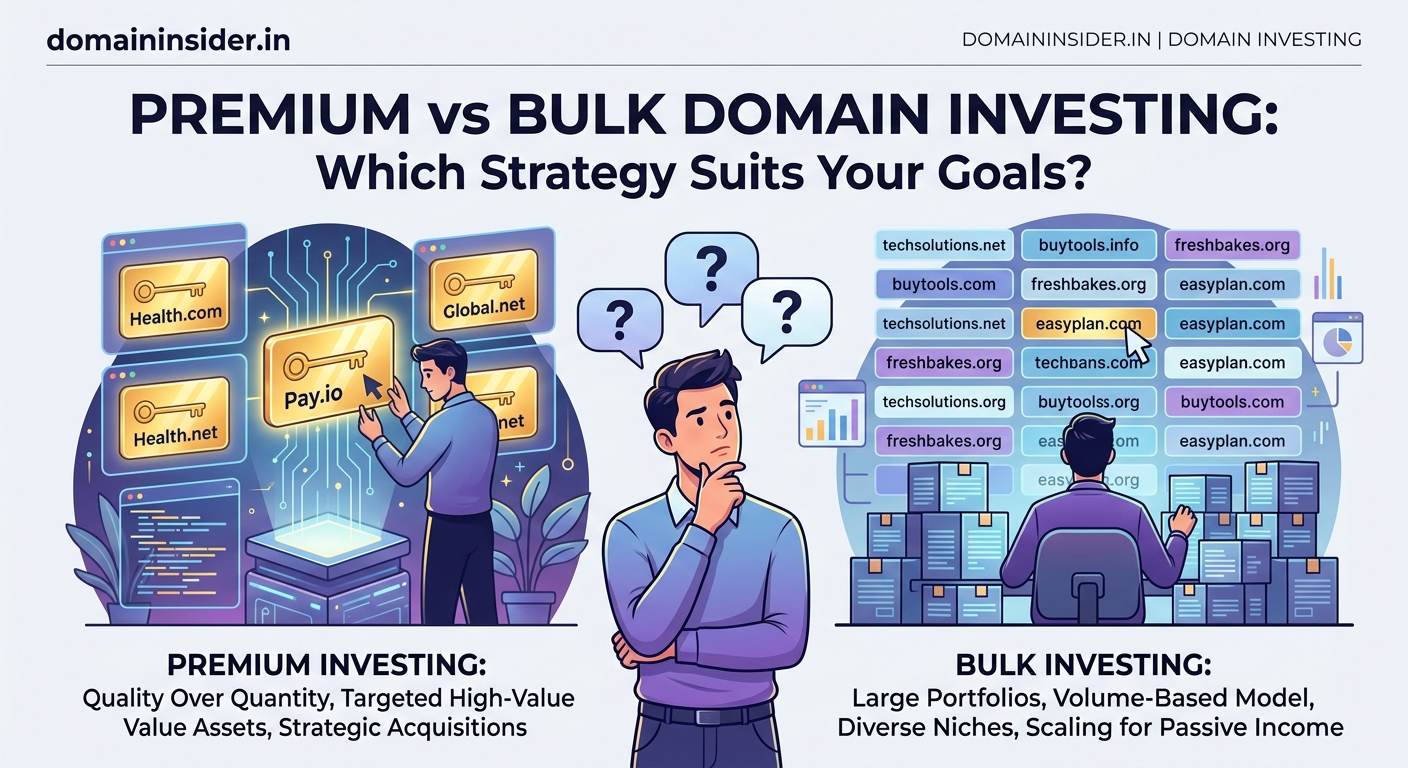
Premium and bulk strategies carry completely different risk signatures.
Premium investing concentrates risk. If you own 5 domains worth ₹5,00,000 total and one proves unsellable, that’s 20% of your portfolio dead. Market shifts can strand your entire investment.
The 2020 pandemic crushed travel domain values overnight. Investors holding TravelAgency.in or TourPackages.co.in watched their assets plummet. Premium investors felt this acutely because each domain represented a larger capital slice.
Bulk investing spreads risk across hundreds of bets. If 30% of your domains never sell, you still have 70% generating potential returns. Diversification protects you from category-specific crashes.
But bulk has its own risks: renewal cost creep, attention fragmentation, and the temptation to hold junk domains hoping for miracle sales.
Consider your psychological makeup:
- Risk-averse investors prefer bulk because no single domain failure destroys the portfolio
- Risk-tolerant investors enjoy premium because massive wins justify occasional total losses
- Balanced investors blend both, using bulk for cashflow and premium for home-run potential
Should you buy an expired domain? Complete risk and reward analysis helps you understand another dimension of risk management across both strategies.
Time commitment and management overhead
Premium domains demand less daily attention but more strategic thinking.
You might spend 2-5 hours weekly managing a premium portfolio: researching potential buyers, crafting outreach emails, monitoring industry news, and negotiating deals.
The work is quality over quantity. Each interaction matters because each sale is significant.
Bulk portfolios require systematic processes. You need spreadsheets tracking renewal dates, automated listing tools, pricing algorithms, and regular portfolio pruning.
Expect 10-15 hours weekly for a 500-domain portfolio. The work is repetitive: uploading domains to marketplaces, responding to lowball offers, deciding which domains to renew, and identifying new registration opportunities.
Many bulk investors automate heavily:
- Auto-renewal for domains under ₹1,000
- Template responses for common buyer questions
- Bulk listing tools that push domains to multiple marketplaces
- Price calculators based on domain metrics
Premium investors automate less because each domain deserves custom treatment.
Sales velocity and profit timelines
Bulk portfolios generate faster initial sales but smaller individual profits.
You might sell your first bulk domain within 30-60 days. It won’t be life-changing money, maybe ₹5,000 to ₹25,000. But regular small sales create momentum and cashflow.
A healthy bulk portfolio might generate 20-50 sales annually. Each sale returns 3x to 15x your registration cost. Total annual profit could range from ₹1,00,000 to ₹10,00,000 depending on portfolio size and quality.
Premium sales are rare but transformative.
You might wait 12-24 months for your first premium sale. But that single transaction could return ₹5,00,000 on a ₹50,000 investment. Or ₹50,00,000 on a ₹5,00,000 investment.
The math works differently. Premium investors might make 1-3 sales annually from a 10-domain portfolio. But each sale moves the needle significantly.
Smart investors use where should you list your domain? Comparing top marketplaces for Indian sellers to maximize visibility across both strategies.
Buyer profiles and negotiation dynamics
Premium and bulk domains attract fundamentally different buyers.
Premium buyers are typically:
- Established businesses rebranding or expanding
- Well-funded startups seeking brand authority
- Marketing agencies acquiring assets for clients
- Other domain investors looking for trophy additions
These buyers understand domain value. They negotiate seriously but respect quality. Expect longer sales cycles, formal contracts, and escrow services. Many premium sales involve payment plans because should you accept instalments when selling premium domains? becomes a relevant consideration.
Bulk buyers are usually:
- Small business owners needing a web presence
- Freelancers launching side projects
- Local service providers wanting exact-match domains
- First-time entrepreneurs on tight budgets
These buyers are price-sensitive. They want domains but won’t overpay. Negotiations are often brief: they accept your asking price, counter once, or disappear.
Your negotiation approach must adapt. Premium sales require patience and relationship building. Bulk sales need efficiency and volume processing.
Building your strategy step by step
Here’s how to choose and execute your preferred approach:
-
Assess your starting capital honestly. If you have less than ₹1,00,000, bulk is your logical starting point. Between ₹1,00,000 and ₹5,00,000, consider a hybrid approach. Above ₹5,00,000, premium becomes viable.
-
Calculate your risk tolerance. Can you stomach seeing ₹2,00,000 locked in a single domain for two years? If not, bulk’s diversification will help you sleep better.
-
Evaluate your available time. Premium suits busy professionals who can dedicate focused weekend hours. Bulk requires consistent daily or weekly attention to manage volume.
-
Research your target market. Indian startups, local businesses, international buyers? Your buyer profile should influence whether you chase premium .com domains or bulk .in variations.
-
Start small and test. Register 10-20 bulk domains or acquire 1-2 lower-tier premium domains. Learn the sales process before scaling capital commitment.
-
Track metrics religiously. Monitor cost per acquisition, average sale price, time to sale, renewal costs, and net profit. Data reveals which strategy actually works for your situation.
-
Adjust based on results. If your bulk domains sell consistently, scale up. If your premium domain attracts serious inquiries, consider acquiring similar assets.
Many investors discover their preference through experience rather than theory. Domain flipping in India: real case studies of 10x returns shows how both strategies produce winners.
Common mistakes that drain profits
Avoid these costly errors regardless of your chosen strategy:
Premium investing mistakes:
- Overpaying for mediocre domains because they seem “premium”
- Holding domains too long hoping for unrealistic prices
- Ignoring market trends that devalue your categories
- Failing to actively market your premium assets
- Accepting lowball offers out of impatience
Bulk investing mistakes:
- Registering hundreds of worthless domains just to hit volume targets
- Letting renewal costs spiral beyond potential sale revenue
- Pricing too high and scaring away small-business buyers
- Neglecting portfolio pruning and holding dead weight
- Spreading attention so thin that nothing gets proper marketing
Universal mistakes:
- Not researching trademark conflicts before buying
- Skipping proper valuation and guessing prices randomly
- Ignoring 5 common domain name mistakes every first-time buyer should avoid
- Failing to use escrow services for transactions above ₹25,000
- Missing renewal deadlines and losing valuable domains
This table summarizes what works and what fails:
| Approach | What Works | What Fails |
|---|---|---|
| Premium | Patience, targeted outreach, quality over quantity | Impulse buying, emotional attachment, unrealistic pricing |
| Bulk | Volume, automation, regular pruning | Hoarding junk, manual processes, ignoring renewals |
| Both | Market research, proper valuation, escrow usage | Trademark violations, poor record-keeping, tax ignorance |
Hybrid approaches for balanced portfolios
Most experienced investors eventually blend both strategies.
A typical hybrid portfolio might include:
- 2-3 premium domains worth ₹1,00,000 to ₹5,00,000 each
- 50-100 mid-tier domains worth ₹5,000 to ₹25,000 each
- 100-200 bulk domains worth ₹2,000 to ₹10,000 each
This structure provides multiple benefits. Premium domains offer home-run potential. Mid-tier domains generate consistent mid-sized sales. Bulk domains create regular cashflow and learning opportunities.
Your capital allocation might look like this:
- 40% in premium assets
- 30% in mid-tier domains
- 20% in bulk holdings
- 10% cash reserve for opportunistic acquisitions
The hybrid approach lets you participate in domain auction strategies that actually win without overpaying while maintaining steady sales velocity from your bulk inventory.
Rebalance quarterly based on performance. If your premium domains attract strong interest, shift more capital there. If bulk sales exceed expectations, scale that segment.
Market indicators that influence strategy choice
External factors should shape your strategic direction.
Premium becomes more attractive when:
- Economic growth accelerates and businesses have marketing budgets
- New industries emerge creating demand for category-defining domains
- International buyers show interest in Indian digital assets
- Domain sale prices trend upward in your target categories
Bulk becomes more attractive when:
- Small business formation increases
- New gTLDs launch offering cheap registration opportunities
- Local markets digitize rapidly creating demand for geo-domains
- Your target categories show consistent but modest price appreciation
7 market indicators every domain investor should monitor in 2024 helps you track these signals systematically.
The Indian market shows interesting patterns. Why .in domains are becoming the first choice for Indian startups in 2024 suggests growing premium potential for quality .in assets, while bulk opportunities remain strong in tier-2 and tier-3 city categories.
Tax implications and legal considerations
Both strategies create tax obligations you must understand.
Domain sales generate capital gains. Short-term gains (domains held under 36 months) are taxed at your income tax slab rate. Long-term gains receive preferential treatment.
Premium investors often hold domains beyond 36 months, qualifying for long-term capital gains treatment. This can significantly reduce tax liability on large sales.
Bulk investors typically flip faster, incurring short-term capital gains. Higher sales volume means more frequent tax events and detailed record-keeping requirements.
Maintain meticulous records:
- Purchase date and price for every domain
- Renewal costs (these increase your cost basis)
- Sale date and price
- Marketplace fees and transaction costs
- Currency conversion rates for international sales
Consult a chartered accountant familiar with digital asset taxation. Domain investing creates unique situations that generic tax advice might miss.
Also verify that your domains don’t infringe trademarks. A cease-and-desist letter can force you to surrender a domain without compensation, destroying your investment instantly.
Scaling your chosen strategy over time
Growth looks different for premium versus bulk investors.
Scaling premium investing:
Start with one quality domain. Learn the sales process completely. Once you’ve made your first premium sale, reinvest 50-70% of profits into your next acquisition.
Build relationships with brokers who handle premium transactions. They’ll alert you to off-market opportunities before public listings.
As your portfolio grows to 10-15 premium domains, consider hiring a part-time virtual assistant to handle routine inquiries, letting you focus on high-value negotiations.
Scaling bulk investing:
Begin with 50-100 domains. Track which categories and patterns sell fastest. Double down on winners, abandon losers.
Automate ruthlessly. Use portfolio management software, bulk listing tools, and template-based communication systems.
At 500+ domains, consider partnering with a marketplace that offers revenue sharing on your inventory. This reduces renewal burden while maintaining upside potential.
Many successful investors eventually specialize. You might focus exclusively on premium .com domains in the fintech category. Or bulk .in domains for Indian cities and services.
Specialization builds expertise, which improves acquisition quality and sales effectiveness. Where to find undervalued premium domains in the Indian market becomes easier when you know one niche deeply.
Learning from successful Indian domain investors
The Indian domain market has produced impressive success stories across both strategies.
Premium investors who acquired domains like Jobs.in, Realty.in, or Insurance.in years ago have seen valuations multiply 50x or more. These investors understood India’s digital transformation early and positioned accordingly.
Bulk investors who systematically registered city-service combinations (DelhiCaterers.in, MumbaiPhotographers.co.in) have built sustainable businesses generating ₹5,00,000 to ₹25,00,000 annually through volume sales.
7 Indian domain investors who made lakhs selling premium domains reveals common patterns: patience, market research, professional presentation, and willingness to walk away from bad deals.
The most successful investors share these traits:
- They treat domain investing as a business, not a hobby
- They maintain detailed financial records and track ROI rigorously
- They continuously educate themselves about market trends
- They network with other investors and share insights
- They’re willing to take calculated risks but never bet everything on one strategy
Finding the right path for your goals
Your personal situation should drive your strategic choice.
Choose premium investing if you:
- Have ₹5,00,000+ in investment capital
- Can wait 12-24 months for returns without financial stress
- Enjoy deep research and strategic thinking
- Prefer quality over quantity
- Have limited time but can focus intensely when needed
Choose bulk investing if you:
- Have ₹50,000 to ₹2,00,000 to invest
- Need cashflow within 3-6 months
- Enjoy systematic processes and data analysis
- Can dedicate 10-15 hours weekly to portfolio management
- Want to learn domain investing without catastrophic risk
Choose a hybrid approach if you:
- Have ₹2,00,000 to ₹5,00,000 available
- Want both stability and upside potential
- Can dedicate 5-10 hours weekly
- Enjoy variety in your investment activities
- Want to test both strategies before committing fully
Neither strategy is inherently superior. Premium investing isn’t more sophisticated or professional than bulk. Bulk isn’t safer or smarter than premium.
They’re different tools for different situations. The best strategy is the one you’ll actually execute consistently.
Start where you are. Use what you have. Learn as you go.
Your next steps in domain investing
You now understand the fundamental differences between premium and bulk domain investing.
Premium offers concentrated bets on exceptional assets with potentially massive returns. Bulk provides diversified exposure with faster initial sales and learning opportunities.
Your budget, risk tolerance, time availability, and personality will determine which path makes sense. Most investors eventually blend both approaches as they gain experience and capital.
The domain market rewards preparation, patience, and consistent execution. Whether you’re hunting for that one perfect premium domain or building a 500-domain bulk portfolio, success comes from treating this as a real business.
Start small. Track everything. Learn from every sale and every domain that doesn’t sell. Adjust your strategy based on results, not emotions.
The beautiful part? You can start today. Register your first domain, list it properly using 7 proven strategies to sell your domain name faster in 2024, and begin your journey.
Your first sale will teach you more than any article ever could. So stop reading and start doing.
