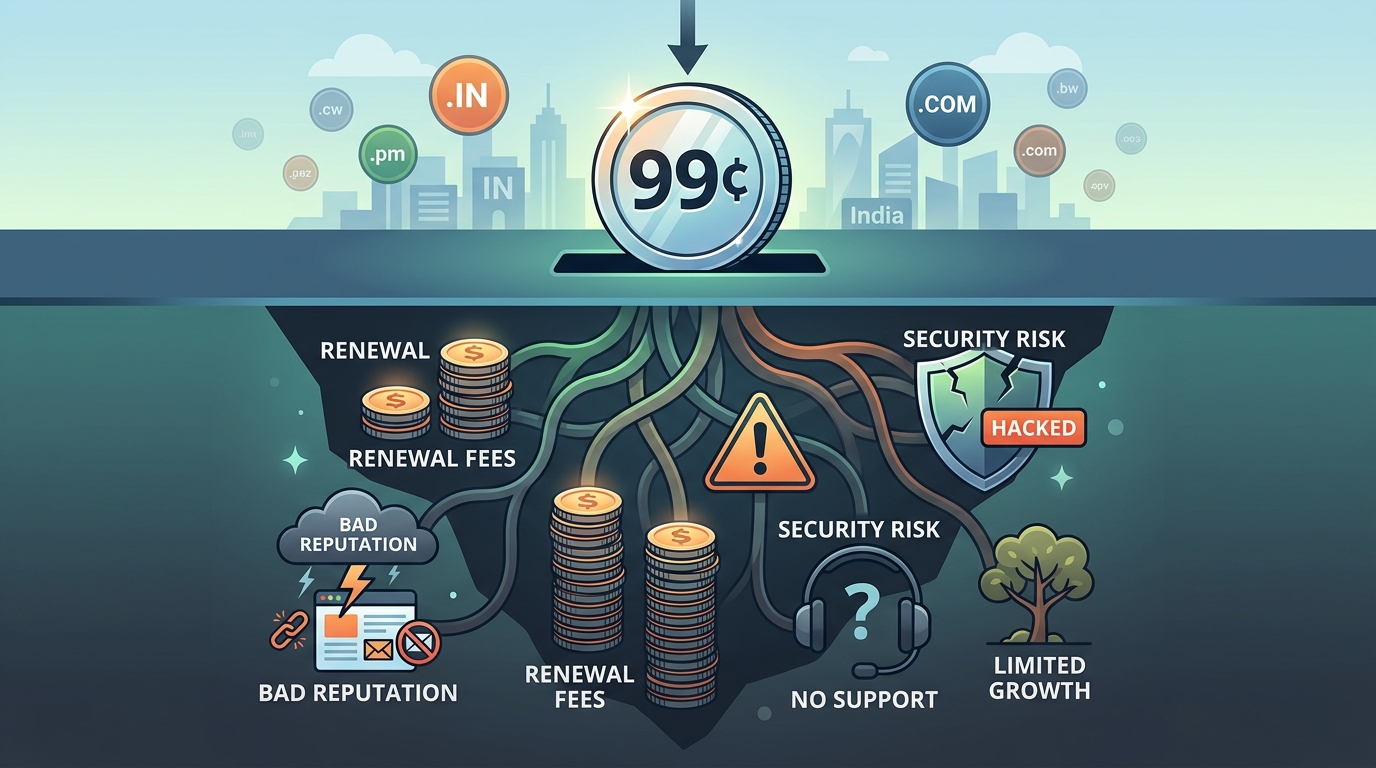
That ₹99 domain offer looks tempting, doesn’t it? You’re about to launch your first website, and saving money on the domain seems like a smart move. But here’s what most registrars won’t tell you upfront: that bargain-basement price is just the hook. The real costs start showing up later, often when you’re least prepared to handle them.
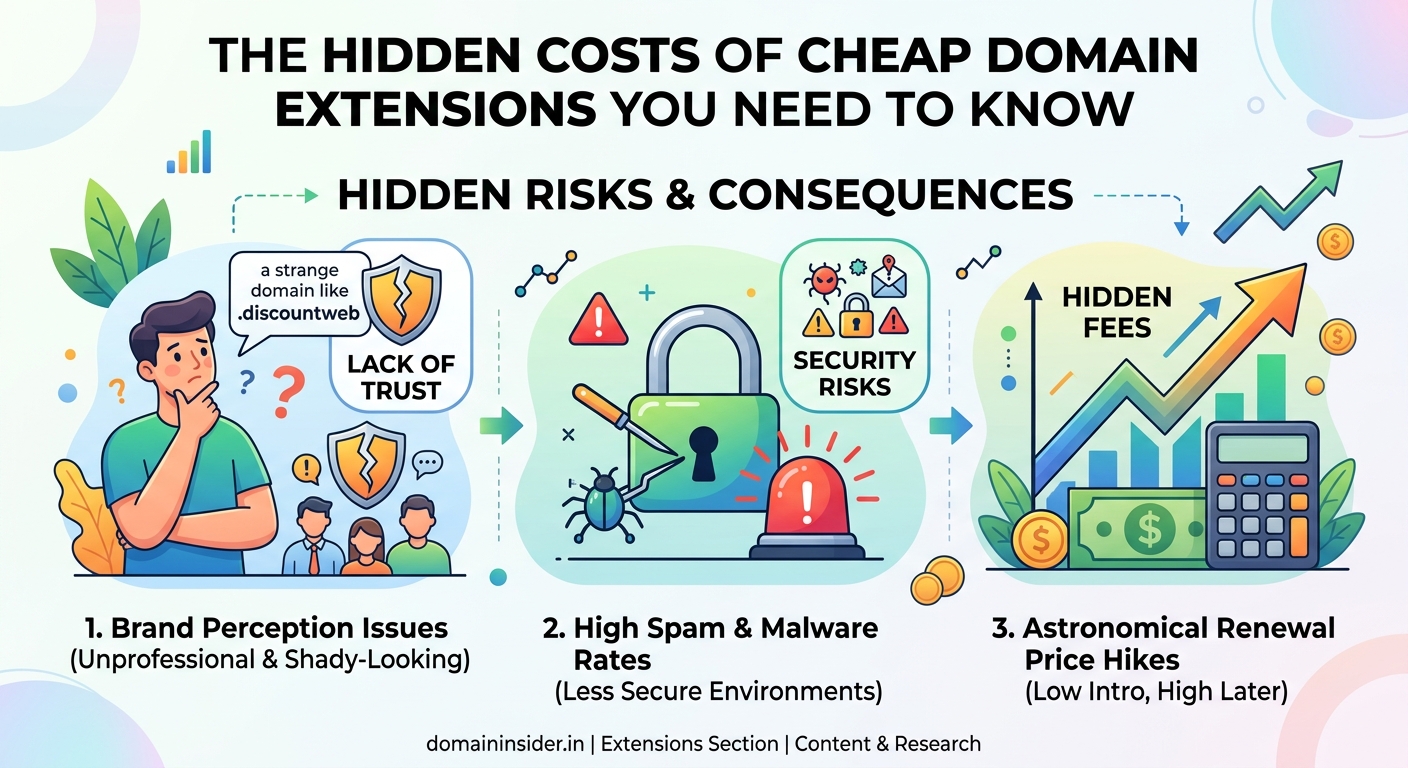
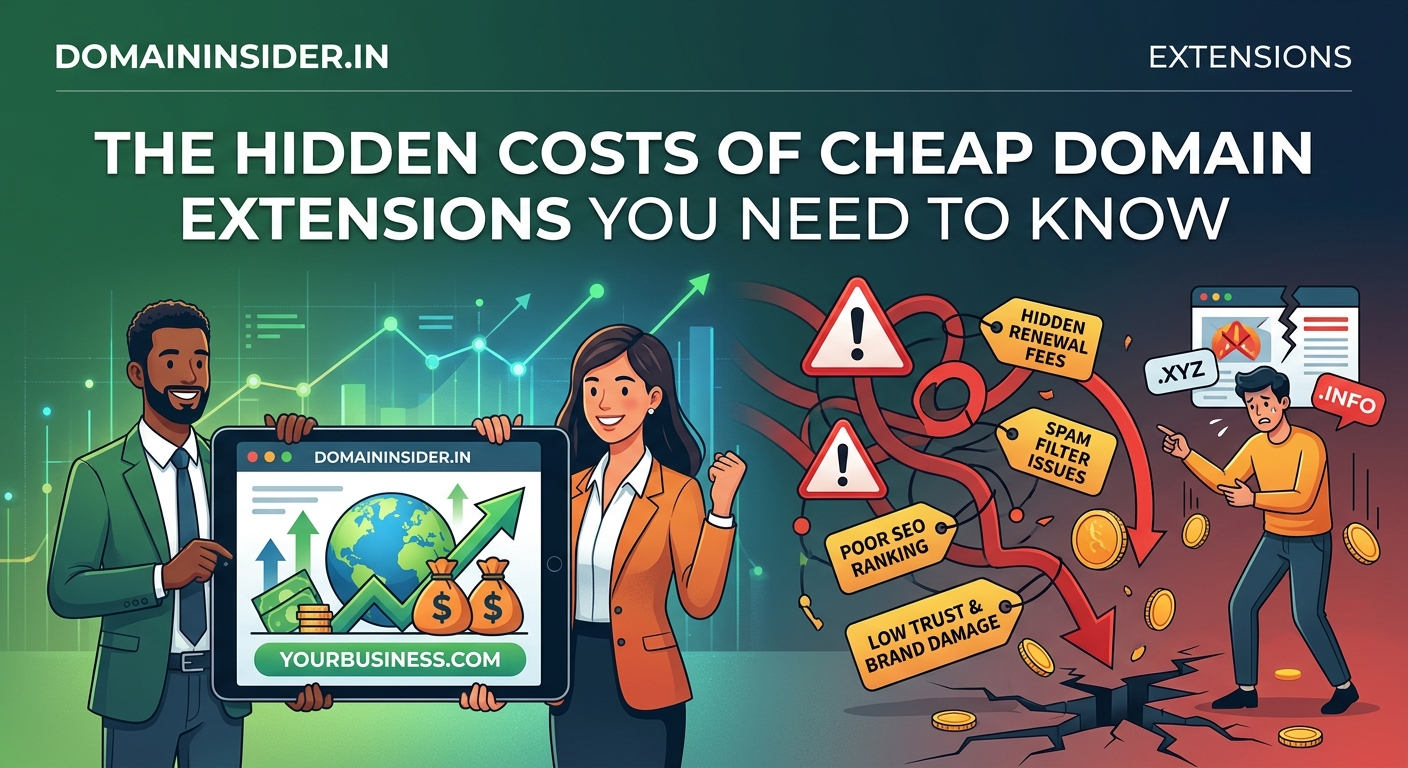
Cheap domain extensions often come with steep renewal rates, mandatory privacy add-ons, limited transfer options, poor search engine perception, and restricted functionality. The first-year discount can lead to annual costs that are 5 to 10 times higher, making premium extensions like .com or .in more economical over a three-year period for serious business owners.
The renewal price trap nobody talks about
You paid ₹99 for your .xyz domain. Feels great, right?
Wait until year two.
That same domain now costs ₹899 to renew. Some extensions jump to ₹1,200 or more. Registrars count on you forgetting to check renewal rates before buying. They know you’ll be invested in your domain name by then. Moving becomes a hassle, so most people just pay up.
Here’s how to spot this trap before it catches you:
- Check the renewal price on the registrar’s pricing page before checkout
- Calculate the three-year total cost, not just the first year
- Compare that total against a standard .com or .in domain over the same period
- Factor in any mandatory add-ons that come with renewal
Many Indian businesses have learned this lesson the hard way. A Mumbai-based designer bought five .club domains at ₹149 each. Renewal time came around, and the bill was ₹4,500 for all five. A single .com would have cost ₹799 per year, saving her money even with multiple sites.
The cheapest domain at checkout is rarely the cheapest domain after three years. Always calculate total cost of ownership, not just the attractive first-year rate.
Privacy protection becomes a recurring tax
Most premium extensions include WHOIS privacy for free. Cheap extensions often charge separately for it.
And you absolutely need privacy protection.
Without it, your personal details become public. Name, email, phone number, physical address. All visible to anyone who runs a WHOIS lookup. Spammers harvest this data. Scammers use it for phishing. Competitors get your contact information.
Privacy protection hides your details behind the registrar’s information. For cheap domains, this service costs extra:
- ₹299 to ₹599 per year for basic privacy
- ₹799 to ₹1,200 for premium privacy with additional features
- Some registrars bundle it but increase the renewal rate instead
That ₹99 domain just became ₹500 in year one, and over ₹1,000 annually after that. Understanding common domain name mistakes every first-time buyer should avoid helps you spot these charges before committing.
Transfer fees and lock-in tactics
Cheap domains often come with transfer restrictions that premium extensions don’t have.
Some extensions require you to wait 60 days after registration before transferring. Others charge hefty unlock fees. A few registrars make the transfer process so complicated that you give up and stay put.
Here’s what transfer restrictions look like in practice:
| Extension Type | Typical Transfer Fee | Lock Period | Additional Barriers |
|---|---|---|---|
| Premium (.com, .in) | Free or ₹0-200 | 60 days | Minimal |
| Budget (.xyz, .online) | ₹299-799 | 60-90 days | Manual approval needed |
| Promotional (.club, .site) | ₹499-1,200 | 90 days | Must renew before transfer |
The lock-in becomes expensive when you want to consolidate domains or switch to a better registrar. You’re stuck paying premium renewal rates at your current registrar because moving costs more than staying.
Search engine perception matters more than you think
Google doesn’t officially penalize cheap domain extensions. But users do.
A .com domain gets clicked more often than a .xyz in search results. People trust familiar extensions. They hesitate when they see unusual ones. This affects your click-through rate, which indirectly impacts your rankings.
Studies show these click-through differences:
- .com domains: baseline performance
- .in and .co.in domains: 85-95% of .com performance in India
- .org and .net domains: 70-80% of .com performance
- Newer budget extensions: 40-60% of .com performance
Lower click-through rates mean Google sees your result as less relevant. Your ranking drops over time. You need more SEO work to compensate. That costs money in tools, content, and time.
Small businesses in competitive niches can’t afford this handicap. A Delhi restaurant using a .menu domain struggled with local SEO despite good reviews. After switching to .in, their local pack rankings improved within two months. The domain change wasn’t the only factor, but it removed a barrier.
Email deliverability takes a hit
Cheap domains get abused by spammers. A lot.
Email providers know this. They treat messages from certain extensions with extra suspicion. Your legitimate business emails land in spam folders. Customers never see your quotes. Suppliers miss your orders.
This happens because:
- Spammers register thousands of cheap domains for phishing campaigns
- Email filters flag entire extensions as high-risk
- Your domain gets grouped with the bad actors by association
- Building sender reputation takes longer and requires more effort
Professional email becomes unreliable. You might need to pay for a third-party email service with better deliverability. That’s another ₹500 to ₹2,000 per year on top of your domain costs.
A Bangalore startup using a .top domain lost three client deals because their proposals went to spam. The clients assumed the company wasn’t interested. Switching to a .com and using proper email authentication fixed the problem, but the lost revenue hurt.
Limited functionality and integration issues
Some platforms and services don’t recognize newer domain extensions.
Payment gateways reject them. SSL certificate providers charge more for them. Certain business tools won’t validate them in their systems. You discover these limitations after you’ve built your brand around the domain.
Common integration problems include:
- Payment processors requiring manual verification for unusual extensions
- Free SSL certificates not supporting certain TLDs
- Email marketing platforms flagging your domain as suspicious
- Business directories not accepting newer extensions in their listings
- Government portals and banking systems rejecting them in forms
Each workaround costs time and often money. Manual verification takes days. Premium SSL certificates cost ₹2,000 to ₹5,000 yearly. You might need to maintain a secondary .com domain just for payment processing.
The credibility cost you can’t measure
Your domain extension shapes first impressions.
Clients judge your professionalism partly by your web address. A .com or country-specific extension signals stability. Unusual extensions make people pause. They wonder if you’re legitimate. They question if you’ll be around next year.
This credibility gap affects:
- B2B sales where trust is everything
- Professional services like consulting or legal work
- E-commerce where customers share payment information
- Local businesses competing against established brands
- Any business seeking partnerships or investors
You can’t put a precise number on lost opportunities from credibility concerns. But they add up. A graphic designer in Pune noticed clients asking more verification questions after rebranding to a .design domain. Switching back to .com reduced those friction points.
Promotional pricing disappears fast
Registrars rotate which extensions they discount. This month it’s .online. Next month it’s .site. The month after, your extension isn’t on sale anymore.
You bought multiple domains during a promotion. Renewal time comes, and only one is still discounted. The others revert to full price. Your domain portfolio costs balloon unexpectedly.
Budget for full-price renewals from day one. Treat promotional pricing as a bonus, not a guarantee. If you’re building a business around a domain name, knowing how to register a domain name in India with realistic cost expectations prevents budget shocks later.
Add-on services become mandatory
Cheap domains often require add-ons that come standard with premium extensions.
DNS management might cost extra. Advanced DNS features like DNSSEC protection add another fee. Email forwarding becomes a paid service. Domain forwarding and masking cost more.
Here’s what “extras” actually cost annually:
- Advanced DNS management: ₹299-599
- DNSSEC protection: ₹199-399
- Email forwarding (5 addresses): ₹399-799
- Domain privacy: ₹299-599
- SSL certificate: ₹1,500-5,000
Add these up, and your ₹99 domain costs ₹2,500 to ₹3,500 yearly with basic functionality. A ₹799 .com with included features becomes the better deal.
Customer support quality drops
Premium domain registrars compete on service. Budget registrars compete on price.
When something goes wrong with a cheap domain, support is often:
- Email-only with 48-72 hour response times
- Staffed by undertrained representatives
- Limited to business hours in a different time zone
- Scripted responses that don’t address your specific issue
- No phone support or live chat options
Domain problems need fast resolution. Your site goes down, and you can’t wait three days for email support. You need someone who understands DNS, can check nameserver propagation, and fixes issues immediately.
Poor support costs you in downtime, lost sales, and stress. A Chennai e-commerce store lost ₹45,000 in sales during a 36-hour DNS issue that their budget registrar took two days to acknowledge. Better support would have resolved it in hours.
The migration headache multiplies
Decided to switch to a better extension? Moving an established website isn’t simple.
You need to:
- Set up 301 redirects from every old URL to the new domain
- Update all internal links in your content
- Change your Google Search Console and Analytics properties
- Notify Google of the domain change
- Update social media profiles and business listings
- Inform email subscribers and update email signatures
- Replace printed materials with the new domain
- Monitor for broken links and redirect issues
Each step takes time. Some require technical knowledge. Mistakes hurt your SEO. You might need to hire help at ₹5,000 to ₹25,000 depending on site complexity.
The hidden cost here is opportunity cost. Those hours spent on migration could have gone into growing your business. Starting with the right domain avoids this entirely.
Making smarter domain choices from the start
Cheap domains aren’t always bad. They work fine for personal blogs, test projects, or temporary campaigns. But for serious business use, the hidden costs of cheap domains often exceed the savings.
Calculate the real cost before buying:
- Add up three years of renewals, not just year one
- Include privacy protection in your budget
- Factor in any required add-ons for basic functionality
- Consider the credibility and SEO implications
- Account for potential integration and support issues
For most Indian businesses, a .in or .co.in domain offers the best value. They’re recognized locally, trusted by customers, and priced reasonably. If you’re targeting international markets, .com remains the gold standard despite higher costs.
When budget is tight, consider these alternatives to cheap extensions:
- Buy a shorter .in domain instead of a long .com
- Use a creative .com that’s available at standard pricing
- Check if undervalued premium domains in the Indian market fit your budget
- Wait and save for the right domain rather than settling for a cheap alternative
Your domain is your digital address. It’s how customers find you, remember you, and judge you. Saving ₹500 in year one isn’t worth the thousands you’ll spend fixing problems later.
Building your web presence on solid ground
The right domain extension supports your business instead of creating obstacles.
You won’t worry about renewal sticker shock. Your emails will reach customers. Search engines will treat your site fairly. Integrations will work smoothly. Support will be there when you need it.
These aren’t small benefits. They’re the foundation of reliable online presence.
Take the time to research before registering. Read the fine print on renewal pricing. Check what’s included and what costs extra. Calculate total ownership costs over three to five years. Choose based on long-term value, not short-term savings.
Your future self will thank you when renewal time comes around and the bill makes sense. When your emails land in inboxes instead of spam folders. When customers trust your domain enough to complete purchases. When you’re building your business instead of fighting your domain choice.
Start with the right foundation, and everything else gets easier.
