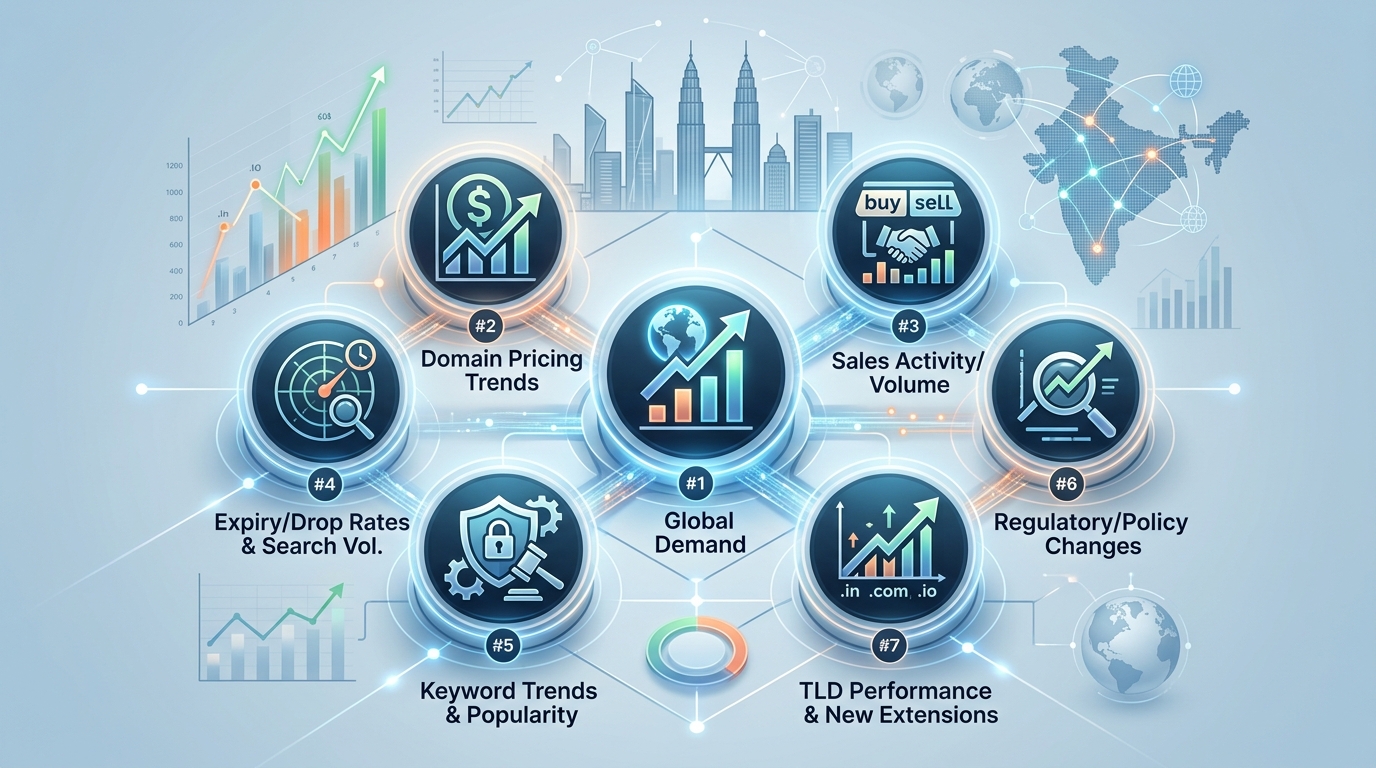
The domain investing landscape in India has transformed dramatically over the past year. What worked in 2023 might not deliver the same returns today. Smart investors now track specific market signals that separate profitable acquisitions from expensive mistakes.
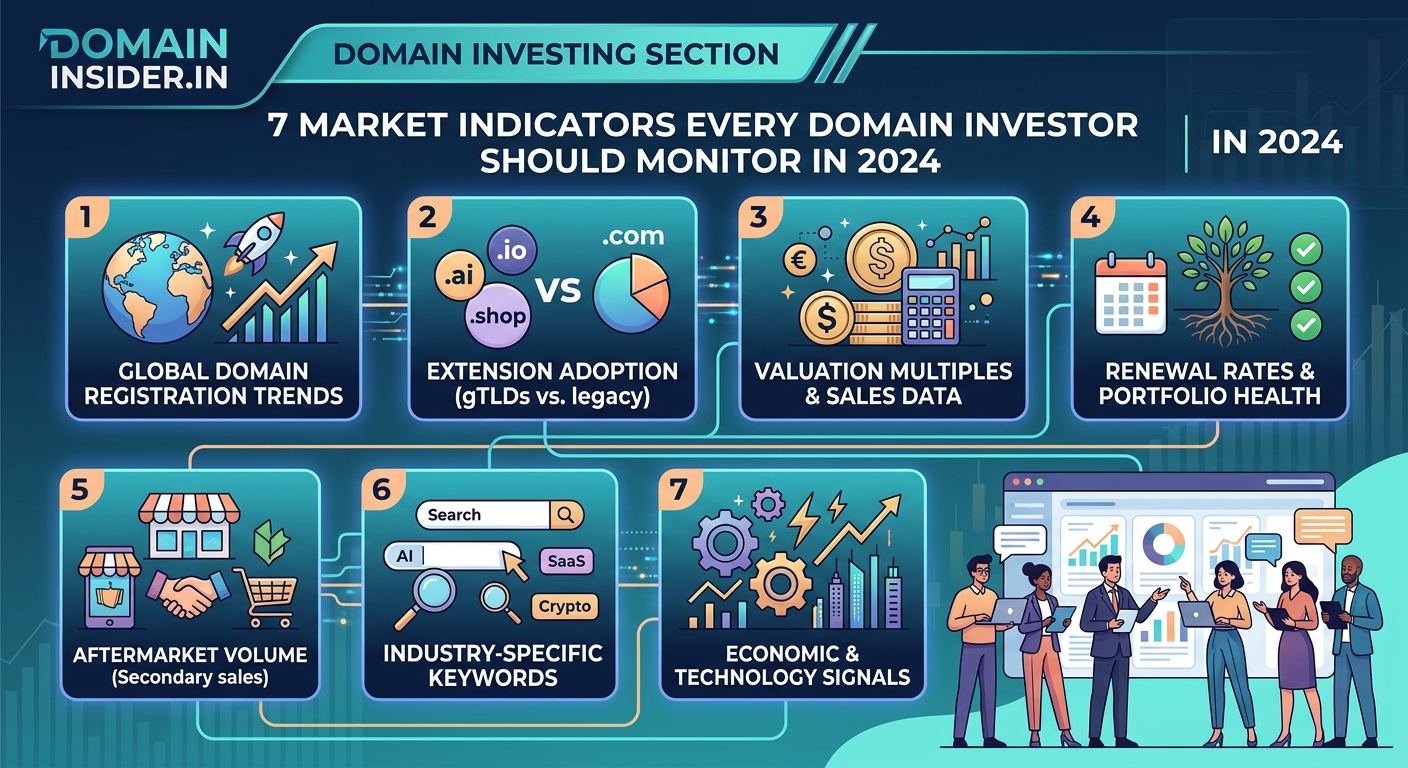
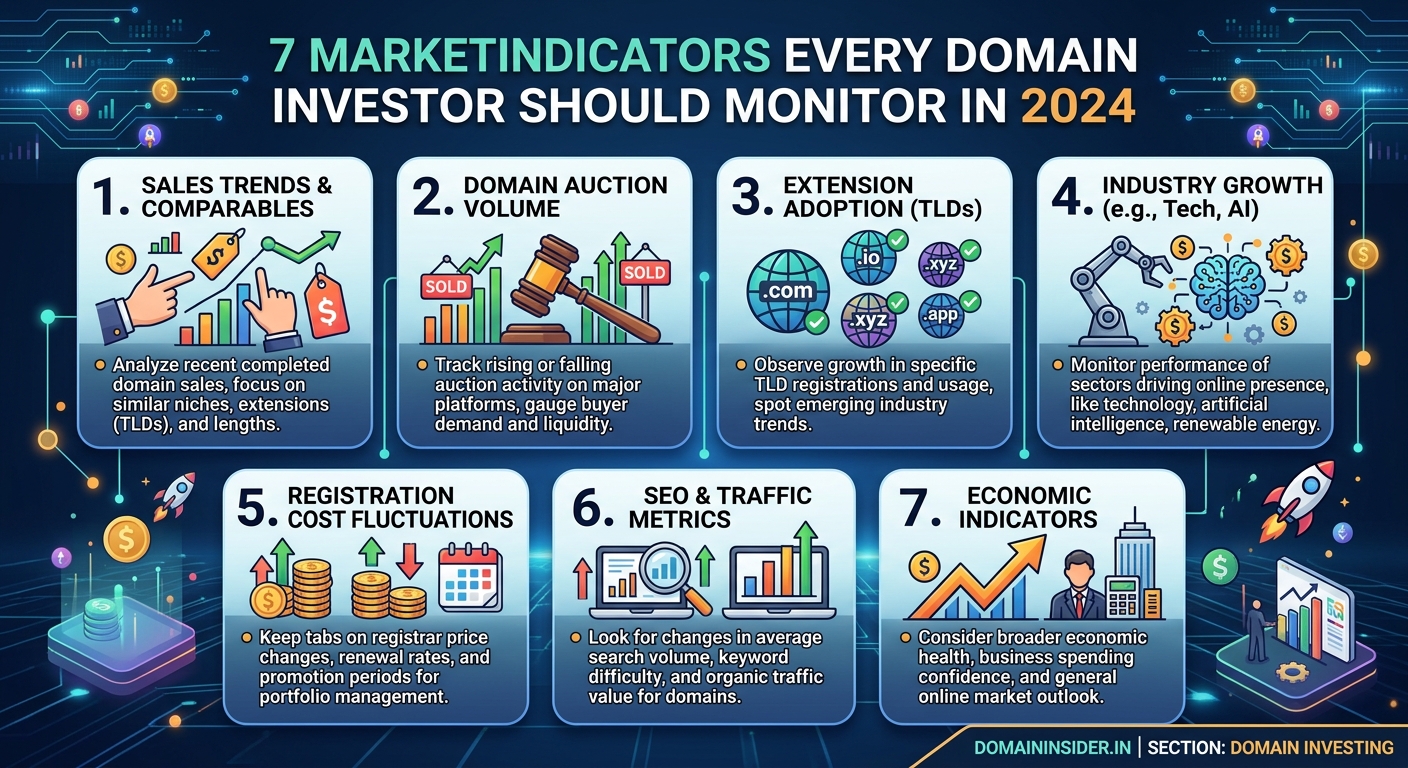
Successful domain investors in 2024 monitor seven critical indicators: search volume trends, extension popularity shifts, industry funding patterns, brandability metrics, aftermarket pricing data, renewal rate benchmarks, and geographic demand signals. Tracking these metrics helps identify undervalued assets before competition drives prices up, especially in India’s rapidly expanding digital economy where domain values can multiply within months.
Search volume trends reveal future demand
Google search data tells you what people want before they know they need it.
Rising search volumes for specific keywords indicate growing market interest. When searches for “electric scooter rental” jumped 340% in Bangalore last year, savvy investors snapped up related domains months before prices spiked.
You can access this data through free tools that show monthly search patterns. Focus on consistent growth over three to six months rather than temporary spikes around news events.
Here’s what matters:
- Sustained upward trends over seasonal variations
- Related keyword clusters showing similar growth
- Geographic concentration in tier-1 and tier-2 Indian cities
- Commercial intent keywords outperforming informational ones
“I made my best returns by buying domains six months before search volumes peaked. The data was already there. Most investors just weren’t looking at it systematically.” – Rajesh Kumar, domain investor since 2019
Compare current search volumes against historical data from the same period last year. A 50% year-over-year increase signals genuine opportunity. Anything less might just reflect normal market fluctuations.
7 free tools to check your domain name value in 2024 can help you validate search trends before making purchase decisions.
Extension popularity shifts change portfolio strategy
The .com extension still dominates, but 2024 data shows interesting shifts.
Indian startups now embrace .in domains at unprecedented rates. Registration data from Q1 2024 shows .in domains grew 47% while .com registrations in India increased only 12%.
This matters for your investment strategy.
| Extension Type | 2023 Growth | 2024 Growth | Investment Signal |
|---|---|---|---|
| .in | 23% | 47% | Strong buy for India-focused names |
| .com | 8% | 12% | Stable, premium pricing justified |
| .co.in | 15% | 19% | Moderate opportunity |
| .ai | 156% | 89% | Cooling but still valuable |
| .store | 34% | 61% | Rising for e-commerce brands |
New gTLDs like .store and .tech show strong adoption in specific sectors. E-commerce businesses increasingly choose .store over generic alternatives because it communicates purpose instantly.
Why .in domains are becoming the first choice for Indian startups in 2024 explains the psychological and practical reasons behind this shift.
Track registration velocity through domain registrar reports. When a specific extension shows accelerating adoption in your target industry, prices for premium names in that extension will follow within 60 to 90 days.
Industry funding patterns predict domain demand
Venture capital flows directly impact domain prices.
When Indian fintech companies raised ₹12,400 crore in Q4 2023, premium fintech domain prices jumped 67% within three months. Investors who tracked funding announcements bought relevant domains before this spike.
Follow these funding indicators:
- Monitor TechCircle, YourStory, and Inc42 for funding announcements
- Track sector-specific investment trends quarterly
- Identify emerging categories receiving first-time institutional money
- Purchase related domains within two weeks of major funding rounds
Edtech funding declined 43% in 2024, and corresponding domain prices dropped proportionally. Investors holding edtech portfolios faced longer selling cycles and lower offers.
The pattern repeats across sectors. Healthcare tech funding up 89% correlates with health-related domain appreciation. Climate tech investments doubled, pushing sustainability-focused domain values higher.
Geographic funding concentration matters too. Bangalore received 34% of all startup funding in 2024, making Bangalore-specific geo domains more valuable than equivalent Mumbai or Delhi variations.
Domain flipping in India shows real case studies of 10x returns demonstrates how investors capitalized on funding trends.
Brandability metrics separate premium from average
Numbers don’t lie about what makes domains valuable.
Brandable domains consistently sell for 3x to 15x more than keyword-exact matches. But “brandability” isn’t subjective anymore. Specific metrics quantify it.
Measure these factors:
- Pronounceability score: Can someone say it correctly after hearing it once?
- Spelling difficulty: Would someone misspell it when typing from memory?
- Length efficiency: Does it communicate maximum meaning in minimum characters?
- Cultural neutrality: Does it work across Indian languages without negative connotations?
Domains scoring high on all four metrics command premium prices regardless of search volume. “Zomato” had zero search volume before the company launched. The name’s inherent brandability created value.
Test potential acquisitions by saying them aloud to ten people. If more than two ask for spelling clarification, brandability suffers. If people remember it three days later without prompting, you’ve found something special.
Short domains (5-7 characters) with no numbers or hyphens consistently outperform longer alternatives. But a memorable 9-character brandable name beats a forgettable 5-character string.
5 common domain name mistakes every first-time buyer should avoid highlights how poor brandability assessment leads to illiquid investments.
Aftermarket pricing data shows true value
Listed prices mean nothing. Actual sale prices reveal market reality.
Public domain sales databases now record thousands of Indian transactions. This data shows what buyers actually pay, not what sellers hope to receive.
Analysis of 2,400 .in domain sales in 2024 reveals:
- 67% sold below asking price
- Average negotiation discount: 34%
- Median time to sale: 127 days
- Premium one-word domains: 18-day average sale time
Compare your target acquisition against recent comparable sales. A seller asking ₹2,50,000 for a domain when similar names sold for ₹85,000 to ₹1,20,000 signals overpricing.
Track these pricing benchmarks monthly:
- Average price per character for .in domains
- Premium multiplier for exact-match commercial keywords
- Geographic domain pricing (city names, regions)
- Industry-specific domain categories (fintech, edtech, healthtech)
How to negotiate domain prices like a pro and save thousands uses aftermarket data to build negotiation strategies.
Pricing data also reveals emerging opportunities. When average sale prices in a category decline while search volumes increase, you’ve found a temporary market inefficiency worth exploiting.
Renewal rate benchmarks indicate portfolio health
Renewal rates tell you what professional investors really think.
When domain investors choose not to renew holdings, they’re voting with actual money. Low renewal rates in specific categories signal declining confidence.
Industry data from major registrars shows:
- Generic keyword domains: 78% renewal rate
- Brandable invented names: 84% renewal rate
- Geographic domains: 71% renewal rate
- Numeric domains: 63% renewal rate
- Hyphenated domains: 52% renewal rate
Categories with renewal rates below 65% face structural challenges. Investors abandon these domains because selling them costs more time and effort than they’re worth.
Your portfolio should maintain renewal rates above industry averages. If you’re renewing less than 75% of your holdings, you’re probably acquiring marginal assets.
Calculate your renewal decision score:
- Estimate realistic sale price based on comparable sales
- Subtract total holding costs (registration, renewals, marketplace fees)
- Divide potential profit by months held
- Compare against alternative investments
Renew only when this calculation shows positive returns within your target timeframe. Professional investors typically expect portfolio turnover within 12 to 24 months.
Should you buy an expired domain with complete risk and reward analysis explains why some investors deliberately let domains expire.
Geographic demand signals create arbitrage opportunities
Location-based search patterns reveal untapped markets.
Domain investors typically focus on metro cities, but 2024 data shows explosive growth in tier-2 and tier-3 markets. Indore, Coimbatore, and Vadodara showed 89%, 76%, and 71% increases in domain-related searches respectively.
This creates pricing inefficiencies. A Bangalore-focused domain might cost ₹3,00,000 while an equivalent Indore domain sells for ₹45,000, despite Indore’s faster digital growth rate.
Monitor these geographic indicators:
- Local business directory growth rates
- Regional language content consumption
- City-specific e-commerce adoption
- Local startup ecosystem development
Jaipur’s startup ecosystem grew 134% in 2024, yet Jaipur-related domain prices remained flat. Early investors who recognized this disconnect acquired premium assets before the market corrected.
Geographic domains work best when they match:
- Cities with populations above 10 lakh
- Locations with established commercial districts
- Regions showing consistent GDP growth
- Areas with improving internet penetration
Where should you list your domain comparing top marketplaces for Indian sellers discusses how geographic targeting affects marketplace selection.
The tier-2 city opportunity window typically lasts 18 to 30 months before prices normalize. Identifying these markets early separates profitable investors from those chasing established trends.
Building your indicator tracking system
You now understand what to monitor. Implementation determines results.
Start with a simple spreadsheet tracking these seven indicators monthly. Set calendar reminders to update data on the first of each month. Consistency matters more than complexity.
Dedicate two hours monthly to:
- Reviewing search volume trends in your target categories
- Checking extension registration velocity reports
- Scanning funding announcement platforms
- Analyzing recent comparable domain sales
- Calculating category-specific renewal rates
- Researching emerging geographic markets
- Updating your portfolio valuation models
This systematic approach removes emotion from investment decisions. You’ll buy based on data, not hunches. You’ll sell when indicators suggest peak value, not when you need cash urgently.
How to build a profitable domain portfolio with just ₹50,000 shows how beginners can start tracking these indicators with limited capital.
The domain investors making consistent returns in 2024 aren’t smarter or luckier. They simply track the right indicators and act on signals before the broader market recognizes them. Your tracking system becomes your competitive advantage in an increasingly data-driven marketplace where gut feelings cost money and metrics create wealth.
