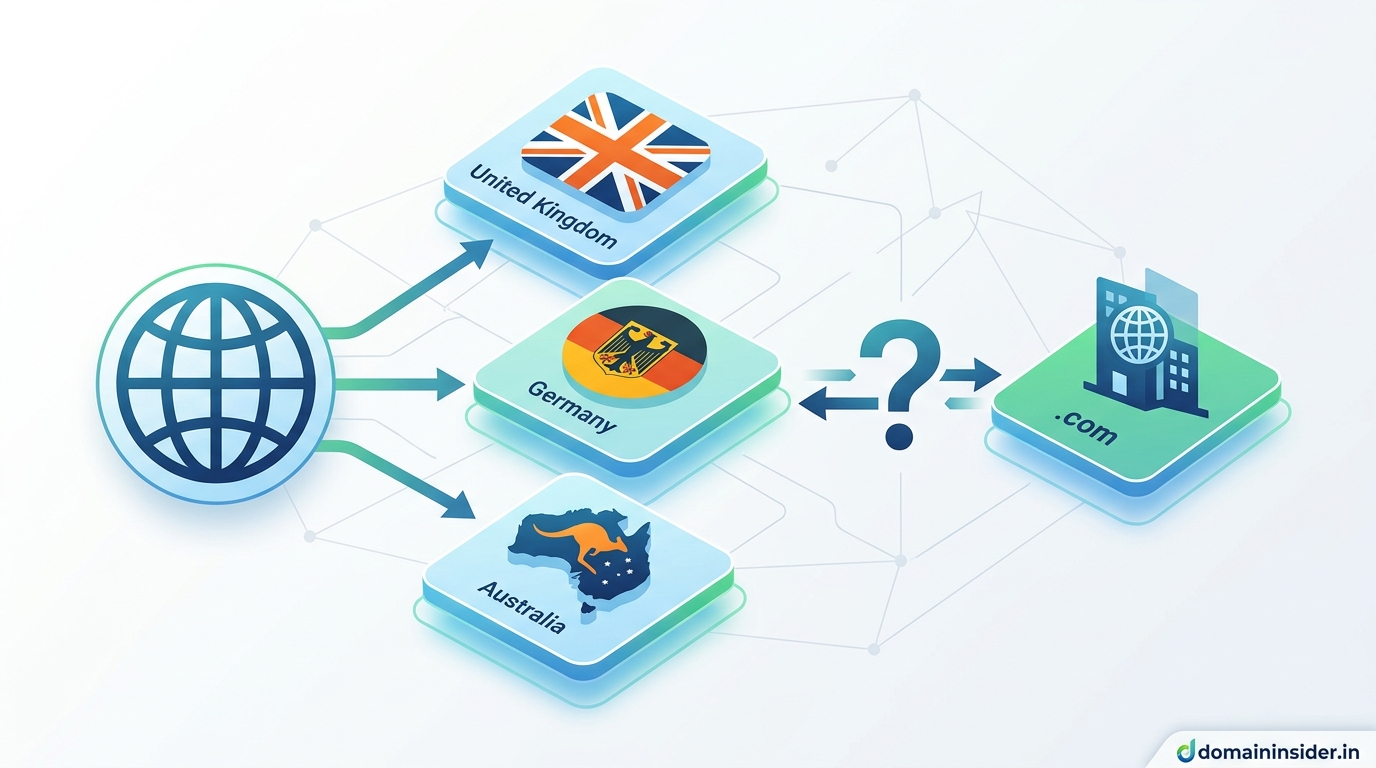
You’ve picked your business name. You’ve sketched the logo. Now you’re staring at a domain registrar page with two options: grab the .com or go local with a country code extension like .in, .uk, or .au.
The choice feels bigger than it should. And honestly, it is.
Your domain extension isn’t just a technical detail. It shapes how customers find you, trust you, and remember you. For small business owners and website creators across India and beyond, understanding the strategic difference between country code domains and .com can mean the difference between a site that thrives locally and one that struggles to connect.
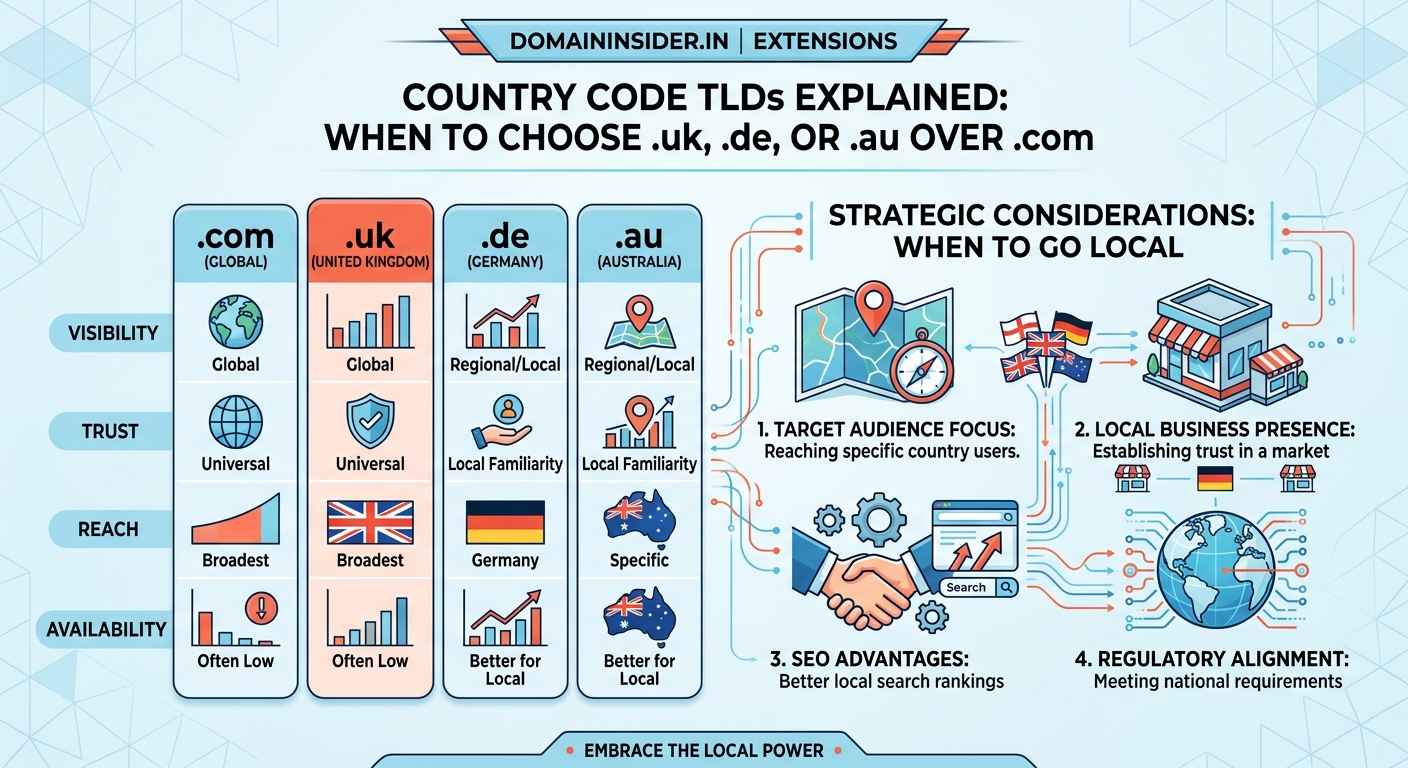
Country code domains like .in, .uk, or .de signal local presence and boost regional search rankings, whilst .com offers global recognition and credibility. Your choice depends on your target market geography, brand strategy, and SEO goals. Local businesses serving one country typically benefit more from country code extensions, whilst companies with international ambitions often prefer .com despite higher competition for available names.
What makes country code domains different from .com
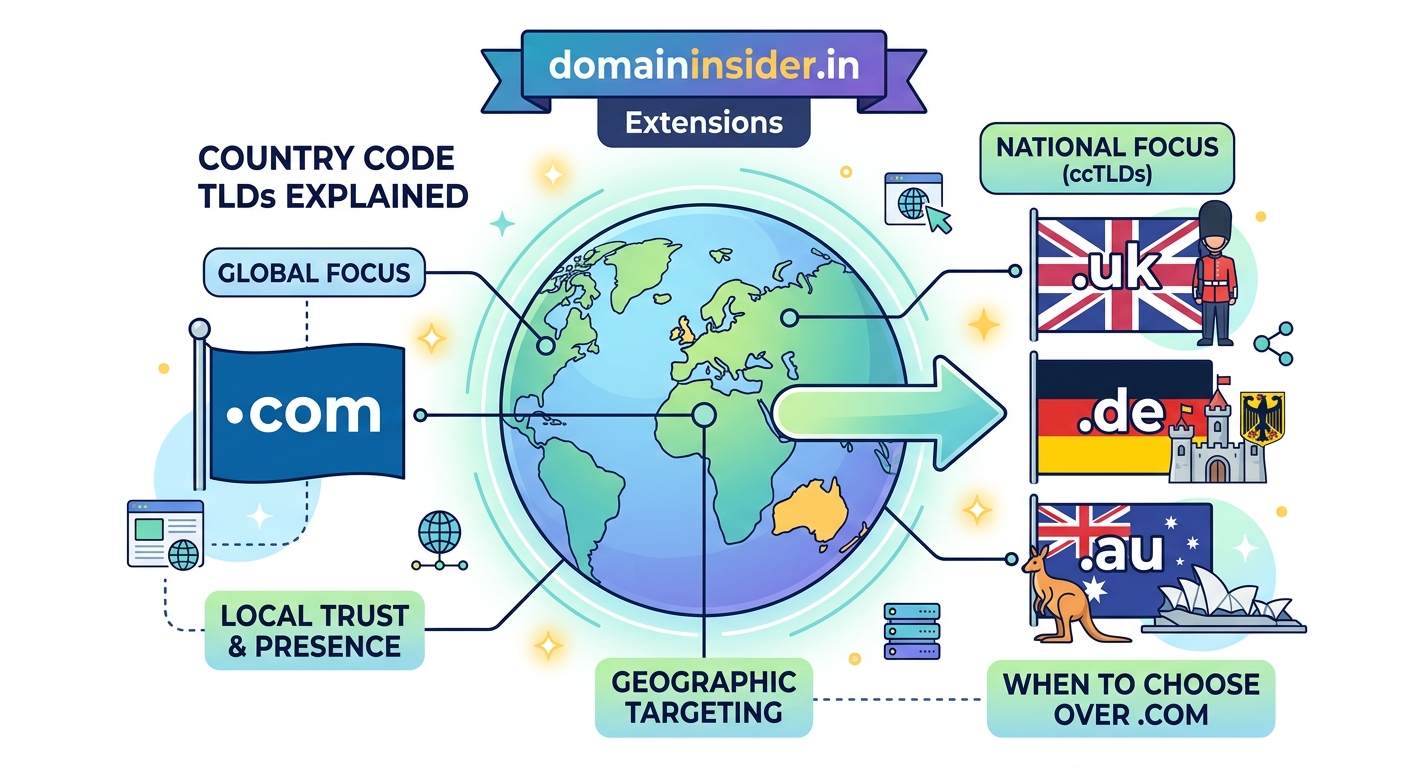
Country code top-level domains, or ccTLDs, represent specific countries or territories. Examples include .in for India, .uk for the United Kingdom, .de for Germany, and .au for Australia.
The .com extension, technically a generic top-level domain or gTLD, was originally meant for commercial entities but evolved into the default choice for businesses worldwide.
The technical difference is simple. The strategic difference runs much deeper.
Search engines treat ccTLDs as strong geographic signals. When you register a .in domain, Google and other search engines understand you’re targeting Indian users. This geographic targeting happens automatically, without any extra configuration.
The .com extension carries no inherent geographic signal. It’s neutral territory. That neutrality can be an advantage or a limitation, depending on your goals.
When country code domains give you a competitive edge
Local businesses serving a single market almost always benefit from country code extensions.
A Mumbai-based accounting firm using accountingpro.in immediately signals to potential clients that they understand Indian tax law, GST compliance, and local business practices. The same firm using accountingpro.com might be based anywhere, requiring visitors to hunt for location information.
Trust builds faster with local extensions. Indian consumers shopping for services often prefer .in domains because they signal a business subject to Indian regulations and consumer protection laws.
Availability matters too. Finding a good .com domain in 2024 feels like searching for an available username on a popular platform. Everything’s taken. Country code extensions offer far more options for short, memorable names.
Consider these scenarios where ccTLDs make strategic sense:
- Government contractors who only work with Indian agencies
- Regional food delivery services operating in specific cities
- Local news publications covering state or city events
- Professional services firms serving clients in one country
- E-commerce stores that only ship domestically
Search rankings in your target country typically improve with the matching ccTLD. Google’s algorithm gives preference to .in domains when users search from India, especially for queries with local intent like “chartered accountant near me” or “best biryani delivery.”
Why .com still dominates for certain business models
Some business models demand the global credibility that .com provides.
Software companies selling to international clients face an uphill battle with country code extensions. A SaaS platform using projectmanager.in might struggle to convince American or European businesses to trust their service, even if the product is excellent.
The .com extension carries decades of brand equity. It’s what people type first. It’s what they remember. It’s what feels legitimate to a global audience.
Investors and partners often view .com domains as more serious. Fair or not, a startup pitching with a .com domain may receive more favorable consideration than one using a ccTLD, especially when seeking international funding.
Brand protection requires .com ownership too. Even if you primarily use a country code domain, owning the .com version prevents competitors or domain squatters from confusing your customers. Many businesses register both and redirect one to the other.
These business types typically need .com:
- Software as a service platforms targeting multiple countries
- Digital product creators selling globally
- International consulting firms
- Tech startups seeking venture capital
- Media brands building worldwide audiences
- Online course creators with global students
The .com extension continues to dominate despite hundreds of alternatives precisely because of this accumulated trust and familiarity.
The hybrid approach many businesses take
Smart business owners don’t always choose one or the other exclusively.
A common strategy involves registering both extensions and using them strategically. Your primary brand might live on .com whilst you redirect the .in version to it, or vice versa depending on your market focus.
Some businesses operate different sites on each extension. The .com hosts the global corporate site whilst the .in version serves localized content, pricing in rupees, and India-specific offerings.
This approach requires more investment but protects your brand across markets and gives you flexibility as your business evolves.
Setting up your domain strategy step by step
- Define your primary market for the next 12 to 24 months. Where will most of your revenue come from?
- Register your preferred extension for that market first. If you’re 80% focused on India, start with .in.
- Check availability and pricing for the alternate extension. Can you afford to register both now?
- Set up proper redirects if you register multiple extensions. Don’t leave secondary domains parked or showing generic pages.
- Update your marketing materials to feature your primary domain consistently. Don’t confuse customers by switching between extensions.
Breaking down the cost and availability factors
Price differences between .com and country code domains vary significantly by extension and registrar.
| Extension | Typical Annual Cost | Availability | Best For |
|---|---|---|---|
| .com | ₹800 to ₹1,200 | Very Limited | Global brands, international reach |
| .in | ₹600 to ₹900 | Moderate | Indian businesses, local services |
| .co.in | ₹500 to ₹800 | Good | Indian companies, commercial entities |
| .uk | ₹700 to ₹1,000 | Limited | UK-focused businesses |
| .de | ₹600 to ₹900 | Moderate | German market targeting |
| .au | ₹1,000 to ₹1,500 | Limited | Australian businesses |
Country code extensions often cost less than .com, though premium names command high prices regardless of extension. The real cost difference comes from availability. You might find your perfect two-word business name available as a .in domain whilst the .com version sells for lakhs on the secondary market.
Before committing to any domain, avoid common mistakes first-time buyers make that can cost you time and money later.
How search engines treat different domain extensions
Google has repeatedly stated that domain extensions don’t directly impact search rankings. A .com site and a .in site have equal potential to rank well.
The indirect effects matter more.
Country code domains receive automatic geographic targeting. Your .in domain will perform better in Indian search results without any extra configuration. A .com domain requires you to manually set your target country in Google Search Console.
Local backlinks flow more naturally to country code domains. Indian websites linking to resources tend to prefer .in domains, assuming they’re more relevant to their audience. These local backlinks strengthen your regional SEO.
User behavior differs by extension too. Indian users clicking search results may favor .in domains, improving your click-through rate, which is a ranking signal Google considers.
“The domain extension you choose sends a signal about who you serve. Make sure that signal matches your actual target audience, or you’ll fight an uphill battle in search rankings and user trust.” — Domain strategy consultant
Technical considerations that affect your decision
Some country code extensions come with restrictions that .com doesn’t have.
The .in extension requires registrants to provide valid identification and contact information. Enforcement varies, but the registry can suspend domains that violate terms.
The .au extension has stricter requirements. You need an Australian Business Number or trademark to register most .au domains. Similar restrictions apply to .uk and other country codes.
The .com extension has no such restrictions. Anyone, anywhere can register a .com domain with basic contact information.
Privacy protection availability differs too. Some country code registries don’t allow WHOIS privacy, meaning your personal contact information becomes publicly searchable. The .com extension supports privacy protection through most registrars.
Email deliverability can vary slightly by extension. Some spam filters treat emails from certain country code domains more suspiciously, though this is becoming less common as ccTLDs gain legitimacy.
Understanding what happens when someone types your domain helps you appreciate these technical nuances.
Real examples of successful domain choices
Flipkart initially operated on flipkart.com but also secured flipkart.in early. As they focused on the Indian market, both extensions pointed to the same site, giving them brand protection and search visibility.
Zoho, the Chennai-based software company, uses zoho.com despite their Indian roots. Their global customer base and international growth ambitions made .com the obvious choice. They do own zoho.in but redirect it to the main site.
Zomato started with zomato.com and maintained it even as they focused heavily on India. The .com extension supported their expansion into multiple countries without requiring market-specific domains.
BigBasket uses bigbasket.com as their primary domain despite serving only Indian customers. The choice reflects their eventual ambitions for regional expansion, even though current operations remain India-focused.
These examples show there’s no universal right answer. Your choice depends on your specific situation, growth plans, and market positioning.
Making your decision with confidence
Start by answering these questions honestly:
- Where will 80% or more of your customers live in the next two years?
- Do you plan to expand internationally or stay focused on one market?
- What domain names are actually available in each extension?
- How do competitors in your space handle their domain strategy?
- What does your budget allow for domain registration and protection?
If you’re primarily serving Indian customers with no immediate international plans, choosing a .in domain makes strategic sense. You’ll rank better locally, build trust faster, and likely find better name availability.
If you’re building a global brand, targeting international customers, or seeking venture funding, .com remains the safer choice despite the challenges of finding available names.
For businesses straddling both worlds, registering both extensions and using them strategically gives you the best of both approaches.
The .in extension is gaining serious traction among Indian startups who recognize the local advantages outweigh global perception concerns.
Common mistakes that undermine your domain choice
Choosing the wrong extension hurts, but these mistakes hurt more:
Picking an extension based solely on price. Saving ₹200 annually on registration whilst losing customers who don’t trust your extension costs far more.
Registering multiple extensions but not using them properly. Parked domains with generic pages dilute your brand instead of protecting it.
Ignoring the .in version entirely when serving Indian customers. You leave the door open for competitors or squatters to confuse your audience.
Choosing .com when a perfect .in name is available just because “.com is better.” Better for whom? Not for your local customers searching for local solutions.
Failing to consider how you’ll explain your domain choice. If you can’t articulate why you chose .in over .com (or vice versa) to a potential customer, you haven’t thought it through.
Not checking if your preferred name is available across multiple extensions before committing to your business name. You might find your perfect name available as .in but owned by someone else as .com, creating future brand confusion.
The registration process in India is straightforward once you’ve made your extension choice, so focus your energy on getting the strategy right first.
Your domain choice shapes your brand’s future
The domain extension you choose today influences your business trajectory for years.
It affects how customers perceive you, how search engines categorize you, and how easily people remember and find you. It determines which markets you can credibly serve and how much you’ll spend protecting your brand.
Neither .com nor country code domains are inherently superior. They serve different strategic purposes. Your job is matching the right tool to your specific situation.
For most small businesses serving primarily Indian customers, a .in domain offers clear advantages in local search rankings, customer trust, and name availability. The global prestige of .com matters less when your customers are all in Mumbai, Bangalore, or Delhi.
For businesses with genuine international ambitions, customer bases spanning multiple countries, or products serving global markets, .com remains the standard despite the challenges.
The businesses that win are those that make intentional choices aligned with their actual market reality, not aspirational dreams disconnected from their current customer base.
Choose the extension that serves the customers you have today whilst leaving room for the customers you’ll have tomorrow. Register both if budget allows. But above all, make the choice deliberately, understanding exactly what you’re optimizing for and what you’re trading away.
Your domain is the foundation of your online presence. Build it on the right extension, and everything else gets easier.
