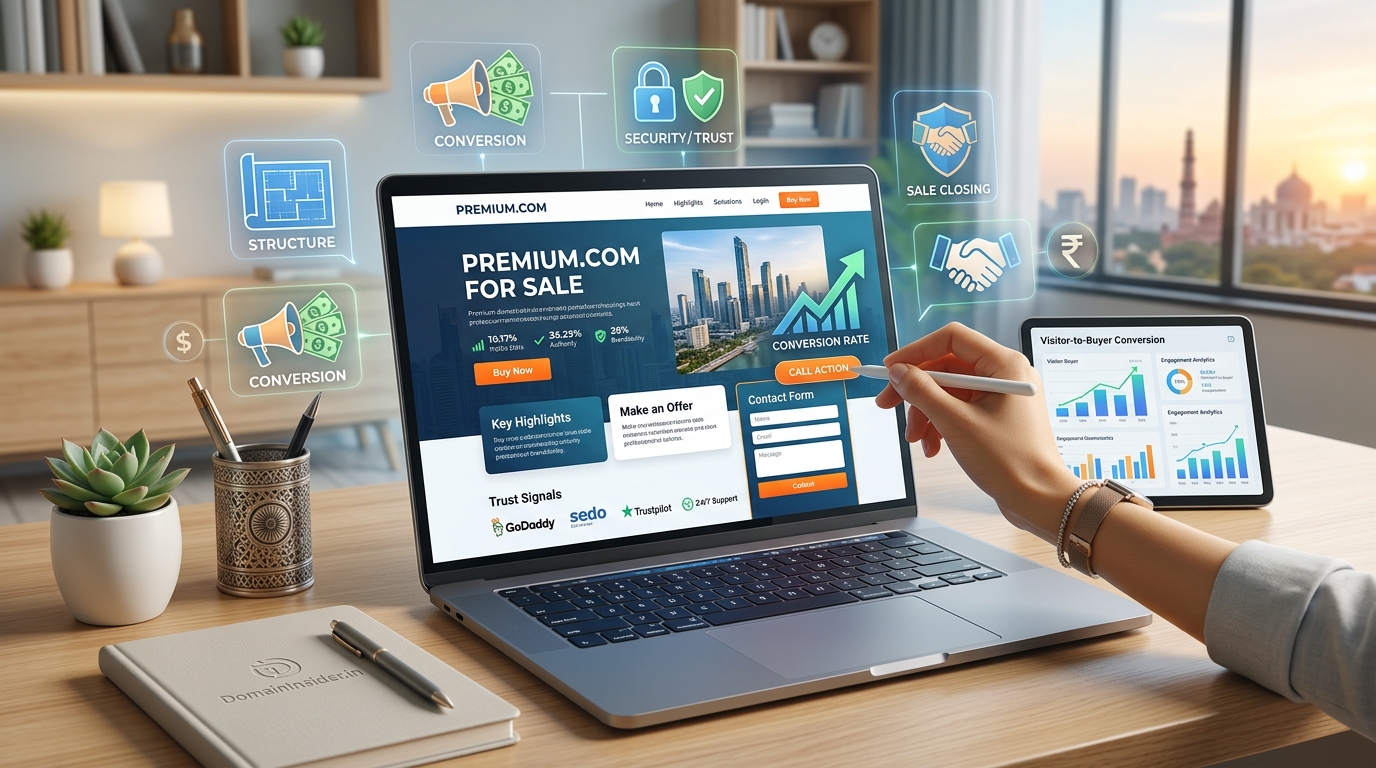
You’ve got a premium domain name. You’ve set your price. But when potential buyers land on your sales page, they leave without making an offer.
The problem isn’t your domain. It’s your sales page.
A well-crafted sales page can turn casual browsers into serious buyers. The difference between a page that converts and one that doesn’t often comes down to a few critical elements that work together to build trust, demonstrate value, and make the buying process effortless.
Creating a high-converting sales page requires a clear value proposition, trust signals, strategic pricing presentation, and frictionless buying process. Focus on benefits over features, use social proof effectively, and remove every obstacle between interest and purchase. The best sales pages answer buyer questions before they’re asked and make the transaction feel safe and straightforward.
Understanding what makes visitors buy
Before you write a single word, you need to understand buyer psychology.
People don’t buy domains. They buy solutions.
A startup founder buying BrandName.com isn’t purchasing letters and a TLD. They’re buying brand credibility, customer trust, and marketing efficiency. Your sales page needs to speak to these deeper motivations.
The most common mistake domain sellers make is listing features instead of benefits. “Short, memorable, .com domain” is a feature. “Build instant brand recognition and save thousands on marketing” is a benefit.
When someone lands on your page, they’re asking three questions within seconds:
- What is this domain worth to me?
- Can I trust this seller?
- How easy is it to buy?
Your entire page should be structured to answer these questions in order.
Crafting your headline and opening section
Your headline is the first conversion point.
Most visitors decide whether to stay or leave based on what they see above the fold. A weak headline like “Domain For Sale” wastes this precious real estate.
Instead, lead with value. “Launch Your Fintech Startup with FinanceHub.com” immediately tells a specific buyer why they should care.
Your opening paragraph should expand on this promise. Keep it to three sentences maximum. State what the domain is, who it’s perfect for, and what outcome they’ll achieve by owning it.
Below your headline, include these essential elements:
- The domain name itself, large and prominent
- Your asking price or “Make an Offer” call to action
- A single sentence describing the primary benefit
- Trust indicators like secure transaction badges
Don’t bury your call to action. Place a “Make an Offer” or “Buy Now” button in the top right corner and repeat it throughout the page.
Building credibility through trust signals
Nobody wants to send money to a stranger on the internet.
Trust signals transform your sales page from a risky proposition into a safe transaction. These signals work because they provide third-party validation or demonstrate your legitimacy.
The most effective trust signals for domain sales pages include:
- Escrow service logos and explanations
- Your transaction history or years in business
- Testimonials from previous buyers
- Professional email address matching a business domain
- Clear contact information with multiple channels
“The single biggest conversion killer I see is lack of transparency. Buyers want to know exactly who they’re dealing with and how the transaction will work. Address these concerns upfront.”
If you’ve sold domains before, showcase those transactions. Even one or two successful sales with buyer testimonials can significantly boost conversion rates.
For newer sellers, transparency becomes even more important. Explain that you’ll use a reputable escrow service. Link to your professional profiles. Provide a business phone number.
The proven strategies to sell your domain name faster often come down to building this foundation of trust.
Presenting your domain’s value proposition
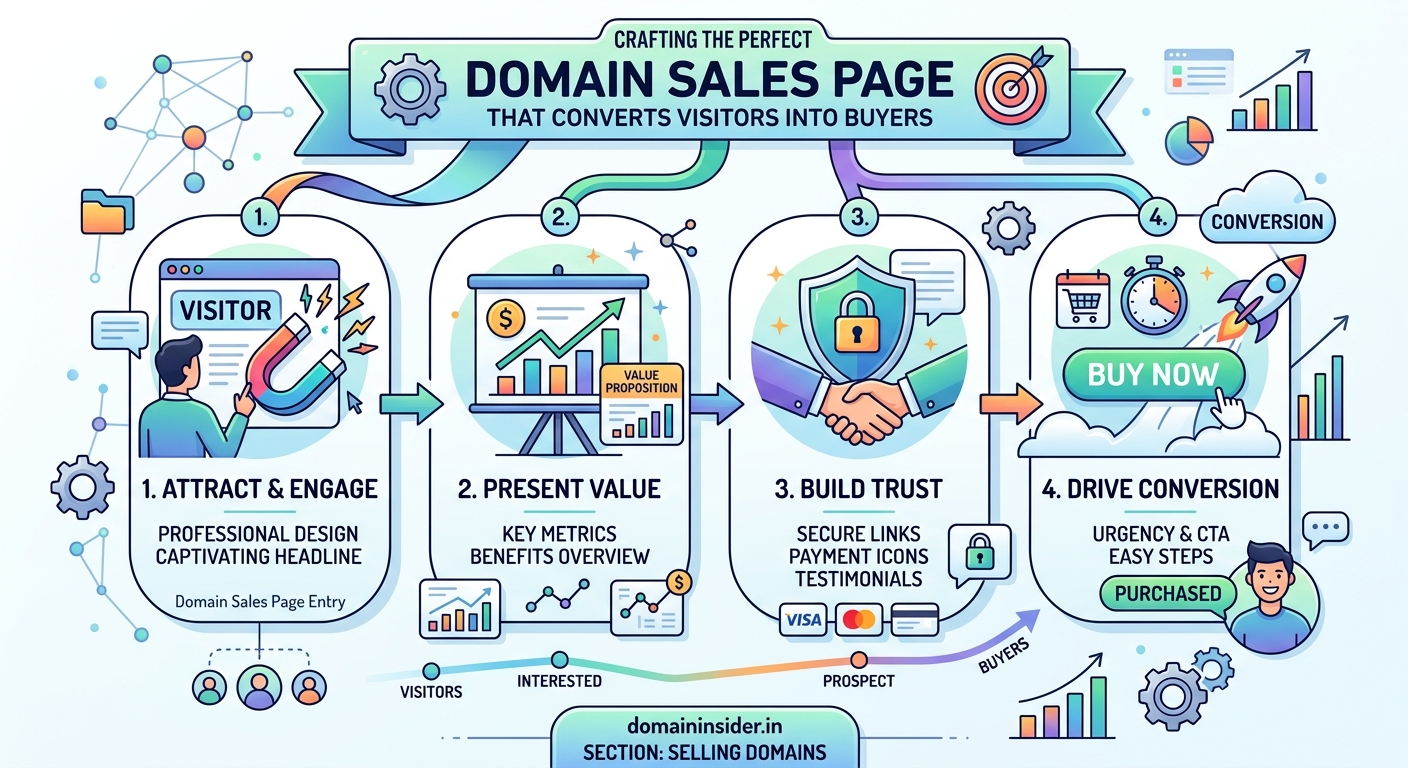
This is where you make your case.
Your value section should explain why this specific domain is worth the investment. Generic statements won’t work here. You need concrete, relevant reasons.
Structure your value proposition in three layers:
Layer one: Intrinsic domain qualities
These are the objective characteristics that make the domain valuable. Length, keyword relevance, extension, memorability, and pronunciation all matter.
For example, if you’re selling a two-word .com domain in a growing industry, highlight that .com domains remain the most dominant choice for serious businesses.
Layer two: Market positioning
Show where this domain fits in its niche. Compare it to similar domains that have sold for high prices. Reference industry trends that make this domain increasingly valuable.
If you’re selling an Indian domain, you might reference how .in domains are becoming the first choice for local startups.
Layer three: Future potential
Paint a picture of what the buyer can build. Be specific about use cases. A domain like CloudKitchen.in could be positioned for food delivery platforms, ghost kitchen operators, or restaurant management software companies.
Pricing strategy and presentation
How you present your price matters as much as the price itself.
Displaying a price without context often leads to sticker shock. Even if your domain is fairly priced, buyers need justification for the investment.
Here’s how to present pricing effectively:
| Pricing approach | When to use it | Conversion impact |
|---|---|---|
| Fixed price with justification | Premium domains with clear comps | High for motivated buyers |
| Make an offer only | Flexible on price, want to negotiate | Medium, attracts serious inquiries |
| Fixed price + payment plan | High-value domains | Higher, removes affordability barrier |
| Lease to own option | Domains over ₹5 lakhs | Significantly higher for startups |
Never just slap a number on the page. Justify it.
“Based on comparable .com domain sales in the fintech sector and the growing Indian digital payments market, we’ve priced FinanceHub.com at ₹12,00,000.”
This sentence provides market context, industry relevance, and competitive positioning. It transforms an arbitrary number into a logical valuation.
If you’re unsure about pricing, free tools to check your domain name value can provide data-backed starting points.
For domains in the premium range, offering payment plans can double your conversion rate. A ₹10 lakh domain becomes ₹85,000 per month for 12 months. The psychological difference is massive.
Creating urgency without desperation
Urgency drives action, but artificial scarcity destroys trust.
“Only available for 48 hours!” sounds desperate when selling a domain you’ve owned for three years. Buyers see through fake urgency immediately.
Instead, create genuine reasons to act now:
- Mention other interested parties if true
- Reference industry events or deadlines
- Highlight seasonal relevance
- Note trademark or competitor risks
For example: “Two other fintech startups have inquired about this domain. With UPI transactions growing 80% year over year, securing your brand name now prevents competitor acquisition.”
This creates urgency through market reality, not artificial timers.
Simplifying the buying process
Every extra step between interest and purchase kills conversions.
Your buying process should be crystal clear and effortless. Confusion creates hesitation. Hesitation creates abandonment.
Walk buyers through the exact process:
- Click “Make an Offer” or “Buy Now” button
- Transaction moves to secure escrow service
- Buyer deposits payment with escrow
- Seller transfers domain to buyer’s registrar
- Escrow releases payment to seller after buyer confirms receipt
Include screenshots or a simple diagram if possible. The more transparent the process, the more comfortable buyers feel.
Address common concerns directly on the page:
- “How long does transfer take?” (Usually 5-7 days)
- “What if something goes wrong?” (Escrow protects both parties)
- “Can I verify domain ownership?” (Yes, here’s the WHOIS data)
The negotiation process becomes smoother when buyers understand the mechanics upfront.
Optimizing your call to action buttons
Your CTA buttons are conversion points.
Yet most domain sales pages use generic, uninspiring buttons like “Submit” or “Contact.”
Effective CTAs are specific, action-oriented, and benefit-focused:
- “Get This Domain” instead of “Buy Now”
- “Start Negotiation” instead of “Make Offer”
- “Secure This Brand” instead of “Purchase”
Button placement matters too. Include CTAs:
- Above the fold in your header
- After your value proposition section
- Following pricing information
- At the end of your page
Use contrasting colors that stand out from your page design. Make buttons large enough to tap easily on mobile devices.
Test different button copy. Sometimes “Make an Offer” converts better than “Buy Now” because it feels less committal.
Writing compelling domain descriptions
Your description should tell a story.
Not the story of how you acquired the domain or why you’re selling it. The story of what the buyer can build with it.
Start with the domain’s best use case. Be specific:
“TravelIndia.com is perfect for travel agencies, tour operators, or booking platforms targeting the domestic tourism market. With Indian tourism expected to reach ₹35 lakh crore by 2028, owning the category-defining domain gives you instant market authority.”
This description immediately helps the right buyer see themselves using the domain.
Include relevant keywords naturally. If you’re selling a tech domain, mention AI, SaaS, or whatever terms your target buyer searches for. This helps with SEO and speaks the buyer’s language.
Avoid common domain name mistakes in your description, like overexplaining obvious points or using industry jargon that confuses buyers.
Adding social proof and case studies
Numbers build credibility.
If you have statistics about the domain, share them:
- Monthly type-in traffic
- Historical backlinks
- Previous revenue if it was a developed site
- Search volume for the exact match keyword
If the domain was previously developed, show screenshots of what it looked like at its peak. This helps buyers visualize potential.
Third-party validation works even better. If domain appraisal services have valued your domain, include those estimates. If industry publications have mentioned domains in this niche, reference those articles.
For sellers building a portfolio, studying real case studies of 10x returns can provide proven frameworks to model.
Mobile optimization matters more than you think
Over 60% of domain buyers browse on mobile devices.
If your sales page doesn’t work perfectly on phones, you’re losing more than half your potential buyers.
Mobile optimization requirements:
- Fast loading speed (under 3 seconds)
- Readable text without zooming
- Tap-friendly buttons and forms
- Simplified navigation
- Click-to-call phone numbers
Test your page on multiple devices. What looks great on your desktop might be unusable on a phone.
Keep forms short. Every field you require reduces mobile conversion rates by 10-15%. Ask only for essential information.
Addressing objections before they arise
Buyers have concerns. Address them proactively.
Common objections for domain purchases include:
- “Is this domain worth the price?”
- “How do I know the seller is legitimate?”
- “What if the transfer fails?”
- “Can I afford this right now?”
- “Is there a better domain available?”
Create an FAQ section that tackles these head-on. Don’t hide from difficult questions. Answering them builds trust.
For pricing objections, compare your domain to similar sales. For trust concerns, detail your escrow process. For transfer worries, explain the step-by-step mechanics.
If buyers are comparing options, acknowledge it: “While other domains in this space exist, none combine the brevity, clarity, and .com extension that makes this domain the premium choice.”
Technical elements that boost conversions
Behind the scenes, technical factors influence buyer behavior.
Page load speed directly impacts conversion rates. Every second of delay costs you 7% of conversions. Compress images, minimize code, and use fast hosting.
SSL certificates are non-negotiable. Browsers now flag non-HTTPS sites as “Not Secure.” This destroys trust instantly.
Clean, professional design signals legitimacy. You don’t need elaborate graphics, but your page should look modern and intentional. Avoid templates that scream “I spent 10 minutes on this.”
Include schema markup for your domain listing. This helps search engines understand your page and can display rich snippets in search results.
Track everything. Use analytics to see where visitors drop off, which CTAs they click, and how long they spend on each section. Data reveals conversion bottlenecks.
Following up without being pushy
Most sales don’t happen on the first visit.
Capture visitor information through a “Get Price Alerts” or “Notify Me of Price Changes” form. This gives you permission to follow up.
Send a sequence of value-driven emails:
- Day 1: Thank them for their interest, reiterate key benefits
- Day 3: Share a case study or success story relevant to the domain
- Day 7: Offer to answer questions or schedule a call
- Day 14: Mention any new interest or market developments
Keep emails short and helpful. Never be aggressive. Your goal is to stay top of mind while providing value.
If someone makes a low offer, don’t dismiss it immediately. Counter with your reasoning. Many successful sales start with lowball offers that turn into negotiations.
Understanding where to list your domain can also drive more qualified traffic to your sales page.
Testing and improving your page
Your first version won’t be perfect.
The best domain sellers continuously test and refine their sales pages. Small changes can create big conversion improvements.
Elements worth testing:
- Headline variations
- CTA button colors and copy
- Price presentation formats
- Page length (long-form vs. concise)
- Trust signal placement
- Images vs. no images
Change one element at a time. If you modify everything simultaneously, you won’t know what worked.
Track your conversion rate over time. If you’re getting 100 visitors but zero inquiries, something is fundamentally broken. If you’re getting inquiries but no sales, your pricing or trust signals need work.
Study successful domain sales pages in your niche. What patterns do they share? How do they present value? What trust signals do they emphasize?
Making the page work for you
A sales page isn’t just a static listing. It’s your 24/7 salesperson.
The difference between a page that converts and one that doesn’t often comes down to empathy. Put yourself in the buyer’s position. What would make you feel confident enough to spend thousands or lakhs on a domain from a stranger?
Answer that question honestly, and your conversion rate will climb. Remove friction, build trust, demonstrate value, and make buying effortless.
Start with these fundamentals, test consistently, and refine based on real buyer behavior. Your sales page will become a reliable asset that turns visitors into buyers while you focus on building a profitable domain portfolio.
