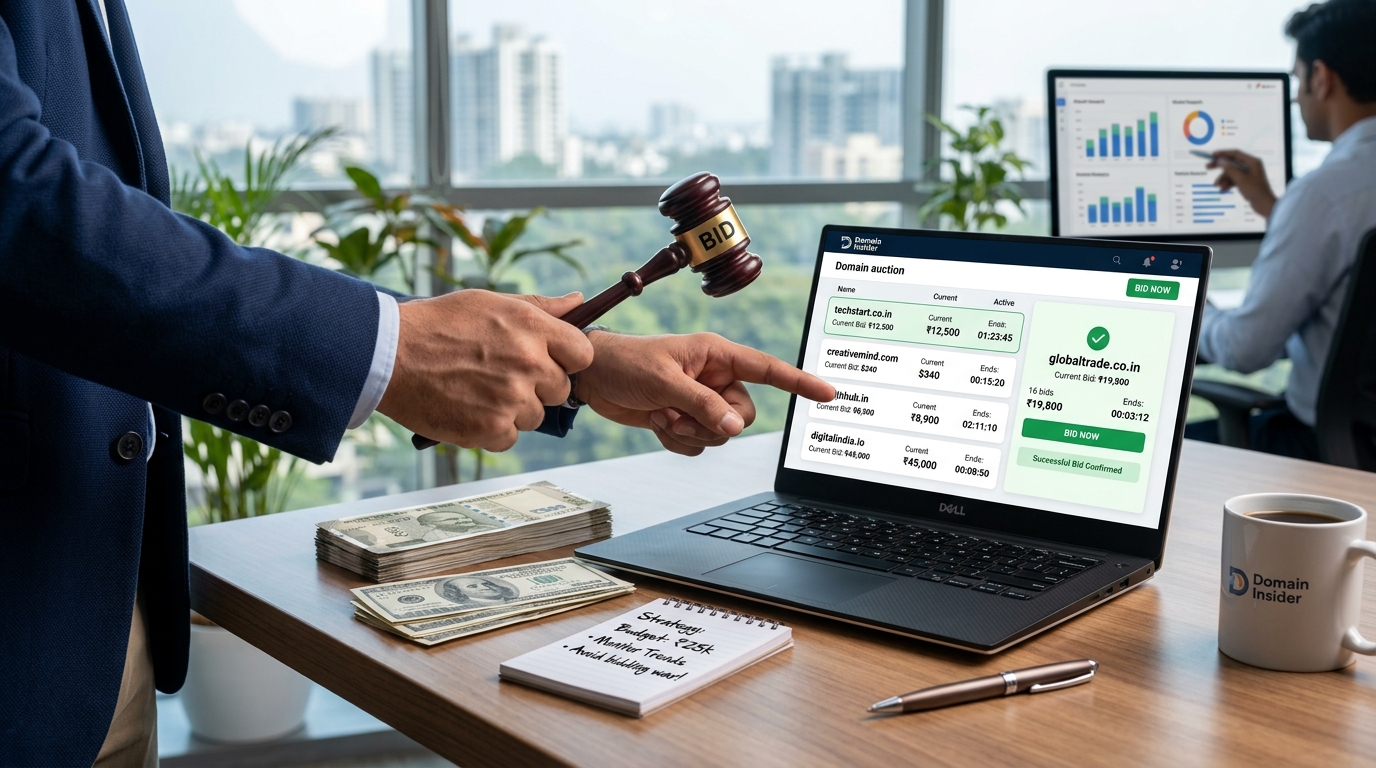
You’ve found the perfect domain name. It’s memorable, brandable, and exactly what your business needs. Then you check the price and realize it’s heading to auction. Your heart sinks because you know what happens next: bidding wars, emotional decisions, and prices that spiral beyond reason.
Domain auctions don’t have to end in regret or an empty wallet. With the right approach, you can win valuable domains at fair prices while others burn through their budgets.
Successful domain auction bidding strategies combine thorough pre-auction research, strict budget discipline, strategic timing, and emotional control. Winners know their maximum value before bidding starts, use proxy bids effectively, avoid last-minute emotional decisions, and walk away when prices exceed intrinsic worth. Smart bidders win 30-40% of auctions they enter by focusing on undervalued opportunities rather than chasing every attractive name.
Research Before You Raise Your Paddle
Most auction losses happen before the first bid. You need data, not gut feelings.
Start by checking comparable sales. What did similar domains sell for in the past six months? GoDaddy Auctions, Sedo, and Namecheap Marketplace all publish historical data. Look for exact keyword matches, similar length, and the same extension.
Next, assess the domain’s intrinsic value. Does it have existing traffic? Check the Wayback Machine to see its history. A domain that hosted a legitimate business has more value than one that sat parked for years. Tools like 7 free tools to check your domain name value in 2024 can help you estimate worth before you commit.
Run a trademark search. Nothing kills an investment faster than a cease-and-desist letter. Search the Indian Trademark Registry and USPTO databases. If the name matches an active trademark in your industry, walk away.
Check backlink profiles using Ahrefs or Moz. Quality backlinks add value. Spammy links subtract it. A domain with 500 legitimate backlinks from .edu and .gov sites is worth more than one with 5,000 links from sketchy directories.
Calculate your maximum bid before the auction opens. Write it down. This number should reflect:
- Comparable sales data
- Your budget constraints
- The domain’s revenue potential
- Alternative options available
Never enter an auction without this number locked in your mind.
Setting Budgets That Actually Protect You
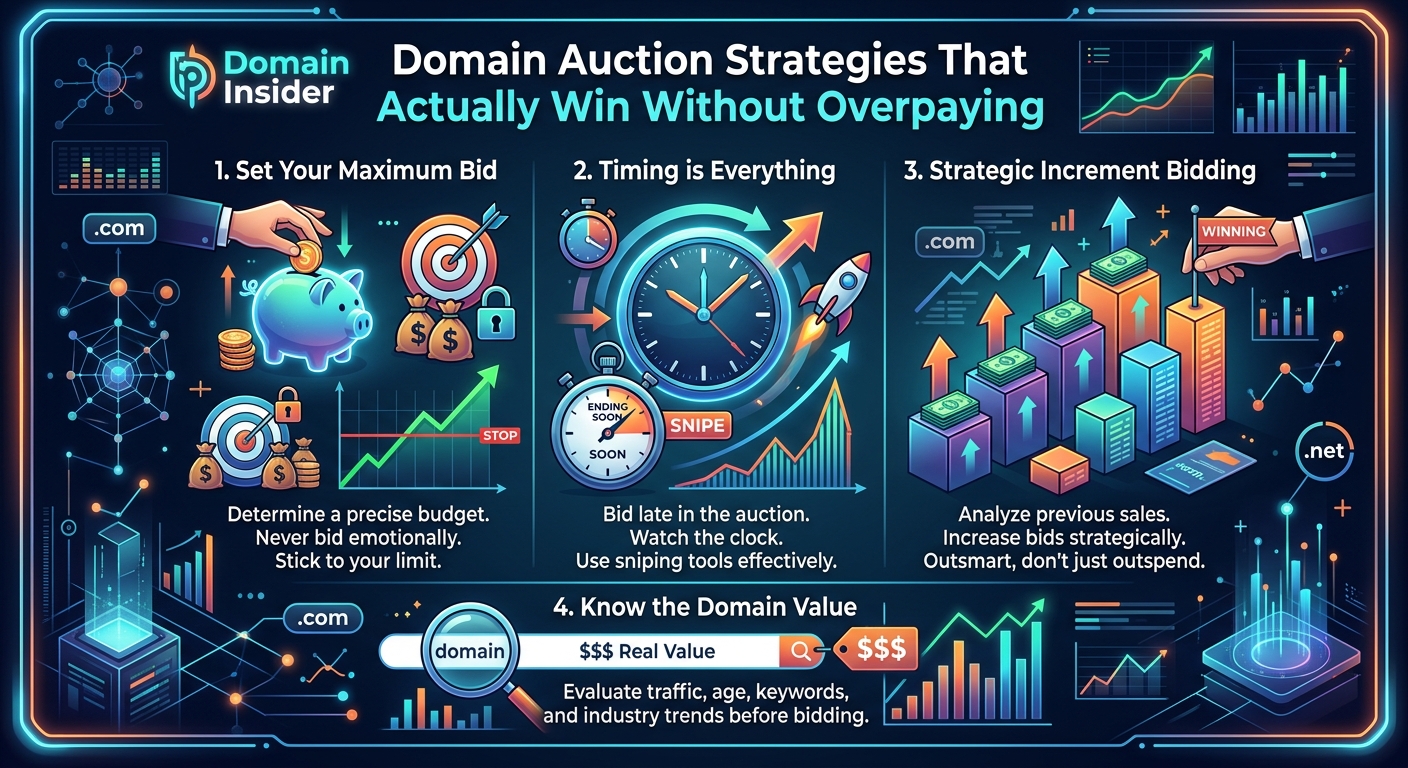
Your maximum bid isn’t just a number. It’s a commitment to yourself.
Professional domain investors follow the 3x rule: never pay more than three times what you can reasonably expect to earn from the domain in the first year. If you plan to build a business that might generate ₹50,000 in year one, your maximum bid should be ₹1,50,000.
For portfolio investors, the calculation changes. You’re betting on appreciation and resale. Use this framework:
- Calculate the lowest price you could realistically sell for in 12 months
- Subtract 20% for market uncertainty
- Subtract holding costs (renewal fees, marketplace listings)
- That’s your maximum bid
Create three budget tiers:
- Target price: What you hope to pay (60-70% of maximum)
- Comfortable price: Still a good deal (80-90% of maximum)
- Walk-away price: Your absolute ceiling (100% of maximum)
Most bidders ignore this structure. They set one number, then convince themselves to go “just a little higher” when emotions kick in. That’s how ₹50,000 budgets become ₹2,00,000 regrets.
Timing Your Bids for Maximum Impact
Domain auctions aren’t like eBay. Different platforms use different closing mechanisms, and timing matters enormously.
Soft-close auctions extend by 5-10 minutes every time someone bids near the deadline. These favor patient bidders. Don’t show your hand early. Watch, wait, and enter only in the final minutes.
Hard-close auctions end at a fixed time regardless of activity. These require a different approach. Place your maximum bid early using a proxy bid system. Let the platform automatically increment for you.
Here’s a step-by-step approach for soft-close auctions:
- Add the auction to your watchlist 24 hours before closing
- Set alerts for the final hour
- Log in 15 minutes before the scheduled end
- Wait until 2-3 minutes remain
- Place your first bid at 70% of your maximum
- If outbid, wait 30 seconds before responding
- Increment slowly toward your maximum
- Stop completely when you hit your walk-away price
The waiting game frustrates impatient bidders. They often drop out when they realize you’re not going to engage in rapid-fire bidding.
For hard-close auctions, the strategy flips:
- Research thoroughly in the days before closing
- Decide your maximum bid 24 hours early
- Place your proxy bid 2-3 hours before closing
- Walk away from your computer
- Accept whatever happens
Proxy bidding removes emotion from the equation. You can’t get caught up in the heat of the moment if you’re not watching.
Reading Your Competition

Every auction has patterns. Learn to recognize them.
The early enthusiast bids immediately and often. They’re usually amateurs who don’t understand proxy bidding. They’ll tire themselves out chasing incremental increases.
The sniper appears only in the final seconds. They’ve done their research and know exactly what they want. These bidders are dangerous because they’re disciplined.
The emotional bidder makes large jumps when frustrated. If someone suddenly jumps from ₹10,000 to ₹50,000, they’re not thinking strategically. They’re reacting. Let them exhaust themselves.
Watch bid increments. Small, steady increases suggest a professional investor with a clear maximum. Large, erratic jumps indicate someone who’s guessing.
Check bidder history if the platform allows it. Someone who wins 5% of their auctions is probably overbidding constantly. Someone who wins 35-40% has discipline and strategy.
Platform-Specific Tactics
Each auction platform has quirks you can exploit.
GoDaddy Auctions uses a 5-minute soft close. The platform attracts many casual buyers who don’t understand domain valuation. This creates opportunities for patient bidders. The best time to find undervalued domains is during major Indian festivals when competition drops.
Namecheap Marketplace has less traffic than GoDaddy but higher-quality inventory. Auctions here tend to be more competitive among serious investors. Use proxy bidding and resist the urge to monitor constantly.
Sedo attracts international buyers, which can drive prices up. However, it also means less competition for India-specific domains. If you’re targeting .in or .co.in extensions, you might find better deals here than on domestic platforms.
Flippa includes entire websites, not just domains. The valuation is more complex. Ignore the seller’s asking price and focus on actual traffic and revenue data. Most Flippa sellers overvalue their assets by 3-5x.
Regional Indian platforms often have hidden gems. Competition is lower, but so is inventory quality. Spend extra time on due diligence. Understanding common domain name mistakes every first-time buyer should avoid becomes even more critical on smaller platforms.
What to Do When You’re Outbid
Getting outbid stings. Your response determines whether you’re a smart investor or an emotional spender.
First, pause. Take three deep breaths. Close the auction tab for 60 seconds. This breaks the psychological grip of competition.
Ask yourself these questions:
- Is the new price still below my maximum?
- Am I bidding because I want the domain or because I want to win?
- Are there alternative domains that would serve the same purpose?
- What would I tell a friend in this situation?
If the price has exceeded your maximum by even ₹1, you’re done. Close the tab. Delete the bookmark. Move on.
If you’re still below your maximum, consider your position:
- How far below maximum are you? (If it’s less than 10%, you’re near the danger zone)
- How many times have you been outbid? (More than three suggests you’re in a serious competition)
- How much time remains? (In soft-close auctions, time is your friend)
Place your next bid only if you can honestly say you’re following your strategy, not your ego.
Alternative Approaches When Auctions Get Too Hot
Sometimes the smartest move is not bidding at all.
If an auction price exceeds your maximum before you’ve even entered, you have options:
Approach the winner directly. Wait 30-60 days after the auction closes. Many auction winners are domain investors who bought for resale. They might sell to you at a reasonable markup rather than waiting months for another buyer. Learning how to negotiate domain prices like a pro and save thousands makes this approach far more effective.
Find expired alternatives. The domain that just sold for ₹5,00,000 might have five similar variations expiring next month. Set up monitoring on domain drop-catch services. You might snag a comparable name for just the registration fee. Resources about buying expired domains can help you evaluate whether this approach fits your situation.
Consider different extensions. If YourBrand.com went for ₹10,00,000, maybe YourBrand.in is available for ₹50,000. For India-focused businesses, choosing between .co.in or .in domains might actually serve you better than overpaying for .com.
Build a brand around an available name. Sometimes the universe is telling you to get creative. Plenty of successful companies built incredible brands on invented words or unexpected spellings. The money you save on the domain can fund actual marketing.
Common Mistakes That Cost Real Money
| Mistake | Why It Happens | Real Cost | Better Approach |
|---|---|---|---|
| Bidding without research | Excitement overrides preparation | 200-300% overpayment | Spend 2 hours researching before spending 2 lakhs |
| Raising maximum mid-auction | Fear of losing triggers irrationality | Budget blown, regret guaranteed | Write maximum on paper, stick to it absolutely |
| Ignoring renewal costs | Focus only on acquisition price | Portfolios become expensive liabilities | Calculate 5-year holding costs before first bid |
| Bidding on trademarked names | Didn’t check legal status | Domain seized, money lost, possible lawsuit | Always search trademarks first, no exceptions |
| Chasing every attractive name | Portfolio building becomes hoarding | Cash tied up, nothing sells | Bid only on names with clear monetization path |
| Emotional revenge bidding | Someone outbid you, ego takes over | Winning a domain you don’t actually want | Set alerts, walk away, return with fresh perspective |
The trademark mistake deserves special attention. I’ve seen investors lose ₹3-5 lakhs on domains they had to surrender within months. A 15-minute trademark search would have saved everything.
Building Your Auction Calendar
Not all auction timing is equal. Patterns emerge when you track results over months.
Best times to bid:
– Major festival periods (Diwali, Holi, Eid) when casual bidders are busy
– December 28-31 when businesses are closed
– Monday mornings when weekend warriors have logged off
– Auctions ending between 2-4 AM IST (international buyers are asleep)
Worst times to bid:
– First week of January (new budgets released)
– September-October (businesses preparing for holiday season)
– Thursday-Friday evenings (maximum competition)
– Right after major domain sales make news (everyone gets excited)
Track your own auction results. Note the day, time, competition level, and outcome. After 20-30 auctions, patterns specific to your niche will emerge.
“The best domain investors I know win about 35% of auctions they enter. If you’re winning 80%, you’re overpaying. If you’re winning 10%, you’re too conservative. Find the middle ground where you win enough to build a portfolio but lose enough to know you’re being selective.”
This advice from a successful Indian domain investor who built a portfolio worth over ₹2 crores captures the balance perfectly.
What Success Actually Looks Like
Forget the fantasy of buying Voice.com for ₹250 crores. Real success in domain auctions is far more modest and far more achievable.
A small business owner needs an exact-match domain for their service. They research for three days, set a maximum of ₹75,000, and win at ₹52,000. The domain drives ₹8,00,000 in revenue over two years. That’s success.
A domain investor spots an undervalued .in domain with good traffic history. They bid ₹15,000, win at ₹12,000, hold for eight months, and sell for ₹65,000. After costs, they net ₹45,000 profit. That’s success.
An entrepreneur gets outbid at ₹1,20,000 on their dream domain. They stick to their ₹1,00,000 maximum, walk away, and find an even better alternative available for direct registration at ₹800. That’s also success.
Success is discipline, not dollars. It’s knowing when to bid and when to close the browser.
If you’re building a broader investment strategy, understanding how to build a profitable domain portfolio with just ₹50,000 can help you allocate auction budgets within a larger framework.
Your Next Auction Starts Now
You don’t need to win every auction. You need to win the right auctions at the right prices.
Start small. Enter three auctions this month with modest budgets. Your goal isn’t winning. It’s learning how you react under pressure, understanding platform mechanics, and testing your research process.
Track everything. Create a spreadsheet with columns for domain name, your maximum bid, actual winning bid, winner username, and your post-auction analysis. This data becomes your edge over time.
Set up alerts for domains matching your criteria. Most platforms let you filter by extension, keyword, age, and price range. Let the system do the watching while you do the thinking.
Remember that every domain you don’t buy saves money for the perfect domain you haven’t found yet. Patience isn’t passive. It’s the most active strategy in your arsenal.
The auction that ends tomorrow isn’t your last chance. Another opportunity arrives every single day. Bid like someone who knows that.
