
You’ve built a portfolio of domain names. Maybe you grabbed a few .in domains years ago, or you’ve been flipping domains as a side business. Either way, you’re sitting on digital assets that could turn into real money. But where do you actually list them?
Choosing the right marketplace can mean the difference between a domain gathering dust and a sale that pays for your next investment. Indian sellers face unique challenges: payment gateway compatibility, INR pricing options, local buyer reach, and commission structures that don’t eat into profits.
Indian domain sellers should evaluate marketplaces based on commission rates, buyer traffic, payment methods, and listing flexibility. Global platforms like Sedo and Dan.com offer international reach, while Indian registrars provide local payment options. Multi-platform listing maximizes visibility, but understanding each marketplace’s strengths helps you prioritize where to invest your time and avoid unnecessary fees that reduce your profit margins.
Understanding marketplace types before you list
Domain marketplaces fall into three main categories, each serving different seller needs.
Global auction platforms connect you with buyers worldwide. They handle escrow, marketing, and negotiations. You get access to serious domain investors with deep pockets. The tradeoff? Higher commission rates and potential currency conversion headaches.
Registrar marketplaces let you list domains directly through your domain registrar. GoDaddy Auctions, Namecheap Marketplace, and similar platforms integrate with your existing account. Convenient, but often limited to buyers already using that registrar.
Landing page platforms turn your parked domain into a sales page. Visitors see a “This domain is for sale” message with your contact details or buy-now price. You control the conversation but handle all negotiations yourself.
Each type suits different situations. Premium domains worth lakhs benefit from global exposure. Starter domains or niche Indian market names might sell faster through local channels.
Top global marketplaces Indian sellers should consider
Sedo
Sedo remains one of the largest domain marketplaces globally. Over 18 million domains listed, with buyers from every corner of the internet.
Why it works for Indian sellers:
– Supports INR pricing and displays
– Established escrow service protects both parties
– Free basic listings with premium upgrade options
– Broker service available for high-value domains
The catch:
– 10% commission on sales (15% for brokered sales)
– Minimum sale price of $60 USD
– Payment processing can take 2-3 weeks
Sedo works best when you’re selling premium domains to international buyers. If your domain has global appeal, the 10% commission pays for itself through access to serious investors. Before listing, check 7 free tools to check your domain name value in 2024 to price competitively.
Afternic
Owned by GoDaddy, Afternic distributes your listing across multiple registrar networks. One listing appears on GoDaddy, Network Solutions, and dozens of partner sites.
Strengths:
– Fast transfer network for .com domains
– No listing fees
– 15% commission on marketplace sales, 20% on partner network sales
– Payment via PayPal or wire transfer
Limitations:
– Best suited for .com, .net, .org extensions
– .in and .co.in domains get less visibility
– USD pricing primarily
Indian sellers with international .com domains benefit most from Afternic’s distribution network. Your single listing reaches buyers browsing multiple platforms.
Dan.com
Dan.com focuses on seamless buying experiences. Buyers can purchase domains with a few clicks, and sellers get paid fast.
What makes it different:
– 0% commission on first sale, 9% thereafter
– Instant transfer technology for supported TLDs
– Buy now, make offer, and payment plan options
– Clean, professional landing pages
Considerations:
– Fewer buyers compared to Sedo
– Payment plans tie up your domain longer
– Currency conversion fees apply
The zero commission on your first sale makes Dan.com worth testing. List a mid-tier domain and see how the platform performs before committing your entire portfolio.
Indian registrar marketplaces worth your attention
GoDaddy Auctions India
GoDaddy’s auction platform serves millions of Indian users already managing domains through their account.
- 7-day or 30-day auction formats
- Buy-it-now pricing option
- ₹500 listing fee for premium exposure
- 20% commission on successful sales
The built-in audience of Indian buyers searching for domains gives you local market access. Payment processing happens in INR, avoiding conversion hassles.
Namecheap Marketplace
Namecheap’s marketplace integrates directly with your domain portfolio. No complex transfers needed to list.
- Free basic listings
- $2.88 USD for featured listings
- 10% commission
- Escrow.com integration for secure transfers
The platform attracts budget-conscious buyers. Good for domains priced under $1,000 USD where lower commissions matter more.
BigRock Marketplace
As one of India’s largest registrars, BigRock offers a marketplace specifically for Indian buyers and sellers.
- Completely free listings
- No commission fees
- INR pricing
- Direct buyer-seller communication
The downside? Limited traffic compared to global platforms. Your domain needs strong Indian market appeal to attract buyers here. Understanding why .in domains are becoming the first choice for Indian startups in 2024 helps you identify which domains to list here.
Comparing marketplace features that actually matter
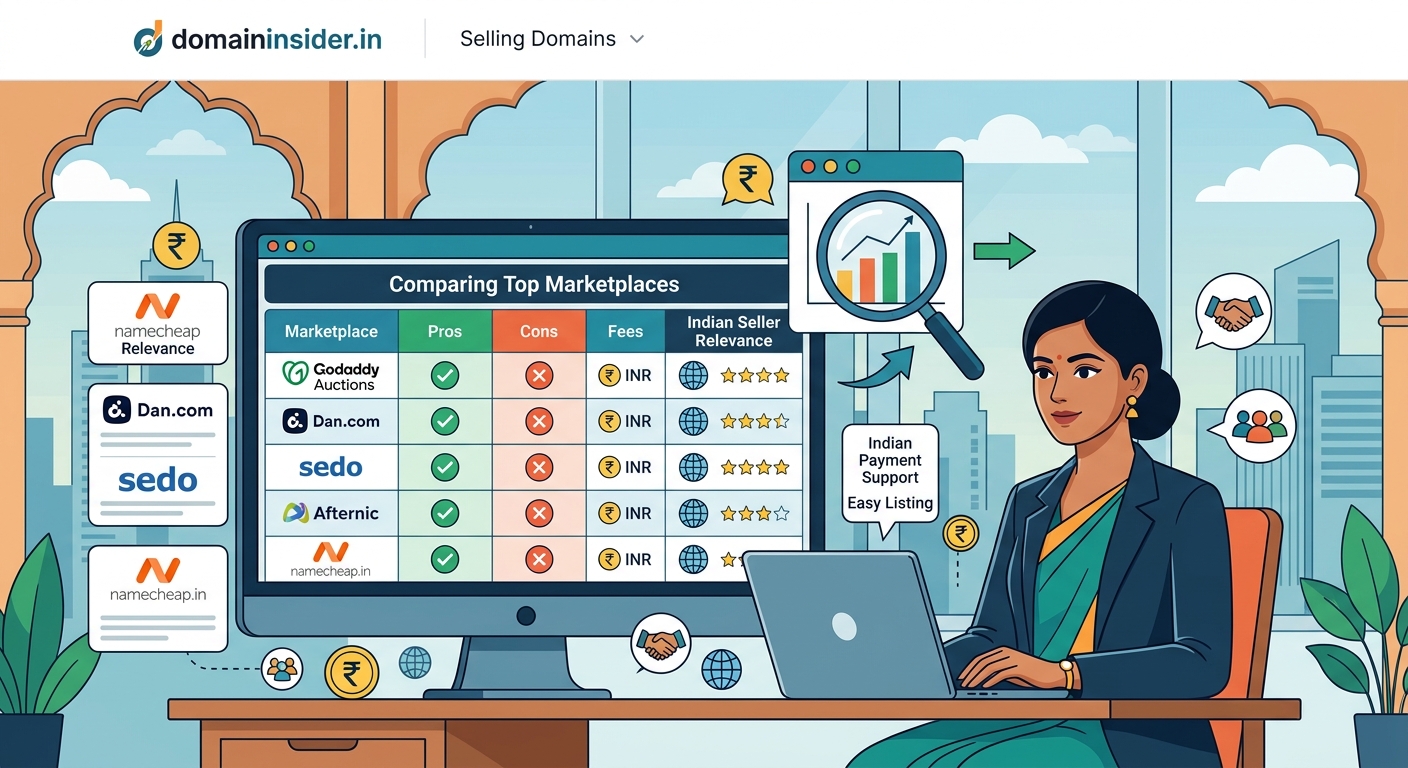
| Platform | Commission | Listing Fee | Escrow | INR Support | Best For |
|---|---|---|---|---|---|
| Sedo | 10-15% | Free | Yes | Yes | Premium international domains |
| Afternic | 15-20% | Free | Yes | Limited | .com distribution |
| Dan.com | 0-9% | Free | Yes | Via conversion | Fast sales |
| GoDaddy Auctions | 20% | ₹500 optional | Yes | Yes | Indian buyers |
| Namecheap | 10% | $2.88 optional | Yes | No | Budget domains |
| BigRock | 0% | Free | No | Yes | .in and .co.in |
This table reveals a pattern. Global reach costs more in commissions. Local platforms save fees but limit buyer pools.
Your strategy should match your domain portfolio. Premium domains justify higher commissions for international exposure. Starter portfolios benefit from zero-fee platforms where you keep more profit per sale.
Step-by-step process to list domains effectively
Listing domains isn’t just uploading a name and waiting. Strategic listing increases sale probability.
-
Value your domain accurately. Overpricing kills sales. Underpricing leaves money on the table. Research comparable sales in your niche. Domain valuation tools provide baselines, but recent actual sales data matters more.
-
Choose 2-3 complementary platforms. Don’t spread too thin. Pick one global marketplace for international reach, one registrar marketplace for convenience, and one landing page service for direct traffic. Managing more becomes a time sink.
-
Create compelling listings. Write clear descriptions highlighting the domain’s commercial value. Mention relevant keywords, industry applications, and memorable qualities. Skip the hype. Buyers want facts.
-
Set realistic pricing tiers. Offer a buy-now price for serious buyers and a make-offer option for negotiations. Price the buy-now at your ideal sale price. Set minimum offers at your absolute floor. Learning how to price your domain for a quick sale without leaving money on the table prevents common mistakes.
-
Monitor and adjust monthly. Check listing performance every 30 days. No views? Lower the price or improve the description. Getting offers below your minimum? Your floor might be too high. Markets change, and your pricing should too.
-
Respond to offers promptly. Buyers move fast. A delayed response sends them to competitors. Even if an offer is too low, counter professionally. How to negotiate domain prices like a pro and save thousands works both ways.
Common mistakes that cost Indian sellers money
Listing only on one platform. Unless you’re selling a premium domain worth multiple lakhs, single-platform listing limits exposure. Buyers browse different marketplaces based on their preferences and existing accounts.
Ignoring currency considerations. A domain priced at $500 USD looks different to an Indian buyer than ₹41,000. Some buyers filter by currency. List in both when platforms allow.
Paying for premium listings too early. Featured placement makes sense for established domains with proven interest. New listings should start free. Spend money on promotion only after organic listing proves the domain has market appeal.
Setting prices in stone. Market conditions shift. A domain worth ₹50,000 last year might fetch ₹75,000 today if the niche exploded. Or it might be worth ₹30,000 if interest faded. Rigid pricing ignores reality.
Forgetting about renewal costs. Every domain costs money to hold. If annual renewals exceed realistic sale prospects, cut your losses. Don’t throw good money after bad domains.
“The biggest mistake I see Indian domain sellers make is treating every domain like a premium asset. Most domains are commodity products. Price them to move, not to retire on. Save the premium pricing for genuinely premium names.” – Experienced domain investor
Payment and transfer considerations for Indian sellers
Getting paid matters as much as making the sale. Different platforms handle payments differently.
Escrow services protect both parties. Never accept direct payment for domains worth more than a few thousand rupees. Escrow.com and platform-integrated escrow hold buyer funds until transfer completes. Worth the small fee for peace of mind.
PayPal works but costs money. International buyers often prefer PayPal. Currency conversion and fees eat 3-4% of your sale. Factor this into pricing.
Wire transfers for large sales. Selling a domain for several lakhs? Wire transfer avoids percentage-based fees. Verify buyer details carefully. Wire fraud exists.
Platform-specific payment methods. Some marketplaces handle all payments internally. You receive funds after transfer confirmation. Slower but safer for new sellers without established reputations.
Tax implications matter. Domain sales count as income. Keep records of purchase prices, renewal costs, and sale amounts. Consult a CA about tax obligations. This isn’t advice, just a reminder that tax authorities care about digital asset sales.
Specialized strategies for different domain types
Premium .com domains
List on Sedo and Afternic simultaneously. The global buyer pool for premium .com domains justifies the commission costs. Set a high buy-now price and accept offers above 60% of valuation.
.in and .co.in domains
Focus on Indian marketplaces first. GoDaddy Auctions India and BigRock reach buyers specifically looking for Indian extensions. Global platforms work as secondary options. Many international buyers overlook country-code TLDs. Knowing should you buy a .co.in or .in domain for your Indian business helps you write better listings.
Expired domains with backlinks
These appeal to SEO professionals and digital marketers. Mention metrics like domain authority, backlink count, and traffic history in listings. List on Flippa or specialized SEO domain marketplaces alongside traditional platforms. Context about should you buy an expired domain helps you position value.
Niche industry domains
Healthcare, legal, finance, and tech domains attract specific buyers. Use industry keywords in descriptions. List on general marketplaces but also consider reaching out directly to businesses in that niche. A direct sale skips commission entirely.
Starter portfolio domains
For domains worth under ₹10,000, avoid platforms with listing fees. Use free options exclusively. Volume matters more than individual sale prices. Quick turnover beats waiting months for an extra thousand rupees.
Building a sustainable selling workflow
Successful domain selling becomes a system, not a one-time effort.
-
Batch your listing work. Set aside one day monthly to list new acquisitions and update existing listings. Trying to list domains piecemeal wastes time.
-
Track everything in a spreadsheet. Record purchase date, cost, renewal dates, listing platforms, asking price, and offers received. This data reveals which domains and platforms perform best.
-
Reinvest proceeds strategically. Sale profits can fund new acquisitions. How to build a profitable domain portfolio with just ₹50,000 shows how small investments compound.
-
Learn from each sale. What made that domain sell? Was it the price, the platform, the description, or pure timing? Replicate success patterns.
-
Network with other sellers. Domain investor communities share marketplace experiences, buyer behavior insights, and platform changes. You’ll learn faster through shared knowledge.
Platform-specific tips that increase sale probability
Sedo: Use the broker service for domains worth over $10,000 USD. The 15% commission pays for itself through professional negotiation and buyer vetting.
Afternic: Enable the fast transfer network. Buyers prefer instant gratification. Domains that transfer in minutes sell faster than those requiring days.
Dan.com: Create custom landing pages with your branding. The professional appearance builds trust. Include use cases showing how the domain benefits potential buyers.
GoDaddy Auctions: Time auctions to end during Indian business hours. More bidders online means higher final prices. Avoid ending auctions on weekends when business buyers aren’t watching.
Namecheap: Bundle related domains. Offering a package deal attracts buyers building comprehensive brand protection. Three related domains for the price of 2.5 individual domains moves inventory faster.
When to consider private sales over marketplaces
Marketplaces provide exposure but take commissions. Private sales keep 100% of proceeds.
Direct outreach works for perfect-fit domains. If you own a domain that clearly matches a specific company’s brand or product, contact them directly. Skip the marketplace middleman.
Existing business relationships. Know someone starting a business? Offer relevant domains from your portfolio. Personal connections close sales faster than cold marketplace listings.
Social media and forums. Domain investor communities on Reddit, Facebook groups, and specialized forums facilitate peer-to-peer sales. No commissions, but you handle all negotiations and transfers yourself.
Your own website. Create a simple portfolio site listing all your domains for sale. Organic traffic from people searching those exact domains can generate inquiries. Free except for hosting costs.
Private sales require more work but maximize profit. Combine marketplace listings for passive exposure with active private outreach for high-value domains.
Adapting your strategy as markets change
The best domain marketplaces for sellers in India today might not hold that position next year. Platform policies change. New marketplaces emerge. Buyer preferences shift.
Stay flexible. Test new platforms with low-value domains before committing premium inventory. Monitor industry news for marketplace acquisitions, policy changes, and new features.
Track your own metrics ruthlessly. If a platform generated three sales last year but zero this year, redistribute those listings. Your time and renewal costs are finite resources. Invest them where returns prove themselves.
Remember that domain selling rewards patience and strategy in equal measure. List strategically, price realistically, and respond professionally. The right marketplace amplifies your efforts, but your domain’s inherent value and your sales skills ultimately close deals.
Making your marketplace choice work for you
Choosing between marketplaces isn’t about finding one perfect platform. It’s about building a multi-channel strategy that matches your portfolio, budget, and time commitment.
Start with one global marketplace for international reach and one local platform for Indian buyers. Add a landing page service for domains receiving direct traffic. Monitor performance for 90 days, then adjust based on actual results, not assumptions.
Your domain portfolio is an investment. Treat marketplace selection with the same care you’d apply to choosing where to list a property for sale. The right platform doesn’t just host your listing. It connects you with buyers ready to pay fair value for digital assets you’ve carefully selected and maintained.
Test, measure, and optimize. Your perfect marketplace mix reveals itself through data, not guesswork.
